2018 NRC Written Exam
Overview
- Exam: SALEM 2018 NRC Exam — 16-01 ILOT
- RO Questions: 75
- SRO-Only Questions: 24
RO Questions
Q1 — RCP Shaft Shear at 25% Power
003 RCPS-K3.01 (3.7)
Given:
• Unit 1 is at 25% Reactor Power and rising due to a plant startup
At time 17:00:00
• The 13 RCP shaft shears
At 17:00:30, which ONE of the following completes the statements below?
The Reactor is _(1)_.
Normal full PZR spray capability _(2)_ available.
• Unit 1 is at 25% Reactor Power and rising due to a plant startup
At time 17:00:00
• The 13 RCP shaft shears
At 17:00:30, which ONE of the following completes the statements below?
The Reactor is _(1)_.
Normal full PZR spray capability _(2)_ available.
A. (1) tripped — (2) is NOT
B. (1) tripped — (2) is
C. (1) at power — (2) is NOT
D. (1) at power — (2) is
▶ Show Answer & Explanation
✓ C. Correct. For Part 1, when the 13 RCP shaft shears at 17:00:00, the RCS low flow reactor trip setpoint will be met for only 13 Loop. Since the reactor is below P-8 (36% power), the reactor will not trip. For Part 2, PZR spray is produced from the 11 and 13 loop D/Ps (created by the 13 and 11 RCPs). However, 13 RCP actually produces most of the spray flow. Consequently, when 13 RCP trips, full PZR spray flow is not available.
✗ A. Incorrect but plausible. For Part 1, a reactor trip on RCS low flow has different coincidences based on reactor power level. Since the reactor is above P-7 (10% power) and there is a reactor trip based on RCS low flow when the reactor is > P-7, the candidate could incorrectly conclude that at 17:00:30, the reactor is tripped. Part 2 is correct.
✗ B. Incorrect but plausible. For Part 1, same reasoning as A — candidate could incorrectly conclude the reactor is tripped. For Part 2, since many other systems only require 1 pump to provide 100% flow (e.g. CCW, SW, SI, CS, CVCS and RHR), the candidate could incorrectly conclude full PZR spray is available with only one RCP.
✗ D. Incorrect but plausible. Part 1 is correct. For Part 2, since many other systems only require 1 pump to provide 100% flow (e.g. CCW, SW, SI, CS, CVCS and RHR), the candidate could incorrectly conclude full PZR spray is available with only one RCP.
Ref: 2-EOP-FRCE-3 (Licensed Operator Fluency List) | LO: NOS05FLUNCY-09 | Source: New | Cognitive: Higher
Connections
- Related systems: RCPs, Pressurizer Level & Press Control, RPS/SSPS
- Related exam: 2018 NRC Written Exam
Q2 — Mixed Bed Demineralizer Malfunction
004 CVCS-K6.20 (2.5)
Given:
• Unit 2 is at 95% Reactor Power and stable
• The Rod Bank Selector Switch is in MANUAL
• The 21 MIXED BED DEMINERALIZER is in service
At time 20:00:00
• 2CC71 (Letdown Heat Exchanger Component Cooling Water Outlet Control Valve) malfunctions causing the letdown temperature to rise and stabilize at 130 °F
Which ONE of the following completes the statements below?
When in service, the mixed bed demineralizer is used to _(1)_.
As the 21 MIXED BED DEMINERALIZER heats up, RCS TAVG will INITIALLY _(2)_.
• Unit 2 is at 95% Reactor Power and stable
• The Rod Bank Selector Switch is in MANUAL
• The 21 MIXED BED DEMINERALIZER is in service
At time 20:00:00
• 2CC71 (Letdown Heat Exchanger Component Cooling Water Outlet Control Valve) malfunctions causing the letdown temperature to rise and stabilize at 130 °F
Which ONE of the following completes the statements below?
When in service, the mixed bed demineralizer is used to _(1)_.
As the 21 MIXED BED DEMINERALIZER heats up, RCS TAVG will INITIALLY _(2)_.
A. (1) provide Lithium control and help maintain RCS pH — (2) rise
B. (1) provide Lithium control and help maintain RCS pH — (2) lower
C. (1) remove chemical impurities from the RCS — (2) rise
D. (1) remove chemical impurities from the RCS — (2) lower
▶ Show Answer & Explanation
✓ D. Correct. For Part 1, when in service, the mixed bed demineralizer is used to remove chemical impurities from the RCS. For Part 2, boron removal is more efficient at lower temperatures. Consequently, the demineralizer will release boron as temperature rises resulting in an unplanned reactivity change. With more boron in the RCS, TAVG will lower to offset the negative reactivity inserted into the core when the demineralizer heated up and released boron.
✗ A. Incorrect but plausible. For Part 1, the Cation Demineralizer is used to remove Lithium from the RCS and to maintain RCS pH. Consequently, the candidate could incorrectly conclude that mixed bed demineralizer is used to help maintain RCS pH. For Part 2, the candidate could incorrectly conclude that the demineralizer will actually absorb more boron as it heats up which would cause TAVG to rise.
✗ B. Incorrect but plausible. For Part 1, the Cation Demineralizer is used to remove Lithium from the RCS and to maintain RCS pH. Consequently, the candidate could incorrectly conclude that mixed bed demineralizer is used to help maintain RCS pH. Part 2 is correct.
✗ C. Incorrect but plausible. Part 1 is correct. For Part 2, the candidate could incorrectly conclude that the demineralizer will actually absorb more boron as it heats up which would cause TAVG to rise.
Ref: NOS05CVCS00-17 (Chemical and Volume Control System) | LO: NOS05CVCS00-17 — Describe demineralizer function and abnormal operations | Source: New | Cognitive: Higher
Connections
- Related systems: CVCS, CCW
- Related exam: 2018 NRC Written Exam
Q3 — RHR Suction and Discharge Alignment
005 RHRS-K1.09 (3.6)
Given:
Which ONE of the following completes the statement below?
The Residual Heat Removal System Pumps take suction from the _(1)_ Hot Leg and can be aligned to discharge into the _(2)_ Hot Legs.
Which ONE of the following completes the statement below?
The Residual Heat Removal System Pumps take suction from the _(1)_ Hot Leg and can be aligned to discharge into the _(2)_ Hot Legs.
A. (1) 21 — (2) 21 and 22
B. (1) 21 — (2) 23 and 24
C. (1) 22 — (2) 21 and 22
D. (1) 22 — (2) 23 and 24
▶ Show Answer & Explanation
✓ B. Correct. The Residual Heat Removal System Pumps take suction from the 21 Hot Leg and can be aligned to discharge into the 23 and 24 Hot Legs.
✗ A. Incorrect but plausible. Since the RHR Pumps take suction from an RCS hot leg and can be aligned to discharge into two RCS hot legs, selection of any combination of the 4 RCS loops is plausible.
✗ C. Incorrect but plausible. Since the RHR Pumps take suction from an RCS hot leg and can be aligned to discharge into two RCS hot legs, selection of any combination of the 4 RCS loops is plausible.
✗ D. Incorrect but plausible. Since the RHR Pumps take suction from an RCS hot leg and can be aligned to discharge into two RCS hot legs, selection of any combination of the 4 RCS loops is plausible.
Ref: NOS05RHR000-16 (Residual Heat Removal System) | LO: NOS05RHR000-16 — Draw a one-line diagram of the RHR System | Source: New | Cognitive: Lower
Connections
- Related systems: RHR, RCS
- Related exam: 2018 NRC Written Exam
Q4 — Cold Leg Recirculation with SJ44 Failure
006 ECCS-K6.05 (3.0)
Given:
• A LBLOCA has occurred
• The crew is performing 2-EOP-LOCA-3 (Transfer To Cold Leg Recirculation)
• 21SJ44 (Containment Sump Suction Valve) can NOT be opened
Which ONE of the following completes the statements below?
The crew was required to realign ECCS valves for cold leg recirculation as soon as the RWST Level _(1)_ alarm was FIRST validated.
With 21SJ44 closed, _(2)_ RHR Pump(s) will be able to draw suction from the Containment Sump and discharge ECCS flow into the RCS cold legs and to the suctions of the SI Pumps and Centrifugal Charging Pumps.
• A LBLOCA has occurred
• The crew is performing 2-EOP-LOCA-3 (Transfer To Cold Leg Recirculation)
• 21SJ44 (Containment Sump Suction Valve) can NOT be opened
Which ONE of the following completes the statements below?
The crew was required to realign ECCS valves for cold leg recirculation as soon as the RWST Level _(1)_ alarm was FIRST validated.
With 21SJ44 closed, _(2)_ RHR Pump(s) will be able to draw suction from the Containment Sump and discharge ECCS flow into the RCS cold legs and to the suctions of the SI Pumps and Centrifugal Charging Pumps.
A. (1) LO — (2) ONLY 22
B. (1) LO — (2) BOTH
C. (1) LO-LO — (2) ONLY 22
D. (1) LO-LO — (2) BOTH
▶ Show Answer & Explanation
✓ A. Correct. For Part 1, IAW EOP-LOCA-1, the crew is required to realign ECCS valves for cold leg recirculation as soon as the RWST Level LO alarm was FIRST validated. For Part 2, with 21SJ44 closed only 22 RHR pump will be able to draw suction from the Containment Sump and discharge ECCS flow into the RCS cold legs and to the suctions of the SI Pumps and CCPs.
✗ B. Incorrect but plausible. Part 1 is correct. For Part 2, the valve arrangements for the ECCS pumps to take suction from a water source are not standardized. For example, if SJ1 (RWST Suction Valve to CCP) had failed to open, BOTH CCPs could take suction from the RWST. Consequently, the candidate could incorrectly conclude the containment suction valves to the RHR pumps are arranged similarly to the SJ1 and SJ2. This would cause the candidate to further incorrectly deduce that with 21SJ44 closed, BOTH RHR Pumps will be able to draw suction from the Containment Sump.
✗ C. Incorrect but plausible. For Part 1, there is a RWST Level LO-LO alarm. Consequently, the candidate could incorrectly conclude that RWST Level LO alarm only warns the crew to prepare for transferring ECCS flow to cold leg recirculation and the transfer will actually occur when the RWST Level LO-LO alarm is validated. Part 2 is correct.
✗ D. Incorrect but plausible. For Part 1, there is a RWST Level LO-LO alarm. Consequently, the candidate could incorrectly conclude that RWST Level LO alarm only warns the crew to prepare for transferring ECCS flow and the transfer will actually occur when the RWST Level LO-LO alarm is validated. For Part 2, the valve arrangements for the ECCS pumps to take suction from a water source are not standardized, leading the candidate to conclude BOTH RHR pumps could take suction with 21SJ44 closed.
Ref: 2-EOP-LOCA-3 (Transfer To Cold Leg Recirculation), NOS05ECCS00-09 (Emergency Core Cooling System) | LO: NOS05ECCS00-09 — Draw one-line diagram of ECCS major components and flowpaths | Source: New | Cognitive: Higher
Connections
- Related systems: ECCS, RHR
- Related EOPs: EOP-LOCA-3 — Transfer to Cold Leg Recirculation, EOP-LOCA-1 — Loss of Reactor or Secondary Coolant
- Related exam: 2018 NRC Written Exam
Q5 — SI Actuation Timing and PZR Heater De-energization
006 ECCS-K6.05 / EA4.09 (4.1)
Given:
• Unit 2 is at 80% Reactor Power and stable
• 21 Charging Pump is in service
• PZR Pressure and Level are lowering
• Containment Pressure is rising
At time 11:00
• PZR Pressure is 1864 psig and lowering
• Containment Pressure is 4.1 psig
At time 11:08
• PZR Pressure is 1764 psig and lowering
• Containment Pressure is 5.2 psig
Which ONE of the following completes the statements below?
_(1)_ is the earliest time that an AUTOMATIC Safety Injection occurred.
The PZR Heaters will de-energize _(2)_.
• Unit 2 is at 80% Reactor Power and stable
• 21 Charging Pump is in service
• PZR Pressure and Level are lowering
• Containment Pressure is rising
At time 11:00
• PZR Pressure is 1864 psig and lowering
• Containment Pressure is 4.1 psig
At time 11:08
• PZR Pressure is 1764 psig and lowering
• Containment Pressure is 5.2 psig
Which ONE of the following completes the statements below?
_(1)_ is the earliest time that an AUTOMATIC Safety Injection occurred.
The PZR Heaters will de-energize _(2)_.
A. (1) 11:00 — (2) based PZR low level
B. (1) 11:00 — (2) when Safety Injection is actuated
C. (1) 11:08 — (2) based PZR low level
D. (1) 11:08 — (2) when Safety Injection is actuated
▶ Show Answer & Explanation
✓ A. Correct. For Part 1, an automatic Safety Injection occurs when PZR Pressure is < 1765 psig or Containment Pressure is > 4 psig. Consequently, 11:00 is the earliest time that an automatic Safety Injection occurred. For Part 2, the PZR heaters will de-energize based on PZR low level (at 17%).
✗ B. Incorrect but plausible. Part 1 is correct. For Part 2, since the SI signal causes several automatic actions, the candidate could incorrectly conclude that the PZR Heaters de-energize when SI is actuated.
✗ C. Incorrect but plausible. For Part 1, the candidate may recognize that at 11:08, the automatic Safety Injection setpoint for low RCS pressure has been reached and incorrectly determine that 11:08 is the earliest time that an automatic Safety Injection setpoint was reached. Part 2 is correct.
✗ D. Incorrect but plausible. For Part 1, the candidate may recognize that at 11:08, the automatic Safety Injection setpoint for low RCS pressure has been reached and incorrectly determine that 11:08 is the earliest time. For Part 2, since the SI signal causes several automatic actions, the candidate could incorrectly conclude that the PZR Heaters de-energize when SI is actuated.
Ref: NOS05FLUNCY-09 (Licensed Operator Fluency List), NOS05ECCS00-09 (Emergency Core Cooling System), NOS05PZRP&L-10 (Pressurizer Pressure and Level Control) | LO: NOS05PZRP&L-10 — Outline interlocks associated with PZR P&L components | Source: New | Cognitive: Higher
Connections
- Related systems: ECCS, Pressurizer Level & Press Control, Pressurizer & PRT
- Related exam: 2018 NRC Written Exam
Q6 — PRT Cooling Operation
007 PRTS-K4.01 (2.6)
Given:
• Cooling of the PRT is required
Which ONE of the following completes the statements below?
Cooling of the PRT can be initiated MANUALLY _(1)_.
During PRT Cooling, the PRT is drained directly to the _(2)_.
• Cooling of the PRT is required
Which ONE of the following completes the statements below?
Cooling of the PRT can be initiated MANUALLY _(1)_.
During PRT Cooling, the PRT is drained directly to the _(2)_.
A. (1) or AUTOMATICALLY — (2) RCDT
B. (1) or AUTOMATICALLY — (2) RCDT pump suction header
C. (1) ONLY — (2) RCDT
D. (1) ONLY — (2) RCDT pump suction header
▶ Show Answer & Explanation
✓ D. Correct. For Part 1, PRT cooling is accomplished by a feed (via 2WR82) and bleed (via 2PR14) of the tank. Operation of WR82 and PR14 can only be performed manually. For Part 2, during PRT Cooling, the PRT is drained directly to the RCDT pump suction header.
✗ A. Incorrect but plausible. For Part 1, since there are many other processes that have automatic functions, the candidate could incorrectly conclude that PRT Cooling can be performed manually and automatically. For Part 2, since the draining of the PRT is ultimately pumped from the RCDTs, the candidate could incorrectly conclude that when the PRT is drained via PR14 directly into the RCDT (like so many other water sources).
✗ B. Incorrect but plausible. For Part 1, since there are many other processes that have automatic functions, the candidate could incorrectly conclude that PRT Cooling can be performed manually and automatically. Part 2 is correct.
✗ C. Incorrect but plausible. Part 1 is correct. For Part 2, since the draining of the PRT is ultimately pumped from the RCDTs, the candidate could incorrectly conclude that when the PRT is drained via PR14 directly into the RCDT (like so many other water sources).
Ref: NOS05PZRPRT-06 (Pressurizer and Pressurizer Relief Tank) | LO: NOS05PZRPRT-06 — Identify CR controls, indications, and alarms for PZR and PRT | Source: Modified Bank | Cognitive: Lower
Connections
- Related systems: Pressurizer & PRT
- Related procedures: S2.OP-SO.PZR-0003 — PRT Operation
- Related exam: 2018 NRC Written Exam
Q7 — CCW Radiation Monitor and Surge Tank Overflow
008 CCWS-A2.04 (3.3)
Given:
• Unit 2 is in MODE 3
At time 15:00:00
• BOTH 2R17A/B (Component Cooling Process Monitors) have just come into HI alarm
At time 15:01:00
• The crew has also initiated S2.OP-AB.CC-0001 (Component Cooling Abnormality) and S2.OP-AB.RAD-0001 (Abnormal Radiation)
At time 15:15:00
• Chemistry has verified a rise in Component Cooling activity
Which ONE of the following completes the statements below?
At 15:00:30, 2CC149 (Surge Tank Vent Valve) is _(1)_.
If CCW Surge Tank overflows, then the in-service Waste Holdup Tank _(2)_ will become contaminated.
• Unit 2 is in MODE 3
At time 15:00:00
• BOTH 2R17A/B (Component Cooling Process Monitors) have just come into HI alarm
At time 15:01:00
• The crew has also initiated S2.OP-AB.CC-0001 (Component Cooling Abnormality) and S2.OP-AB.RAD-0001 (Abnormal Radiation)
At time 15:15:00
• Chemistry has verified a rise in Component Cooling activity
Which ONE of the following completes the statements below?
At 15:00:30, 2CC149 (Surge Tank Vent Valve) is _(1)_.
If CCW Surge Tank overflows, then the in-service Waste Holdup Tank _(2)_ will become contaminated.
A. (1) open — (2) and the 22 ABV Exhaust Filter Unit
B. (1) open — (2) ONLY
C. (1) closed — (2) and the 22 ABV Exhaust Filter Unit
D. (1) closed — (2) ONLY
▶ Show Answer & Explanation
✓ C. Correct. For Part 1, 2CC149 automatically closes on high radiation alarm on 2R17A/B. For Part 2, IAW S2.OP-AB.CC-0001 Step 3.8 NOTE, "Allowing CCW Surge Tank to overflow will contaminate the in-service Waste Holdup Tank and the 22 ABV Exhaust Filter Unit".
✗ A. Incorrect but plausible. For Part 1, 2CC149 is normally open and the candidate could not recall that 2CC149 closes when 2R17A/B being in alarm. Consequently at 15:00:30, the candidate could incorrectly conclude that 2CC149 is open. Part 2 is correct.
✗ B. Incorrect but plausible. For Part 1, 2CC149 is normally open and the candidate could not recall that 2CC149 closes when 2R17A/B being in alarm. Consequently at 15:00:30, the candidate could incorrectly conclude that 2CC149 is open. For Part 2, the candidate could fail to recognize the 22 ABV Exhaust Filter Unit will also become contaminated when the CCW Surge Tank overflows.
✗ D. Incorrect but plausible. Part 1 is correct. For Part 2, the candidate could fail to recognize the 22 ABV Exhaust Filter Unit will also become contaminated when the CCW Surge Tank overflows.
Ref: NOS05CCW000-11 (Component Cooling Water) | LO: NOS05CCW000-11 — Describe how CC-149 Surge Tank Vent Valve impacts CCW during normal and abnormal conditions | Source: New | Cognitive: Lower
Connections
- Related systems: CCW, ABV
- Related procedures: AB.CC-0001 — Loss of Component Cooling Water, AB.RAD-0001 — Radiation Monitor Abnormality
- Related exam: 2018 NRC Written Exam
Q8 — PZR Saturation and RCP Restart [EDITED]
010 PZR PCS-K5.01 (3.5)
Given:
• The crew is attempting to maintain the PZR water saturated so 13 RCP can be restarted in accordance with 1-EOP-TRIP-6 (Natural Circulation Rapid Cooldown Without RVLIS) Step 1
• PZR Pressure is 2005 psig
• PZR Liquid Temperature is 635 °F
Which ONE of the following completes the statements below?
The PZR is _(1)_.
In accordance with the 1-EOP-TRIP-6, the reason for establishing and maintaining saturation conditions in the PZR is to limit the PZR pressure _(2)_ upon RCP restart.
• The crew is attempting to maintain the PZR water saturated so 13 RCP can be restarted in accordance with 1-EOP-TRIP-6 (Natural Circulation Rapid Cooldown Without RVLIS) Step 1
• PZR Pressure is 2005 psig
• PZR Liquid Temperature is 635 °F
Which ONE of the following completes the statements below?
The PZR is _(1)_.
In accordance with the 1-EOP-TRIP-6, the reason for establishing and maintaining saturation conditions in the PZR is to limit the PZR pressure _(2)_ upon RCP restart.
A. (1) subcooled — (2) rise
B. (1) subcooled — (2) reduction
C. (1) water saturated — (2) rise
D. (1) water saturated — (2) reduction
▶ Show Answer & Explanation
✓ B. Correct. For Part 1, with PZR Pressure at 2005 psig (2020 psia), saturation temperature is 637 °F. Consequently, with PZR liquid temperature at 635 °F, the PZR is NOT water saturated. For Part 2, IAW 1-EOP-TRIP-6, "To limit the pressure decrease upon RCP restart, saturated conditions should first be established in the PZR."
✗ A. Incorrect but plausible. Part 1 is correct. For Part 2, there are concerns for pressure to rise when an RCP is started when the plant is water solid. Consequently, the candidate could incorrectly conclude that the reason for establishing and maintaining saturation conditions in the PZR is to limit the PZR pressure increase upon RCP restart IAW 1-EOP-TRIP-6.
✗ C. Incorrect but plausible. For Part 1, since the steam tables are listed in psia (not psig), the candidate could enter the steam tables at 1990 psia and incorrectly interpolate to determine that the PZR is water saturated. For Part 2, same reasoning as A regarding pressure increase concerns.
✗ D. Incorrect but plausible. For Part 1, since the steam tables are listed in psia (not psig), the candidate could enter the steam tables at 1990 psia and incorrectly interpolate to determine that the PZR is water saturated. Part 2 is correct.
Ref: Steam Tables, 1-EOP-TRIP-6 (Natural Circulation Rapid Cooldown Without RVLIS) | LO: NOS05TRP004-06 — Determine the basis for each step in a Natural Circulation Cooldown | Source: New | Cognitive: Higher
Connections
- Related systems: Pressurizer & PRT, RCPs, Pressurizer Level & Press Control
- Related EOPs: EOP-TRIP-6 — Natural Circulation Cooldown Without RVLIS
- Related exam: 2018 NRC Written Exam
Q9 — PZR Spray and PORV Setpoints
010 PZR PCS-A3.02 (3.6)
Given:
• Unit 2 is at 100% Reactor Power
• A secondary transient is causing PZR pressure to rise
At time 12:00:00
• PZR pressure is 2312 psig
At time 12:00:30
• PZR pressure is 2340 psig
Which ONE of the following completes the statements below?
At 12:00:00, PZR Spray Valves (2PS1 and 2PS3) are _(1)_.
At 12:00:30, PZR PORVs (2PR1 and 2PR2) are _(2)_.
• Unit 2 is at 100% Reactor Power
• A secondary transient is causing PZR pressure to rise
At time 12:00:00
• PZR pressure is 2312 psig
At time 12:00:30
• PZR pressure is 2340 psig
Which ONE of the following completes the statements below?
At 12:00:00, PZR Spray Valves (2PS1 and 2PS3) are _(1)_.
At 12:00:30, PZR PORVs (2PR1 and 2PR2) are _(2)_.
A. (1) throttled — (2) open
B. (1) throttled — (2) closed
C. (1) fully open — (2) open
D. (1) fully open — (2) closed
▶ Show Answer & Explanation
✓ C. Correct. For Part 1, with PZR Pressure at 2312, the PZR Spray Valves are fully open. For Part 2, with PZR Pressure at 2340, the PZR PORVs are open.
✗ A. Incorrect but plausible. For Part 1, 2315 psig is the PZR Pressure setpoint at which the PORVs would fully close. Consequently, the candidate could mistake the 2315 psig setpoint for when the PZR Spray valves go fully open. Consequently, the candidate would incorrectly conclude that at 12:00:00, the PZR Spray valves are throttled (and not fully open). Part 2 is correct.
✗ B. Incorrect but plausible. For Part 1, same reasoning as A. For Part 2, the PZR master controller setpoint is at 100% when PZR pressure is 2355 psig. The candidate could incorrectly conclude that the PZR PORVs open when the PZR master controller is at 100% (or 2355 psig). This would then cause the candidate to incorrectly conclude that at 12:00:30, the PZR PORVs are closed.
✗ D. Incorrect but plausible. Part 1 is correct. For Part 2, the PZR master controller setpoint is at 100% when PZR pressure is 2355 psig. The candidate could incorrectly conclude that the PZR PORVs open when the PZR master controller is at 100% (or 2355 psig). This would then cause the candidate to incorrectly conclude that at 12:00:30, the PZR PORVs are closed.
Ref: NOS05PZRP&L-10 (Pressurizer Pressure and Level Control) | LO: NOS05PZRP&L-10 — Describe how Spray Valves, PORVs, and MPC impact PZR P&L during normal and abnormal conditions | Source: New | Cognitive: Higher
Connections
- Related systems: Pressurizer Level & Press Control, Pressurizer & PRT
- Related exam: 2018 NRC Written Exam
Q10 — RPS PZR Pressure Channel Failure
012 RPS-K4.05 (2.7)
Given:
• Unit 2 is at 100% Reactor Power and stable
• The PZR Pressure Transmitters read the following:
Which ONE of the following completes the statements below concerning the design of the Reactor Protection System (RPS)?
With 2PT-456 failed low, the coincidence for the PZR Pressure LOW Reactor Trip (based on the remaining functional PZR Pressure Channels) is now ___
• Unit 2 is at 100% Reactor Power and stable
• The PZR Pressure Transmitters read the following:
| CH I | CH II | CH III | CH IV | |
| 2PT-455 | 2PT-456 | 2PT-457 | 2PT-474 | 2PT-1648 |
| 2235 PSIG | 0 PSIG | 2235 PSIG | 2235 PSIG | 2235 PSIG |
With 2PT-456 failed low, the coincidence for the PZR Pressure LOW Reactor Trip (based on the remaining functional PZR Pressure Channels) is now ___
A. 2 out of 4
B. 1 out of 4
C. 2 out of 3
D. 1 out of 3
▶ Show Answer & Explanation
✓ D. Correct. PT-455/456/457/474 are the pressure transmitters that feed into the PZR Pressure LOW Reactor Trip coincidence (2 out of 4 below low pressure trip setpoint). With 2PT-456 failed low, the coincidence for the PZR Pressure LOW Reactor Trip (based on the remaining functional PZR Pressure Channels) is now 1 out of 3.
✗ A. Incorrect but plausible. The candidate could incorrectly conclude that PT-1648 also feeds into the PZR Pressure LOW Reactor Trip coincidence and when 2PT-456 fails, this causes the 2PT-456 bistable to be bypassed from the PZR Pressure LOW Reactor Trip. Consequently, with 2PT-456 failed low, the candidate would then incorrectly determine that the coincidence is now 2 out of 4.
✗ B. Incorrect but plausible. The candidate could incorrectly conclude that PT-1648 also feeds into the PZR Pressure LOW Reactor Trip coincidence. PT-1648 is only used for indication at the RSP. Consequently, with 2PT-456 failed low, the candidate would then incorrectly determine that the coincidence is now 1 out of 4.
✗ C. Incorrect but plausible. The candidate could incorrectly conclude that when 2PT-456 fails, this causes the 2PT-456 bistable to be bypassed from the PZR Pressure LOW Reactor Trip. Consequently, coincidence for the PZR Pressure LOW Reactor Trip would be 2 out of 3.
Ref: NOS05RXPROT-12 (Reactor Protection System) | LO: NOS05RXPROT-12 — Describe the design bases of the RPS including redundancy, independence, fail safe, testability | Source: New | Cognitive: Higher
Connections
- Related systems: RPS/SSPS, Pressurizer Level & Press Control
- Related exam: 2018 NRC Written Exam
Q11 — RCP Undervoltage Reactor Trip
013 ESFAS-K1.02 (3.2)
Given:
Which ONE of the following completes the statement below concerning RCP Undervoltage Reactor Trip Setpoint and Coincidence?
If the associated Permissive Interlock is satisfied, a Reactor Trip Signal will be generated when 4KV Group Busses H and _(1)_ are less than a maximum of _(2)_ % of normal bus voltage.
Which ONE of the following completes the statement below concerning RCP Undervoltage Reactor Trip Setpoint and Coincidence?
If the associated Permissive Interlock is satisfied, a Reactor Trip Signal will be generated when 4KV Group Busses H and _(1)_ are less than a maximum of _(2)_ % of normal bus voltage.
A. (1) G (2) 70
B. (1) G (2) 90
C. (1) E (2) 70
D. (1) E (2) 90
▶ Show Answer & Explanation
✓ A. Correct. If the associated Permissive Interlock is satisfied, a Reactor Trip Signal will be generated when 4KV Group Busses H and G are less than a maximum of 70% of normal bus voltage.
✗ B. Part 1 is correct. For Part 2, 90% is setpoint for the RCP Low Flow Reactor Trip. Consequently, the candidate could incorrectly conclude that 90% normal bus voltage is the setpoint for the RCP Undervoltage Reactor Trip.
✗ C. The RCP Undervoltage Reactor Trip is based on two selected 4KV Group Busses in an undervoltage condition. The candidate could incorrectly conclude that the 2 selected 4KV Group Busses are H and E. Part 2 is correct.
✗ D. The candidate could incorrectly conclude that the 2 selected 4KV Group Busses are H and E. For Part 2, 90% is setpoint for the RCP Low Flow Reactor Trip. Consequently, the candidate could incorrectly conclude that 90% normal bus voltage is the setpoint for the RCP Undervoltage Reactor Trip.
Ref: NOS05FLUNCY-09 (Licensed Operator Fluency List) | LO: NOS05FLUNCY-09 — State those items in the Licensed Operator Fluency List: Permissives and Control Grade Interlocks, Reactor Trips | Source: Bank | Cognitive: Lower (Memory)
Connections
- Related systems: RPS/SSPS, 4KV
- Related exam: 2018 NRC Written Exam
Q12 — Containment Cooling DBA Configurations
022 CCS-A1.03 (3.2)
Given:
Consider the following Containment Cooling configurations with a DBA occurring inside containment:
1. ONLY ONE CS Pump operating
2. ONLY ONE CS Pump operating plus ONLY 3 CFCUs operating
3. ONLY ONE CS Pump operating plus ONLY 2 CFCUs operating
4. ONLY 5 CFCUs operating
Which ONE of the following completes the statements below?
___ are the MINIMUM Containment Cooling components required to be in operation that will maintain Containment Pressure, Temperature and Humidity within design limits with a DBA occurring inside containment.
Consider the following Containment Cooling configurations with a DBA occurring inside containment:
1. ONLY ONE CS Pump operating
2. ONLY ONE CS Pump operating plus ONLY 3 CFCUs operating
3. ONLY ONE CS Pump operating plus ONLY 2 CFCUs operating
4. ONLY 5 CFCUs operating
Which ONE of the following completes the statements below?
___ are the MINIMUM Containment Cooling components required to be in operation that will maintain Containment Pressure, Temperature and Humidity within design limits with a DBA occurring inside containment.
A. 1 or 3
B. 1 or 4
C. 2 or 4
D. 2 or 3
▶ Show Answer & Explanation
✓ C. Correct. The following Containment Cooling configurations will maintain Containment Pressure, Temperature and Humidity within design limits with a DBA occurring inside containment: 2 CS Pumps (not given in question stem), 1 CS Pump + 3 CFCUs, and 5 CFCUs.
✗ A. Since all of the given Containment Cooling configurations are possible containment cooling configurations, then all of the distractors are plausible.
✗ B. Since all of the given Containment Cooling configurations are possible containment cooling configurations, then all of the distractors are plausible.
✗ D. Since all of the given Containment Cooling configurations are possible containment cooling configurations, then all of the distractors are plausible.
Ref: NOS05CONTMT-15 (Containment and Containment Support Systems) | LO: NOS05CONTMT-15 — Describe how CFCUs impact the Containment and Containment Support Systems during normal and abnormal conditions | Source: New | Cognitive: Lower (Memory)
Connections
- Related systems: CFCUs, Containment Spray
- Related exam: 2018 NRC Written Exam
Q13 — Containment Spray NaOH Additive
026 CSS-G2.1.27 (3.9)
Given:
Which ONE of the following completes the statements below?
_(1)_ is added to Containment Spray flow to remove elemental iodine from the containment atmosphere _(2)_.
Which ONE of the following completes the statements below?
_(1)_ is added to Containment Spray flow to remove elemental iodine from the containment atmosphere _(2)_.
A. (1) Sodium Hydroxide (2) ONLY
B. (1) Sodium Hydroxide (2) and to reduce corrosion of containment components
C. (1) Hydrazine (2) ONLY
D. (1) Hydrazine (2) and to reduce corrosion of containment components
▶ Show Answer & Explanation
✓ B. Correct. NaOH is added to Containment Spray flow to remove elemental iodine from the containment atmosphere and to prevent corrosion of containment components.
✗ A. Part 1 is correct. For Part 2, the candidate may fail to recall that NaOH is also used to prevent corrosion of containment components.
✗ C. Hydrazine is a familiar chemical added to the RCS to scavenge oxygen. The candidate may incorrectly conclude Hydrazine is added to Containment Spray flow. For Part 2, the candidate may fail to recall that NaOH is also used to prevent corrosion of containment components.
✗ D. Hydrazine is a familiar chemical added to the RCS to scavenge oxygen. The candidate may incorrectly conclude Hydrazine is added to Containment Spray flow.
Ref: NOS05CSPRAY-06 (Containment Spray System) | LO: NOS05CSPRAY-06 — Describe the purpose and design bases of the Containment Spray System | Source: Modified Bank | Cognitive: Lower (Memory)
Connections
- Related systems: Containment Spray
- Related exam: 2018 NRC Written Exam
Q14 — Containment Spray Pump Power Supplies
026 CSS-K2.01 (3.4)
Given:
- A LOCA coincident with a Loss Of Offsite Power has occurred at Unit 2
- The 2C 4KV Vital Bus is de-energized due to a fault on the bus
At time 16:30:00
- Containment Pressure is 15.1 psig and slowly rising
At 16:30:30, which ONE of the following completes the statements below?
___ Containment Spray Pump(s) is/are running
- A LOCA coincident with a Loss Of Offsite Power has occurred at Unit 2
- The 2C 4KV Vital Bus is de-energized due to a fault on the bus
At time 16:30:00
- Containment Pressure is 15.1 psig and slowly rising
At 16:30:30, which ONE of the following completes the statements below?
___ Containment Spray Pump(s) is/are running
A. NO
B. BOTH
C. ONLY 21
D. ONLY 22
▶ Show Answer & Explanation
✓ C. Correct. 21 CS Pump is powered from 2A 4KV Vital Bus and 22 CS Pump is powered from 2C 4KV Vital Bus. Additionally, a Containment Spray actuation occurs at 15 psig Containment pressure. At 16:30:00, a containment spray actuation signal exists and 2C 4KV Vital Bus is de-energized. Consequently, ONLY 21 CS Pump is running.
✗ A. The candidate could incorrectly conclude that at 16:30:00, the Containment Spray setpoint has not been reached or that the electrical transient has affected both CS pumps. In either case, the candidate would then incorrectly deduce that no CS pumps are running.
✗ B. The candidate could incorrectly conclude that both CS pumps are not powered from the 2C 4KV Vital Bus. Consequently, with a valid Containment Spray signal present, the candidate would incorrectly deduce that both CS pumps are running.
✗ D. The candidate could incorrectly conclude that only the 21 CS Pump is powered from 2C 4KV Vital Bus. Consequently, with a valid Containment Spray signal present, the candidate would incorrectly deduce that only 22 CS pump is running.
Ref: NOS05FLUNCY-09 (Licensed Operator Fluency List), NOS05CSPRAY-06 (Containment Spray System) | LO: NOS05CSPRAY-06 — State the power supply to the Containment Spray Pumps | Source: Modified Bank | Cognitive: Higher (Analysis)
Connections
- Related systems: Containment Spray, 4KV
- Related exam: 2018 NRC Written Exam
Q15 — SG Tube Leak MS10 Setpoint Adjustment
039 MRSS-G2.2.2 (4.6)
Given:
- 21 SG has a confirmed tube leak
- The crew is preparing to adjust 21MS10 (MS PWR RELIEF Vlv) setpoint in accordance with S2.OP-AB.SG-0001 (Steam Generator Tube Leak)
Which ONE of the following completes the statements below?
The PO will set the 21MS10 setpoint to _(1)_ psig by depressing button _(2)_.
- 21 SG has a confirmed tube leak
- The crew is preparing to adjust 21MS10 (MS PWR RELIEF Vlv) setpoint in accordance with S2.OP-AB.SG-0001 (Steam Generator Tube Leak)
Which ONE of the following completes the statements below?
The PO will set the 21MS10 setpoint to _(1)_ psig by depressing button _(2)_.
A. (1) 1045 (2) A
B. (1) 1045 (2) B
C. (1) 1070 (2) A
D. (1) 1070 (2) B
▶ Show Answer & Explanation
✓ A. Correct. For Part 1, IAW S2.OP-AB.SG-0001 Step 3.31, the 21MS10 setpoint will be set to 1045 psig. For Part 2, button A will be depressed on the 21MS10 controller to raise the setpoint.
✗ B. Part 1 is correct. For Part 2, button B on the 21MS10 is used to raise the manual output to the valve so it opens more. Consequently, the candidate could incorrectly conclude that button B actually raises the controller's setpoint.
✗ C. For Part 1, 1070 psig is a familiar pressure (setpoint for MS15 Main Steam Safety Valve). The candidate could incorrectly conclude that the MS10 controller will be adjusted to 1070 psig. Part 2 is correct.
✗ D. For Part 1, 1070 psig is a familiar pressure (setpoint for MS15 Main Steam Safety Valve). The candidate could incorrectly conclude that the MS10 controller will be adjusted to 1070 psig. For Part 2, button B on the 21MS10 is used to raise the manual output to the valve so it opens more. The candidate could incorrectly conclude that button B actually raises the controller's setpoint.
Ref: NOS05ABSGTL-05 (Steam Generator Tube Leak) | LO: NOS05ABSGTL-05 — Describe the actions taken in S1/S2.OP-AB.SG-0001 and the bases for the actions | Source: New | Cognitive: Higher (Analysis)
Connections
- Related systems: Main Steam
- Related procedures: AB.SG-0001 — Steam Generator Tube Leak
- Related exam: 2018 NRC Written Exam
Q16 — Main Steam Warmup MSIV Opening
039 MRSS-K5.01 (2.9)
Given:
- The crew is performing S2.OP-SO.MS-0001 (Main, Reheat, Turbine Bypass Steam Warmup) and is preparing to open 21-24MS167 (Main Steam Isolation Valves)
In accordance with S2.OP-SO.MS-0001, which ONE of the following completes the statements below?
The reason that 21-24MS7 (Main Steam Loop Drain Valves) are opened before 21-24MS167 is to _(1)_.
The crew will open 21-24MS167 when there is less than a MAXIMUM of _(2)_ psid across each valve.
- The crew is performing S2.OP-SO.MS-0001 (Main, Reheat, Turbine Bypass Steam Warmup) and is preparing to open 21-24MS167 (Main Steam Isolation Valves)
In accordance with S2.OP-SO.MS-0001, which ONE of the following completes the statements below?
The reason that 21-24MS7 (Main Steam Loop Drain Valves) are opened before 21-24MS167 is to _(1)_.
The crew will open 21-24MS167 when there is less than a MAXIMUM of _(2)_ psid across each valve.
A. (1) prevent pressurized steam from forcing residual water in the piping to cause water hammer on downstream components (2) 15
B. (1) prevent pressurized steam from forcing residual water in the piping to cause water hammer on downstream components (2) 50
C. (1) remove any collected corrosion products or impurities to ensure Main Turbine blading is not impinged (2) 15
D. (1) remove any collected corrosion products or impurities to ensure Main Turbine blading is not impinged (2) 50
▶ Show Answer & Explanation
✓ B. Correct. For Part 1, the reason that 21-24MS7 (Main Steam Loop Drain Valves) are opened before 21-24MS167 is to prevent pressurized steam from forcing residual water in the piping to cause water hammer on downstream components. For Part 2, The crew will open 21-24MS167 when there is less than a maximum of 50 psid across each valve.
✗ A. Part 1 is correct. For Part 2, there are multiple steps in S2.OP-SO.MS-0001 that require actions to be performed when MS Header pressure is ~15 psig. The candidate could incorrectly conclude that 21-24MS167 will be opened when there is less than a maximum of 15 psid across each valve.
✗ C. For Part 1, preventing damage to the Turbine is a general concern and the candidate could incorrectly conclude that 21-24MS7 are opened to remove corrosion products or impurities to ensure Main Turbine blading is not impinged. For Part 2, there are multiple steps in S2.OP-SO.MS-0001 that require actions when MS Header pressure is ~15 psig. The candidate could incorrectly conclude 15 psid is the maximum delta-P for opening MS167s.
✗ D. For Part 1, preventing damage to the Turbine is a general concern and the candidate could incorrectly conclude that 21-24MS7 are opened to remove corrosion products or impurities. Part 2 is correct.
Ref: S2.OP-SO.MS-0001 | LO: NOS05MSTEAM-11 — Given industry operating experience, review the OE and outline a course of action to prevent recurrence | Source: Modified Bank (ILOT 0901) | Cognitive: Lower (Memory)
Connections
- Related systems: Main Steam
- Related procedures: S2.OP-SO.MS-0001 — Main Steam Warmup
- Related exam: 2018 NRC Written Exam
Q17 — SGFP Suction Pressure Trip
059 MFW-A1.03 (2.7)
Given:
- Unit 2 is at 100% Reactor Power and stable
At time 09:00:00
- The suction pressure transmitter for the 22 SGFP FAILS to 200 psig
Which ONE of the following completes the statements below?
The 22 SGFP will TRIP _(1)_.
After 22 SGFP has tripped, Reactor Power will stabilize at approximately _(2)_ %.
- Unit 2 is at 100% Reactor Power and stable
At time 09:00:00
- The suction pressure transmitter for the 22 SGFP FAILS to 200 psig
Which ONE of the following completes the statements below?
The 22 SGFP will TRIP _(1)_.
After 22 SGFP has tripped, Reactor Power will stabilize at approximately _(2)_ %.
A. (1) IMMEDIATELY (at 09:00:00) (2) 50
B. (1) IMMEDIATELY (at 09:00:00) (2) 66
C. (1) at 09:00:10 (after a 10 second delay) (2) 50
D. (1) at 09:00:10 (after a 10 second delay) (2) 66
▶ Show Answer & Explanation
✓ D. Correct. For Part 1, the SGFP will trip when suction pressure is less than 215 psig for 10 seconds. Consequently, given the question stem, 09:00:10 is the LATEST time that the 22 SGFP TRIPS. For Part 2, once 22 SGFP trips, a turbine runback to 66% will be generated. Since Reactor Power follows steam demand, Reactor Power will stabilize at approximately 66%.
✗ A. For Part 1, there is an instantaneous SGFP trip on low suction pressure (< 190 psig). The candidate could incorrectly conclude that the SGFP will trip instantaneously at 09:00:00. For Part 2, there are only two SGFPs. The candidate could incorrectly conclude that each SGFP provides 50% total flow and that a turbine runback will occur to 50%.
✗ B. For Part 1, there is an instantaneous SGFP trip on low suction pressure (< 190 psig). The candidate could incorrectly conclude that the SGFP will trip instantaneously at 09:00:00. Part 2 is correct.
✗ C. Part 1 is correct. For Part 2, there are only two SGFPs. The candidate could incorrectly conclude that each SGFP provides 50% total flow and that a turbine runback will occur to 50%.
Ref: NOS05CN&FDW-15 (Condensate and Feedwater System) | LO: NOS05CN&FDW-15 — Identify and describe the Control Room controls, indications, and alarms associated with the Condensate and Feedwater System | Source: Modified Bank | Cognitive: Higher (Analysis)
Connections
- Related systems: Feed & Condensate
- Related exam: 2018 NRC Written Exam
Q18 — AFW Backleakage Testing and Consequences
061 AFW-A2.06 (2.7)
Given:
- Unit 2 is 100% Reactor Power and stable
- S2.OP-PT.AF-0002 (Auxiliary Feedwater Backleakage) Section 5.1 (Backleakage Monitoring and Determination) has just been completed
- Indications show there is backleakage on the 23 Auxiliary Feedwater line
In accordance with S2.OP-PT.AF-0002, which ONE of the following completes the statements below?
S2.OP-PT.AF-0002 was REQUIRED to be performed _(1)_ after an AFW Pump was initially shutdown in MODES 1-3.
Backleakage of feedwater into the AFW System can DISABLE the motor-driven AFW Pumps by causing _(2)_.
- Unit 2 is 100% Reactor Power and stable
- S2.OP-PT.AF-0002 (Auxiliary Feedwater Backleakage) Section 5.1 (Backleakage Monitoring and Determination) has just been completed
- Indications show there is backleakage on the 23 Auxiliary Feedwater line
In accordance with S2.OP-PT.AF-0002, which ONE of the following completes the statements below?
S2.OP-PT.AF-0002 was REQUIRED to be performed _(1)_ after an AFW Pump was initially shutdown in MODES 1-3.
Backleakage of feedwater into the AFW System can DISABLE the motor-driven AFW Pumps by causing _(2)_.
A. (1) IMMEDIATELY (2) the pumps to rotate backward
B. (1) IMMEDIATELY (2) vapor binding in the pumps
C. (1) between 30 to 60 minutes (2) the pumps to rotate backward
D. (1) between 30 to 60 minutes (2) vapor binding in the pumps
▶ Show Answer & Explanation
✓ D. Correct. For Part 1, IAW S2.OP-PT.AF-0002 P&L 3.1, "This procedure shall be performed 30 to 60 minutes after an Auxiliary Feedwater Pump is shutdown in Modes 1-3". For Part 2, IAW SOER 84-3 (and the AFW Lesson Plan), "backleakage of hot feedwater has disabled auxiliary feedwater (AFW) pumps due to steam binding."
✗ A. For Part 1, the candidate could incorrectly conclude that S2.OP-PT.AF-0002 is required to be performed immediately after an AFW Pump is shutdown in Modes 1-3. For Part 2, when a pump rotates backward and the pump is started, the duration of the starting current is extended because it takes longer to get up to speed. In some cases, this extended starting current can cause the breaker for the motor to open. RCPs are specifically designed with Anti-Reverse-Rotation Devices. The candidate could incorrectly conclude that backleakage of feedwater into the AFW System can DISABLE the motor-driven AFW Pumps by causing them to rotate backwards.
✗ B. For Part 1, the candidate could incorrectly conclude that S2.OP-PT.AF-0002 is required to be performed immediately after an AFW Pump is shutdown in Modes 1-3. Part 2 is correct.
✗ C. Part 1 is correct. For Part 2, when a pump rotates backward and the pump is started, the duration of the starting current is extended. RCPs are specifically designed with Anti-Reverse-Rotation Devices. The candidate could incorrectly conclude that backleakage causes the AFW pumps to rotate backwards.
Ref: NOS05AFW000-15 (Auxiliary Feedwater System) | LO: NOS05AFW000-15 — Discuss the procedural requirements associated with the AFW System, including major precaution and limitations; Given industry OE, review and outline a course of action to prevent recurrence | Source: New | Cognitive: Higher (Analysis)
Connections
- Related systems: AFW
- Related procedures: S2.OP-PT.AF-0002 — AFW Backleakage Testing
- Related exam: 2018 NRC Written Exam
Q19 — 4KV SPT Failure and Bus Transfer
062 AC Dist-A1.03 (2.5)
Given:
- Unit 2 is MODE 3
- 2A 4KV Vital Bus is powered from 23 SPT
- 2B and 2C 4KV Vital Busses are powered from 24 SPT
Subsequently
- The 23 SPT fails to 0 VAC
Which ONE of the following completes the statement below?
The 23 SPT Supply Breaker to 2A 4KV Vital Bus will FIRST open when 23 SPT Voltage lowers to less than a MAXIMUM of _(1)_ % of normal voltage.
After the electrical transient is complete, 2A 4KV Vital Bus will be powered by _(2)_.
- Unit 2 is MODE 3
- 2A 4KV Vital Bus is powered from 23 SPT
- 2B and 2C 4KV Vital Busses are powered from 24 SPT
Subsequently
- The 23 SPT fails to 0 VAC
Which ONE of the following completes the statement below?
The 23 SPT Supply Breaker to 2A 4KV Vital Bus will FIRST open when 23 SPT Voltage lowers to less than a MAXIMUM of _(1)_ % of normal voltage.
After the electrical transient is complete, 2A 4KV Vital Bus will be powered by _(2)_.
A. (1) 70 (2) EDG 2A
B. (1) 35 (2) EDG 2A
C. (1) 70 (2) 24 SPT
D. (1) 35 (2) 24 SPT
▶ Show Answer & Explanation
✓ C. Correct. For Part 1, the 23 SPT Supply Breaker to 2A 4KV Vital Bus will FIRST open when 23 SPT Voltage lowers to less than a MAXIMUM of 70% of normal voltage. For Part 2, after the electrical transient is complete, 2A 4KV Vital Bus will be powered by 24 SPT.
✗ A. Part 1 is correct. For Part 2, EDG 2A can power the 2A 4KV Vital bus. The candidate could incorrectly conclude that when 23ASD breaker opens, EDG 2A will power the 2A 4KV Bus.
✗ B. For Part 1, 35% of bus normal voltage is permissive setpoint which allows breaker 24ASD to close to power the 2A 4KV Vital Bus. The candidate could incorrectly conclude that the 23 SPT Supply Breaker will FIRST open when voltage lowers to less than 35% of normal. For Part 2, EDG 2A can power the 2A 4KV Vital bus. The candidate could incorrectly conclude that EDG 2A will power the bus.
✗ D. For Part 1, 35% of bus normal voltage is permissive setpoint which allows breaker 24ASD to close to power the 2A 4KV Vital Bus. The candidate could incorrectly conclude that the 23 SPT Supply Breaker will FIRST open at 35%. Part 2 is correct.
Ref: NOS054KVAC0-08 (4160 Electrical System) | LO: NOS054KVAC0-08 — State the setpoints, coincidence, blocks and permissives for automatic actuations associated with the 4160 Electrical System | Source: Bank | Cognitive: Higher (Analysis)
Connections
- Related systems: 4KV
- Related exam: 2018 NRC Written Exam
Q20 — 250 VDC System Loads
063 DC Dist-K2.01 (2.9)
Given:
Which ONE of the following completes the statements below concerning the Unit 1 250 VDC system?
The Unit 1 ___ is/are powered from the Unit 1 250 VDC Battery and Charger System.
Which ONE of the following completes the statements below concerning the Unit 1 250 VDC system?
The Unit 1 ___ is/are powered from the Unit 1 250 VDC Battery and Charger System.
A. Field Excitation Circuitry for the EDGs
B. Main Turbine Emergency Oil Pump
C. Vital Instrument Bus Inverters
D. Emergency Lighting Inverters
▶ Show Answer & Explanation
✓ B. Correct. The Unit 1 Main Turbine Emergency Oil Pump is powered from the Unit 1 250 VDC Battery and Charger System.
✗ A. All of the distractors are powered from the Unit 1 125 VDC Battery and Charger System. The candidate could incorrectly conclude that the Field Excitation Circuitry for the EDGs is powered from the 250 VDC system.
✗ C. All of the distractors are powered from the Unit 1 125 VDC Battery and Charger System. The candidate could incorrectly conclude that the Vital Instrument Bus Inverters are powered from the 250 VDC system.
✗ D. All of the distractors are powered from the Unit 1 125 VDC Battery and Charger System. The candidate could incorrectly conclude that the Emergency Lighting Inverters are powered from the 250 VDC system.
Ref: NOS05DCELEC-09 (DC Electrical Systems) | LO: NOS05DCELEC-09 — Identify and describe the local controls and indications associated with the DC Electrical System | Source: Modified Bank | Cognitive: Lower (Memory)
Connections
- Related systems: DC Power
- Related exam: 2018 NRC Written Exam
Q21 — EDG TS 3.8.1.2 (Shutdown)
064 ED/G-G2.2.22 (4.0)
In accordance LCO 3.8.1.2 (ELECTRICAL POWER SYSTEMS - SHUTDOWN), which ONE of the following completes the statements below?
LCO 3.8.1.2 requires a MINIMUM of _(1)_ separate and independent diesel generators to be OPERABLE.
If ALL REQUIRED EDGs are inoperable, the crew _(2)_ required to IMMEDIATELY suspend all operations involving positive reactivity changes.
LCO 3.8.1.2 requires a MINIMUM of _(1)_ separate and independent diesel generators to be OPERABLE.
If ALL REQUIRED EDGs are inoperable, the crew _(2)_ required to IMMEDIATELY suspend all operations involving positive reactivity changes.
A. _(1)_ two _(2)_ is
B. _(1)_ two _(2)_ is NOT
C. _(1)_ three _(2)_ is
D. _(1)_ three _(2)_ is NOT
▶ Show Answer & Explanation
✓ A. Correct. For Part 1, LCO 3.8.1.2 requires a minimum of two separate and independent diesel generators to be OPERABLE. For Part 2, If ALL REQUIRED EDGs are inoperable, the crew is required to IMMEDIATELY suspend all operations involving positive reactivity changes.
✗ B. Incorrect but plausible. Part 1 is correct. For Part 2, LCO 3.8.1.2 REQUIRED ACTION A has an option to ONLY declare the affected required features inoperable in lieu of suspending all operations involving positive reactivity changes. Consequently, the candidate could incorrectly conclude that LCO 3.8.1.2 REQUIRED ACTION B does not require suspending all operations involving positive reactivity changes.
✗ C. Incorrect but plausible. For Part 1, LCO 3.8.1.1 (ELECTRICAL POWER SYSTEMS - OPERATING) requires a minimum of three separate and independent diesel generators to be OPERABLE. Consequently, the candidate could incorrectly conclude that LCO 3.8.1.2 also requires a minimum of three separate and independent diesel generators to be OPERABLE. Part 2 is correct.
✗ D. Incorrect but plausible. For Part 1, LCO 3.8.1.1 (ELECTRICAL POWER SYSTEMS - OPERATING) requires a minimum of three separate and independent diesel generators to be OPERABLE. Consequently, the candidate could incorrectly conclude that LCO 3.8.1.2 also requires a minimum of three separate and independent diesel generators to be OPERABLE. For Part 2, LCO 3.8.1.2 REQUIRED ACTION A has an option to ONLY declare the affected required features inoperable in lieu of suspending all operations involving positive reactivity changes. Consequently, the candidate could incorrectly conclude that LCO 3.8.1.2 REQUIRED ACTION B does not require suspending all operations involving positive reactivity changes.
Ref: NOS05EDG000-12 (EMERGENCY DIESEL GENERATORS) | LO: 10 — Given a situation dealing with Emergency Diesel Generator operability, examine the situation and apply the appropriate Technical Specification action | Source: New | Cognitive: Lower
Connections
- Related systems: EDGs
- Related tech specs: TS 3/4.8 — Electrical
- Related exam: 2018 NRC Written Exam
Q22 — EDG Failure / ECCS Load Status
064 ED/G-K3.02 (4.2)
Given:
At time 10:00:00
• A Reactor Trip and Safety Injection have occurred coincident with a LOOP at Unit 2
• EDG 2B can NOT be started
At 10:15:00, which ONE of the following completes the statement below?
22 RHR Pump is _(1)_ and 22 SI Pump is _(2)_.
At time 10:00:00
• A Reactor Trip and Safety Injection have occurred coincident with a LOOP at Unit 2
• EDG 2B can NOT be started
At 10:15:00, which ONE of the following completes the statement below?
22 RHR Pump is _(1)_ and 22 SI Pump is _(2)_.
A. _(1)_ stopped _(2)_ running
B. _(1)_ stopped _(2)_ stopped
C. _(1)_ running _(2)_ running
D. _(1)_ running _(2)_ stopped
▶ Show Answer & Explanation
✓ A. Correct. 22 RHR pump is powered from 2B 4KV Vital Bus and 22 SI Pump is powered from 2C 4KV Vital Bus. Additionally, 2B EDG can not be started after the LOOP occurs. Consequently, 15 minutes after a reactor trip and safeguards have occurred (coincident with the loop), 2A and 2C Vital Busses are being powered from EDG 2A and EDG 2C and all of the appropriate ECCS loads have been loaded onto the running EDGs. Therefore, at 10:15:00, 22 RHR Pump is stopped and 22 SI Pump is running.
✗ B. Incorrect but plausible. Part 1 is correct. For Part 2, the candidate could incorrectly conclude that 22 SI pump is powered from 2B 4KV Vital Bus. This would result in the candidate incorrectly deducing that at 10:15:00, the 22 SI Pump is stopped.
✗ C. Incorrect but plausible. For Part 1, the candidate could incorrectly conclude that 22 RHR pump is powered from 2C 4KV Vital Bus. This would result in the candidate incorrectly deducing that at 10:15:00, the 22 RHR Pump is running. Part 2 is correct.
✗ D. Incorrect but plausible. For Part 1, the candidate could incorrectly conclude that 22 RHR pump is powered from 2C 4KV Vital Bus. This would result in the candidate incorrectly deducing that at 10:15:00, the 22 RHR Pump is running. For Part 2, the candidate could incorrectly conclude that 22 SI pump is powered from 2B 4KV Vital Bus. This would result in the candidate incorrectly deducing that at 10:15:00, the 22 SI Pump is stopped.
Ref: NOS054KVAC0-08 (4160 ELECTRICAL SYSTEM) | LO: 9 — State the setpoints, coincidence, blocks and permissives for automatic actuations associated with the 4160 Electrical System | Source: New | Cognitive: Higher
Connections
Q23 — R19 SGBD Warning Unit Difference
073 PRM-K4.01 (4.0)
Given:
• Unit 1 and Unit 2 are at 100% Reactor Power
At time 17:00
• 1R19A (Steam Generator Blowdown Liquid Monitor) goes into WARNING
At time 19:45
• 2R19C (Steam Generator Blowdown Liquid Monitor) goes into WARNING
Which ONE of the following completes the statements below?
At 17:01, 11GB185 (Blowdown Discharge to Condenser) is _(1)_.
At 19:46, 23GB185 (Blowdown Discharge to Condenser) is _(2)_.
• Unit 1 and Unit 2 are at 100% Reactor Power
At time 17:00
• 1R19A (Steam Generator Blowdown Liquid Monitor) goes into WARNING
At time 19:45
• 2R19C (Steam Generator Blowdown Liquid Monitor) goes into WARNING
Which ONE of the following completes the statements below?
At 17:01, 11GB185 (Blowdown Discharge to Condenser) is _(1)_.
At 19:46, 23GB185 (Blowdown Discharge to Condenser) is _(2)_.
A. _(1)_ closed _(2)_ open
B. _(1)_ closed _(2)_ closed
C. _(1)_ open _(2)_ open
D. _(1)_ open _(2)_ closed
▶ Show Answer & Explanation
✓ D. Correct. For Part 1, Unit 1 has no automatic functions when a R19 goes in to warning. Automatic functions only occur when the monitor goes into alarm. Consequently, with 1R19A in warning (at 17:01:00), 11GB185 (Blowdown Discharge to Condenser) is open. For Part 2, Unit 2 has automatic functions that occur when a R19 goes in to warning. Consequently, with 2R19C in warning (at 19:46:00), 23GB185 (Blowdown Discharge to Condenser) is closed.
✗ A. Incorrect but plausible. For Part 1, the candidate may incorrectly conclude that for Unit 1, there are automatic functions when a R19 goes in to warning. Consequently, the candidate would then incorrectly deduce that at 17:01:00, 11GB185 (Blowdown Discharge to Condenser) is closed. For Part 2, the candidate may incorrectly conclude that for Unit 2, there are no automatic functions when a R19 goes in to warning. Consequently, the candidate would then incorrectly deduce that at 19:46:00, 23GB185 (Blowdown Discharge to Condenser) is open.
✗ B. Incorrect but plausible. For Part 1, the candidate may incorrectly conclude that for Unit 1, there are automatic functions when a R19 goes in to warning. Consequently, the candidate would then incorrectly deduce that at 17:01:00, 11GB185 (Blowdown Discharge to Condenser) is closed. Part 2 is correct.
✗ C. Incorrect but plausible. Part 1 is correct. For Part 2, the candidate may incorrectly conclude that for Unit 2, there are no automatic functions when a R19 goes in to warning. Consequently, the candidate would then incorrectly deduce that at 19:46:00, 23GB185 (Blowdown Discharge to Condenser) is open.
Ref: NOS05RMS000-17 (RADIATION MONITORING SYSTEM) | LO: 5 NCT — Outline the interlocks associated with the R19A, B, C, & D Steam Generator Blowdown Liquid Monitors | Source: Modified Bank | Cognitive: Higher
Connections
- Related systems: Radiation Monitoring, Steam Generator & Blowdown
- Related exam: 2018 NRC Written Exam
Q24 — SW Nuclear Header Leak Isolation
076 SWS-A2.02 (2.7)
Given:
• The crew is performing S2.OP-AB.SW-0001 (Loss of Service Water Header Pressure)
• The leak is determined to be downstream of 21SW22 (NUCLEAR HEADER)
Which ONE of the following completes the statements below?
In accordance with S2.OP-AB.SW-0001, the crew will CLOSE 21SW22 and ENSURE _(1)_ 21SW23 and 22SW23 (TIE VALVES).
After the valve manipulations have been completed, SW cooling _(2)_ available to 21CFCU and 22CFCU.
• The crew is performing S2.OP-AB.SW-0001 (Loss of Service Water Header Pressure)
• The leak is determined to be downstream of 21SW22 (NUCLEAR HEADER)
Which ONE of the following completes the statements below?
In accordance with S2.OP-AB.SW-0001, the crew will CLOSE 21SW22 and ENSURE _(1)_ 21SW23 and 22SW23 (TIE VALVES).
After the valve manipulations have been completed, SW cooling _(2)_ available to 21CFCU and 22CFCU.
A. _(1)_ closed _(2)_ is
B. _(1)_ closed _(2)_ is NOT
C. _(1)_ open _(2)_ is
D. _(1)_ open _(2)_ is NOT
▶ Show Answer & Explanation
✓ B. Correct. For Part 1 and in accordance with S2.OP-AB.SW-0001 Attachment 4 Step 2.0, the crew will CLOSE 21SW22 and ENSURE CLOSE 21SW23 and 22SW23 (TIE VALVES). For Part 2, after the valve manipulations have been completed, SW cooling is NOT available to 21CFCU and 22CFCU.
✗ A. Incorrect but plausible. Part 1 is correct. For Part 2, the candidate could not recall the proper cooling arrangement between 21 and 22 SW headers. Additionally, 23 CFCU is the only CFCU that can be cooled by both SW headers. Either way, the candidate could then incorrectly determine that 21 and 22 CFCUs will still have SW cooling.
✗ C. Incorrect but plausible. For Part 1 and in accordance with S2.OP-AB.SW-0001 Attachment 4 Step 3.0, if the 21 SW header was leaking upstream of 21SW22, the crew would CLOSE 21SW22 and ENSURE OPEN 21SW23 and 22SW23 (TIE VALVES). Consequently, given the question stem, the candidate could incorrectly conclude that opening 21SW23 and 22SW23 is required.
✗ D. Incorrect but plausible. For Part 1 and in accordance with S2.OP-AB.SW-0001 Attachment 4 Step 3.0, if the 21 SW header was leaking upstream of 21SW22, the crew would CLOSE 21SW22 and ENSURE OPEN 21SW23 and 22SW23 (TIE VALVES). Consequently, given the question stem, the candidate could incorrectly conclude that opening 21SW23 and 22SW23 is required. Part 2 is correct.
Ref: NOS05ABSW01-03 (LOSS OF SERVICE WATER HEADER PRESSURE) | LO: 1 — Describe the operation of the SW system as applied to S1/S2.OP-AB.SW-0001; 4 — Given initial conditions, determine the appropriate AOP and describe plant response | Source: Modified Bank | Cognitive: Higher
Connections
- Related systems: Service Water, CFCUs
- Related procedures: AB.SW-0001 — Loss of SW Header Pressure
- Related exam: 2018 NRC Written Exam
Q25 — Control Air CA330 / PORV Accumulators
078 IAS-K3.01 (3.1)
Which ONE of the following completes the statement below?
11CA330 (CONT SUP INLET VALVE) and 12CA330 (CONT SUP INLET VALVE) fail CLOSED on a Loss of _(1)_.
With BOTH 11CA330 and 12CA330 closed, EACH PZR PORV _(2)_ be operated if needed.
11CA330 (CONT SUP INLET VALVE) and 12CA330 (CONT SUP INLET VALVE) fail CLOSED on a Loss of _(1)_.
With BOTH 11CA330 and 12CA330 closed, EACH PZR PORV _(2)_ be operated if needed.
A. _(1)_ Control Air _(2)_ can
B. _(1)_ Control Air _(2)_ can NOT
C. _(1)_ 125 VDC or 28 VDC Power _(2)_ can
D. _(1)_ 125 VDC or 28 VDC Power _(2)_ can NOT
▶ Show Answer & Explanation
✓ A. Correct. For Part 1, the CA330s fail closed on a loss of control air. For Part 2, each PORV has 2 accumulators and the accumulators are sized for 100 opening/closing cycles (50/accumulator). Consequently, with BOTH 11CA330 and 12CA330 CLOSED, each PZR PORV can be operated if needed.
✗ B. Incorrect but plausible. Part 1 is correct. For Part 2, the candidate could fail to recall that each PORV have accumulators. Consequently, with BOTH 11CA330 and 12CA330 CLOSED, the candidate would then incorrectly conclude that the PORVs can not be operated if needed.
✗ C. Incorrect but plausible. For Part 1, since the CA330s are Containment Isolation Valves, the candidate could incorrectly conclude that the CA330s fail closed on a loss of 125 VDC or 28 VDC Power. Part 2 is correct.
✗ D. Incorrect but plausible. For Part 1, since the CA330s are Containment Isolation Valves, the candidate could incorrectly conclude that the CA330s fail closed on a loss of 125 VDC or 28 VDC Power. For Part 2, the candidate could fail to recall that each PORV have accumulators. Consequently, with BOTH 11CA330 and 12CA330 CLOSED, the candidate would then incorrectly conclude that the PORVs can not be operated if needed.
Ref: NOS05CONAIR-12 (CONTROL AIR SYSTEM) | LO: 1 — Describe how each impact the Control Air System during normal and abnormal conditions: CA Containment Isolation Valves | Source: New | Cognitive: Higher
Connections
- Related systems: Control Air, Pressurizer & PRT, Containment
- Related exam: 2018 NRC Written Exam
Q26 — ECAC Auto Start / Manual Start
078 IAS-A4.01 (3.1)
Given:
• The PO observes the following:
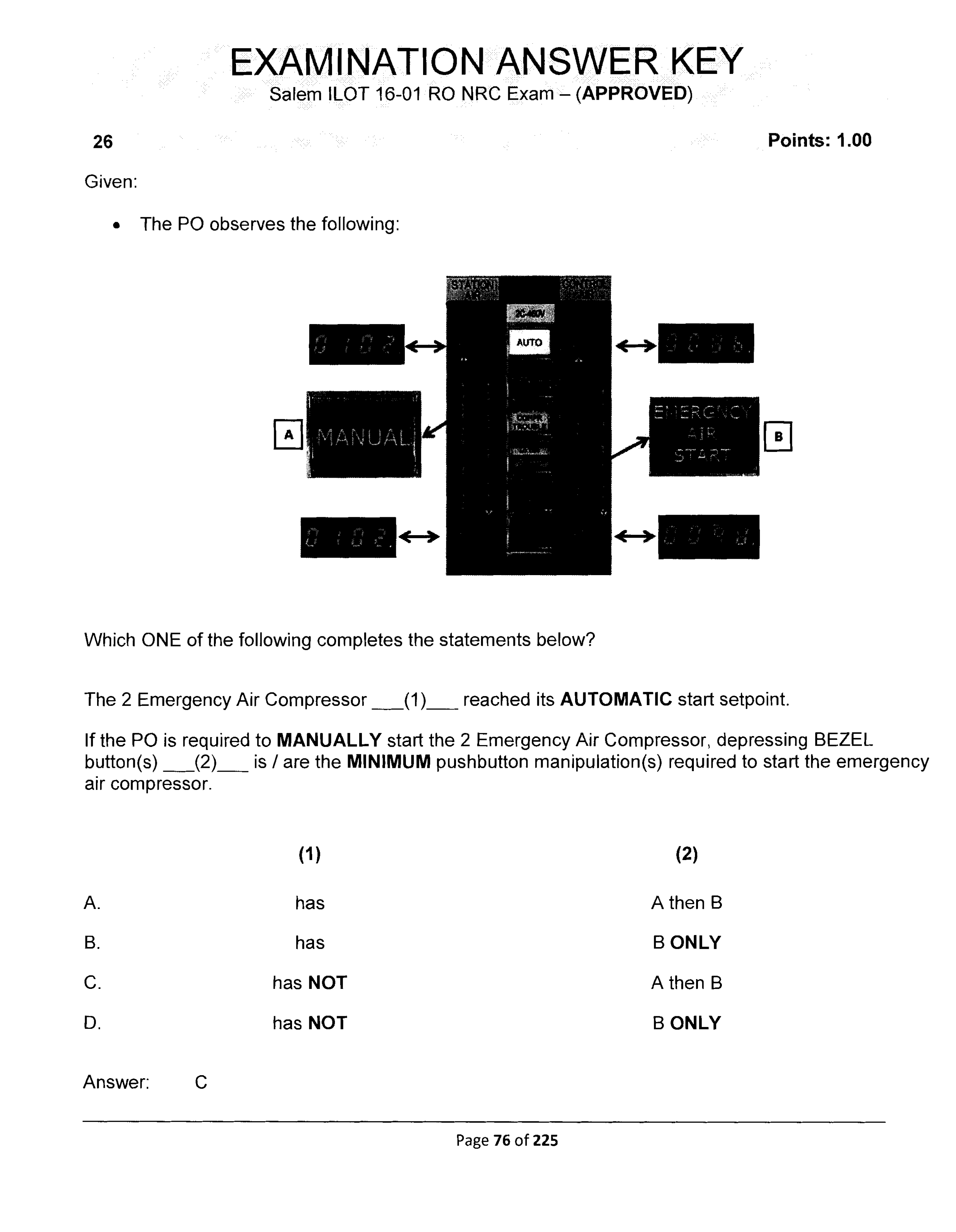
Note: Image difficult to read. Key information: ECAC is in AUTO. Lowest Control Air HDR Press is 86 psig. A Button is "MANUAL" and B Button is "START".
Which ONE of the following completes the statements below?
The 2 Emergency Air Compressor _(1)_ reached its AUTOMATIC start setpoint.
If the PO is required to MANUALLY start the 2 Emergency Air Compressor, depressing BEZEL button(s) _(2)_ is/are the MINIMUM pushbutton manipulation(s) required to start the emergency air compressor.
• The PO observes the following:
Note: Image difficult to read. Key information: ECAC is in AUTO. Lowest Control Air HDR Press is 86 psig. A Button is "MANUAL" and B Button is "START".
Which ONE of the following completes the statements below?
The 2 Emergency Air Compressor _(1)_ reached its AUTOMATIC start setpoint.
If the PO is required to MANUALLY start the 2 Emergency Air Compressor, depressing BEZEL button(s) _(2)_ is/are the MINIMUM pushbutton manipulation(s) required to start the emergency air compressor.
A. _(1)_ has _(2)_ A then B
B. _(1)_ has _(2)_ B ONLY
C. _(1)_ has NOT _(2)_ A then B
D. _(1)_ has NOT _(2)_ B ONLY
▶ Show Answer & Explanation
✓ C. Correct. For Part 1, the 2 ECAC will automatically start when control air pressure is less than 85 psig. Consequently, since the lowest control air pressure is 86 psig, the 2 Emergency Air Compressor has NOT reached its AUTOMATIC start setpoint. For Part 2, depressing BEZEL button(s) A then B are the MINIMUM pushbutton manipulation(s) required to start the emergency air compressor.
✗ A. Incorrect but plausible. For Part 1, S2.OP-AB.CA-0001 (Loss of Control Air) requires the crew to manually start ECAC when control air pressure reaches 88 psig. Consequently, the candidate could incorrectly deduce that the automatic start setpoint for the ECAC is 88 psig. Part 2 is correct.
✗ B. Incorrect but plausible. For Part 1, S2.OP-AB.CA-0001 (Loss of Control Air) requires the crew to manually start ECAC when control air pressure reaches 88 psig. Consequently, the candidate could incorrectly deduce that the automatic start setpoint for the ECAC is 88 psig. For Part 2, since the crew is attempting to manually start the emergency air compressor (ECAC), the candidate could incorrectly deduce the controller is designed to start the ECAC with only one button.
✗ D. Incorrect but plausible. Part 1 is correct. For Part 2, since the crew is attempting to manually start the emergency air compressor (ECAC), the candidate could incorrectly deduce the controller is designed to start the ECAC with only one button.
Ref: NOS05CONAIR-12 (CONTROL AIR SYSTEM) | LO: 8 — Identify and describe the Control Room controls, indications, and alarms associated with the Control Air System | Source: New | Cognitive: Higher
Connections
- Related systems: Control Air
- Related procedures: AB.CA-0001 — Loss of Control Air
- Related exam: 2018 NRC Written Exam
Q27 — CFCU SEC Mode 1 Response
103 Containment-K1.01 (3.6)
Given:
• Unit 2 is at 100% Reactor Power and stable
• 21-24 CFCUs are running in high speed
• 25 CFCU is stopped
At time 13:50
• A Reactor Trip and Safety Injection have occurred
Ten minutes later at 14:00, which ONE of the following completes the statement below?
21-24 CFCUs are running in _(1)_ speed and 25 CFCU is _(2)_.
• Unit 2 is at 100% Reactor Power and stable
• 21-24 CFCUs are running in high speed
• 25 CFCU is stopped
At time 13:50
• A Reactor Trip and Safety Injection have occurred
Ten minutes later at 14:00, which ONE of the following completes the statement below?
21-24 CFCUs are running in _(1)_ speed and 25 CFCU is _(2)_.
A. _(1)_ high _(2)_ stopped
B. _(1)_ high _(2)_ running in high speed
C. _(1)_ low _(2)_ stopped
D. _(1)_ low _(2)_ running in low speed
▶ Show Answer & Explanation
✓ D. Correct. At 14:00:00 the SECs will be in MODE 1. This will cause the running CFCUs to stop and then all of the CFCUs will be started in low speed. Consequently, at 14:00:00, 21-24 CFCUs are running in low speed and 25 CFCU is running in low speed.
✗ A. Incorrect but plausible. The candidate could incorrectly conclude that with the SECs in Mode 1, this will cause only the previously running CFCUs to shift to high speed.
✗ B. Incorrect but plausible. The candidate could incorrectly conclude that with the SECs in Mode 1, this will cause all of the CFCUs to shift to high speed.
✗ C. Incorrect but plausible. The candidate could incorrectly conclude that with the SECs in Mode 1, this will cause only the previously running CFCUs to shift to low speed.
Ref: NOS05ESF000-02 (INTRODUCTION TO ENGINEERED SAFETY FEATURES AND DESIGN CRITERIA) | LO: 4 — Describe the function and operating characteristics for the Engineered Safety Features Standby Power System components: The Safeguards Equipment Cabinets | Source: Bank | Cognitive: Higher
Connections
- Related systems: CFCUs, SECs, ESF & Design
- Related exam: 2018 NRC Written Exam
Q28 — CVCS Phase A Containment Isolation
103 Containment-A3.01 (3.9)
Given:
• Unit 1 is at 100% Reactor Power and stable
• 1CV5 (75 GPM ORIFICE) is in service
At time 12:00:00
• A spurious Phase A Containment Isolation occurs
At 12:01:00, which ONE of the following completes the statements below?
Seal Return flow is being directed to the _(1)_.
_(2)_ are BOTH closed.
NOTE:
• 1CV2 (LTDWN LINE ISOL V)
• 1CV277 (LTDWN LINE ISOL V)
• 1CV7 (LTDWN HX INLET V)
• Unit 1 is at 100% Reactor Power and stable
• 1CV5 (75 GPM ORIFICE) is in service
At time 12:00:00
• A spurious Phase A Containment Isolation occurs
At 12:01:00, which ONE of the following completes the statements below?
Seal Return flow is being directed to the _(1)_.
_(2)_ are BOTH closed.
NOTE:
• 1CV2 (LTDWN LINE ISOL V)
• 1CV277 (LTDWN LINE ISOL V)
• 1CV7 (LTDWN HX INLET V)
A. _(1)_ PRT _(2)_ 1CV2 and 1CV277
B. _(1)_ PRT _(2)_ 1CV5 and 1CV7
C. _(1)_ VCT _(2)_ 1CV2 and 1CV277
D. _(1)_ VCT _(2)_ 1CV5 and 1CV7
▶ Show Answer & Explanation
✓ B. Correct. For Part 1, 1CV284 & 1CV116 (RCP SW RET HOR STOP VALVES) will close. This causes seal return flow to be redirected from the VCT to the PRT via Relief Valve 1CV15. For Part 2, letdown will be isolated during a Phase A isolation. This is accomplished by closing 1CV5 and 1CV7.
✗ A. Incorrect but plausible. Part 1 is correct. For Part 2, 1CV2 and 1CV277 will automatically close on low PZR level. Consequently, the candidate could incorrectly conclude that 1CV2 and 1CV277 also automatically close on a Phase A Containment Isolation.
✗ C. Incorrect but plausible. For Part 1, seal injection flow is normally directed to the VCT. The candidate could incorrectly conclude that redirecting seal injection to the PRT is not desirable since this will cause a loss of RCS inventory. For Part 2, 1CV2 and 1CV277 will automatically close on low PZR level. Consequently, the candidate could incorrectly conclude that 1CV2 and 1CV277 also automatically close on a Phase A Containment Isolation.
✗ D. Incorrect but plausible. For Part 1, seal injection flow is normally directed to the VCT. The candidate could incorrectly conclude that redirecting seal injection to the PRT is not desirable since this will cause a loss of RCS inventory. Part 2 is correct.
Ref: NOS05CVCS00-17 (CHEMICAL AND VOLUME CONTROL SYSTEM) | LO: 9 — State the setpoints for automatic actuations associated with the Chemical and Volume Control System | Source: Modified Bank | Cognitive: Higher
Connections
- Related systems: CVCS, Containment, Pressurizer & PRT
- Related exam: 2018 NRC Written Exam
Q29 — Charging Pump Power Supplies
011 PZR Level Control-K2.01 (3.1)
Which ONE of the following completes the statements below?
21 Centrifugal Charging Pump is powered from the _(1)_ 4KV Vital Bus.
22 Centrifugal Charging Pump is powered from the _(2)_ 4KV Vital Bus.
21 Centrifugal Charging Pump is powered from the _(1)_ 4KV Vital Bus.
22 Centrifugal Charging Pump is powered from the _(2)_ 4KV Vital Bus.
A. _(1)_ 2A _(2)_ 2B
B. _(1)_ 2A _(2)_ 2C
C. _(1)_ 2B _(2)_ 2A
D. _(1)_ 2B _(2)_ 2C
▶ Show Answer & Explanation
✓ D. Correct. 21 Centrifugal Charging Pump is powered from the 2B 4KV Vital Bus. 22 Centrifugal Charging Pump is powered from the 2C 4KV Vital Bus.
✗ A. Incorrect but plausible. Since there are three 4KV Vital Busses that power two trains of each type of ECCS pumps, selecting any combination of two separate 4KV Vital busses is plausible.
✗ B. Incorrect but plausible. Since there are three 4KV Vital Busses that power two trains of each ECCS pumps, selecting any combination of two separate 4KV Vital busses is plausible.
✗ C. Incorrect but plausible. Since there are three 4KV Vital Busses that power two trains of each ECCS pumps, selecting any combination of two separate 4KV Vital busses is plausible.
Ref: NOS05CVCS00-17 (CHEMICAL AND VOLUME CONTROL SYSTEM) | LO: 9 — State the power supply to the following Chemical and Volume Control System components: Charging Pumps, Boric Acid Transfer Pumps, Primary Water Pumps | Source: New | Cognitive: Lower
Connections
- Related systems: CVCS, 4KV
- Related exam: 2018 NRC Written Exam
Q30 — Dropped Rod Withdrawal Speed
014 RPIS-A4.02 (3.4)
Given:
• The crew is recovering a dropped Control Bank A Rod in accordance with S2.OP-AB.ROD-0002 (Dropped Rod)
• The ROD BANK SELECTOR SWITCH has just been placed in CBA
Which ONE of the following completes the statement below?
With the ROD BANK SELECTOR SWITCH in CBA, the dropped rod will be withdrawn at ___ steps per minute in small increments per reactor Engineering guidance.
• The crew is recovering a dropped Control Bank A Rod in accordance with S2.OP-AB.ROD-0002 (Dropped Rod)
• The ROD BANK SELECTOR SWITCH has just been placed in CBA
Which ONE of the following completes the statement below?
With the ROD BANK SELECTOR SWITCH in CBA, the dropped rod will be withdrawn at ___ steps per minute in small increments per reactor Engineering guidance.
A. 72
B. 64
C. 48
D. 8
▶ Show Answer & Explanation
✓ C. Correct. With the ROD BANK SELECTOR SWITCH in CBA, the dropped rod will be withdrawn at 48 steps per minute.
✗ A. Incorrect but plausible. 72 steps per minute is maximum speed for withdrawing rods when the ROD BANK SELECTOR SWITCH is in AUTO. Consequently, the candidate could incorrectly conclude that with ROD BANK SELECTOR SWITCH in CBA, the dropped rod will be withdrawn at 72 steps per minute.
✗ B. Incorrect but plausible. 64 steps per minute is the speed for withdrawing rods when the ROD BANK SELECTOR SWITCH is in SBA, SBB, SBC or SBD. Consequently, the candidate could incorrectly conclude that with ROD BANK SELECTOR SWITCH in CBA, the dropped rod will be withdrawn at 64 steps per minute.
✗ D. Incorrect but plausible. 8 steps per minute is minimum speed for withdrawing rods when the ROD BANK SELECTOR SWITCH is in AUTO. Consequently, the candidate could incorrectly conclude that with ROD BANK SELECTOR SWITCH in CBA, the dropped rod will be withdrawn at 8 steps per minute.
Ref: NOS05RODS00-12 (ROD CONTROL AND POSITION INDICATION SYSTEMS) | LO: 11 — Identify and describe the Control Room controls, indications, and alarms associated with the Rod Control and Position Indication Systems | Source: New | Cognitive: Lower
Connections
- Related systems: Control Rod Drive
- Related procedures: AB.ROD-0002 — Dropped Rod
- Related exam: 2018 NRC Written Exam
Q31 — CVCS Auto Makeup / CV179 Failure
015 NIS-A3.05 (2.6)
Given:
• Unit 2 is in MODE 3 preparing to do a plant startup
At Time 07:00
• An AUTOMATIC RCS Makeup starts
At Time 07:01
• 125 VDC power to 2CV179 (PRIMARY WATER FLOW) has been lost
• The Primary Water Flow Deviation Alarm actuates
At Time 07:02
• 2CV185 (MAKEUP FLOWPATH) fails to AUTOMATICALLY close
Which ONE of the following completes the statements below?
The Primary Water Flow Deviation Alarm actuates when primary water flow is greater than a MINIMUM of ±_(1)_ gpm above the setpoint.
The Source Range NI Audible Count Rate indication is expected to _(2)_ as the makeup continues with 2CV179 in its failed position.
• Unit 2 is in MODE 3 preparing to do a plant startup
At Time 07:00
• An AUTOMATIC RCS Makeup starts
At Time 07:01
• 125 VDC power to 2CV179 (PRIMARY WATER FLOW) has been lost
• The Primary Water Flow Deviation Alarm actuates
At Time 07:02
• 2CV185 (MAKEUP FLOWPATH) fails to AUTOMATICALLY close
Which ONE of the following completes the statements below?
The Primary Water Flow Deviation Alarm actuates when primary water flow is greater than a MINIMUM of ±_(1)_ gpm above the setpoint.
The Source Range NI Audible Count Rate indication is expected to _(2)_ as the makeup continues with 2CV179 in its failed position.
A. _(1)_ 5.0 _(2)_ rise
B. _(1)_ 5.0 _(2)_ lower
C. _(1)_ 0.8 _(2)_ rise
D. _(1)_ 0.8 _(2)_ lower
▶ Show Answer & Explanation
✓ B. Correct. For Part 1 and IAW S2.OP-AR.ZZ-0012, the Primary Water Flow Deviation Alarm actuates when primary water flow is greater than a MINIMUM of ±5.0 gpm above the setpoint. For Part 2, 2CV179 fails closed. Consequently, actual boron flow into the boric acid blender will be higher than the predetermined setpoint for the auto makeup (based on current RCS Boron concentration). This will cause actual RCS boron concentration to rise since the boron concentration of auto makeup flow is higher than the setpoint for the existing RCS Boron concentration. An increase in actual RCS Boron concentration will insert negative reactivity which will cause the Source Range NI Audible Count Rate indication to lower.
✗ A. Part 1 is correct. For Part 2, the candidate could incorrectly conclude that 2CV179 fails open. With 2CV179 open during an automatic RCS makeup, actual RCS Boron Concentration will lower. Lowering actual RCS Concentration will add positive reactivity which will cause the Source Range NI Audible Count Rate indication to rise.
✗ C. For Part 1, the Boric Acid Flow Deviation actuates when boric acid flow is greater than a MINIMUM of ±0.8 gpm above the setpoint. Consequently, the candidate could incorrectly conclude that the Primary Water Flow Deviation Alarm actuates when primary water flow is greater than a MINIMUM of ±0.8 gpm above the setpoint. For Part 2, the candidate could incorrectly conclude that 2CV179 fails open.
✗ D. For Part 1, the Boric Acid Flow Deviation actuates when boric acid flow is greater than a MINIMUM of ±0.8 gpm above the setpoint. Part 2 is correct.
Ref: NOS05CVCS00-17 (Chemical and Volume Control System) | LO: NOS05CVCS00-17 Obj 11 — Given a CVCS failure, predict the effect on the RCS | Source: New | Cognitive: Higher
Connections
- Related systems: CVCS, Excore NIs
- Related procedures: S2.OP-AR.ZZ-0012 — Console Alarm Response
- Related exam: 2018 NRC Written Exam
Q32 — Containment Internal Pressure / TS 3.6.1.4
029 CPS-A2.01 (2.9)
Given:
• Unit 2 is at 25% Reactor Power and stable
• Emergent maintenance activities are ongoing inside containment
• Containment pressure is slowly rising due to the maintenance activities
In accordance with Unit 2 Technical Specifications, which ONE of the following completes the statements below?
LCO 3.6.1.4 (CONTAINMENT INTERNAL PRESSURE) will NOT be met when containment pressure is greater than a MINIMUM of + _(1)_ psig.
When LCO 3.6.1.4 is NOT met, the crew is required to restore containment internal pressure within limits within a MAXIMUM of _(2)_ minutes or place the Unit in HOT STANDBY within the next 6 hours.
• Unit 2 is at 25% Reactor Power and stable
• Emergent maintenance activities are ongoing inside containment
• Containment pressure is slowly rising due to the maintenance activities
In accordance with Unit 2 Technical Specifications, which ONE of the following completes the statements below?
LCO 3.6.1.4 (CONTAINMENT INTERNAL PRESSURE) will NOT be met when containment pressure is greater than a MINIMUM of + _(1)_ psig.
When LCO 3.6.1.4 is NOT met, the crew is required to restore containment internal pressure within limits within a MAXIMUM of _(2)_ minutes or place the Unit in HOT STANDBY within the next 6 hours.
A. _(1)_ 0.2 _(2)_ 30
B. _(1)_ 0.2 _(2)_ 60
C. _(1)_ 0.3 _(2)_ 30
D. _(1)_ 0.3 _(2)_ 60
▶ Show Answer & Explanation
✓ D. Correct. For Part 1, LCO 3.6.1.4 (INTERNAL PRESSURE) will NOT be met when containment pressure is greater than a minimum of +0.3 psig. For Part 2, when LCO 3.6.1.4 is NOT met, the crew is required to restore containment internal pressure within limits within a MAXIMUM of 60 minutes or place the Unit in HOT STANDBY within the next 6 hours.
✗ A. For Part 1, the BEZEL Hi CNTMT Pressure Alarm is 0.2 psid. Consequently, the candidate could incorrectly determine that LCO 3.6.1.4 will NOT be met when containment pressure is greater than a minimum of +0.2 psig. For Part 2, there are other LCOs with 30 minutes REQUIRED ACTION (LCOs 3.2.1, 3.2.4, 3.4.10.2 and 3.7.2). Consequently, the candidate could incorrectly conclude that the restoration time is 30 minutes.
✗ B. For Part 1, the BEZEL Hi CNTMT Pressure Alarm is 0.2 psid. Part 2 is correct.
✗ C. Part 1 is correct. For Part 2, there are other LCOs with 30 minutes REQUIRED ACTION (LCOs 3.2.1, 3.2.4, 3.4.10.2 and 3.7.2). Consequently, the candidate could incorrectly conclude that the restoration time is 30 minutes.
Ref: NOS05CONTMT-15 (Containment and Containment Support Systems) | LO: NOS05CONTMT-15 Obj 9 — Given a Containment situation, apply the appropriate Tech Spec action | Source: Modified Bank | Cognitive: Lower
Connections
- Related systems: Containment
- Related tech specs: TS 3/4.6 — Containment
- Related exam: 2018 NRC Written Exam
Q33 — SFP Routine Makeup Water Sources
033 SFPCS-K4.01 (2.9)
Given the following Salem Water Sources:
1. Demineralized Water System
2. Primary Water Storage Tank
3. CVCS Holdup Tanks
4. Refueling Water Storage Tank
5. Fresh Water and Fire Protection Water Storage Tank
Which ONE of the following completes the statements below concerning Unit 2 Spent Fuel Pool?
In accordance with S2.OP-SO.SF-0001 (Fill And Transfer Of The Spent Fuel Pool), ___ are sources of water that can be used to provide ROUTINE makeup to the Spent Fuel Pool.
1. Demineralized Water System
2. Primary Water Storage Tank
3. CVCS Holdup Tanks
4. Refueling Water Storage Tank
5. Fresh Water and Fire Protection Water Storage Tank
Which ONE of the following completes the statements below concerning Unit 2 Spent Fuel Pool?
In accordance with S2.OP-SO.SF-0001 (Fill And Transfer Of The Spent Fuel Pool), ___ are sources of water that can be used to provide ROUTINE makeup to the Spent Fuel Pool.
A. 1, 2, 3, and 4 ONLY
B. 2, 3, and 4 ONLY
C. 3, 4, and 5 ONLY
D. 1, 2, 3, 4, and 5
▶ Show Answer & Explanation
✓ A. Correct. In accordance with S2.OP-SO.SF-0001 (Fill And Transfer Of The Spent Fuel Pool), the following water sources are allowed to be used for ROUTINE makeup to the Spent Fuel Pool: 1) Demineralized Water System, 2) Primary Water Storage Tank, 3) CVCS Holdup Tanks, 4) Refueling Water Storage Tank. The Fresh Water and Fire Protection Water Storage Tank is NOT an allowed ROUTINE makeup source.
✗ B. All of the listed water sources are actual Salem Water Sources. Consequently, all of the distractors are plausible when determining the allowed ROUTINE makeup sources to the Spent Fuel Pool.
✗ C. All of the listed water sources are actual Salem Water Sources. Consequently, all of the distractors are plausible when determining the allowed ROUTINE makeup sources to the Spent Fuel Pool.
✗ D. All of the listed water sources are actual Salem Water Sources. Consequently, all of the distractors are plausible when determining the allowed ROUTINE makeup sources to the Spent Fuel Pool.
Ref: NOS05SFP000-10 (Spent Fuel Pool Cooling System) | LO: NOS05SFP000-10 Obj 11 — Discuss procedural requirements associated with the SFP Cooling System | Source: New | Cognitive: Lower
Connections
- Related systems: Spent Fuel Pool, CVCS, Demin Water
- Related procedures: S2.OP-SO.SF-0001 — Fill and Transfer of Spent Fuel Pool
- Related exam: 2018 NRC Written Exam
Q34 — Fuel Transfer Cart Interlocks
034 FHES-A1.02 (2.9)
Given:
• A Unit 1 Core reload is in progress
• The Fuel Transfer Cart is in the Fuel Handling Building with the upender in the horizontal position
At 09:00:00
• The limit switch on the Fuel Transfer Tube Gate Valve fails and the valve no longer indicates open
• An NEO has verified that the Fuel Transfer Tube Gate Valve is open
At 09:05:00
• Water level in the refueling canal begins to rapidly lower
• The crew is preparing to close the Fuel Transfer Tube Gate Valve
Which ONE of the following completes the statements below?
At 09:00:00 and if desired, the Fuel Transfer Cart can be moved MANUALLY _(1)_ to Containment with the failed limit switch on the Fuel Transfer Tube Gate Valve.
At 09:05:00, the crew _(2)_ FULLY close the Fuel Transfer Tube Gate Valve with the Fuel Transfer Cart located in the Fuel Handling Building.
• A Unit 1 Core reload is in progress
• The Fuel Transfer Cart is in the Fuel Handling Building with the upender in the horizontal position
At 09:00:00
• The limit switch on the Fuel Transfer Tube Gate Valve fails and the valve no longer indicates open
• An NEO has verified that the Fuel Transfer Tube Gate Valve is open
At 09:05:00
• Water level in the refueling canal begins to rapidly lower
• The crew is preparing to close the Fuel Transfer Tube Gate Valve
Which ONE of the following completes the statements below?
At 09:00:00 and if desired, the Fuel Transfer Cart can be moved MANUALLY _(1)_ to Containment with the failed limit switch on the Fuel Transfer Tube Gate Valve.
At 09:05:00, the crew _(2)_ FULLY close the Fuel Transfer Tube Gate Valve with the Fuel Transfer Cart located in the Fuel Handling Building.
A. _(1)_ ONLY _(2)_ can
B. _(1)_ ONLY _(2)_ can NOT
C. _(1)_ or ELECTRICALLY _(2)_ can
D. _(1)_ or ELECTRICALLY _(2)_ can NOT
▶ Show Answer & Explanation
✓ B. Correct. For Part 1, the Fuel Transfer Cart has two interlocks that will prevent/allow cart movement: upender must be in the horizontal position and the Fuel Transfer Tube Gate Valve must be open (as indicated with the open limit switch). At 09:00:00, both interlocks are not satisfied and the Fuel Transfer Cart can not be moved to containment. For Part 2, the crew can not close the Fuel Transfer Tube Gate Valve with the Fuel Transfer Cart located in the Fuel Handling Building.
✗ A. Part 1 is correct. For Part 2, the candidate could incorrectly conclude that the Fuel Transfer Tube Gate Valve can be closed regardless of the fuel transfer cart location (inside containment or inside the fuel handling building).
✗ C. For Part 1, the candidate could incorrectly conclude that the fuel cart interlock was only based on position of the upender and the Fuel Transfer Tube Gate Valve was verified open administratively prior to moving the fuel transfer cart. For Part 2, the candidate could incorrectly conclude that the valve can be closed regardless of fuel transfer cart location.
✗ D. For Part 1, the candidate could incorrectly conclude that the fuel cart interlock was only based on position of the upender and the Fuel Transfer Tube Gate Valve was verified open administratively prior to moving the fuel transfer cart. Part 2 is correct.
Ref: S2.OP-AB.FUEL-0002 (Loss Of Refueling Cavity Or Spent Fuel Pool Level), NOS05REFUEL-11 (Refueling System) | LO: NOS05REFUEL-11 Obj 5 — Outline the interlocks associated with refueling system components | Source: Modified Bank | Cognitive: Higher
Connections
- Related systems: Refueling
- Related abnormals: AB.FUEL-0002 — Loss of Refueling Cavity or SFP Level
- Related exam: 2018 NRC Written Exam
Q35 — Steam Dump Load Rejection Controller [EDITED]
041 SDS-K6.03 (2.7)
Given:
• Unit 2 is at 100% Reactor Power and stable
At time 10:00:00
• The 21BF19 Main Feedwater Control Valve controller malfunctions causing 21BF19 to close
At time 10:00:30
• The crew performs a MANUAL Reactor Trip
• ONLY Reactor Trip Train A Breaker opens
Which ONE of the following completes the statement below?
The Steam Dump System will use the _(1)_ to stabilize RCS TAVG at _(2)_ °F.
• Unit 2 is at 100% Reactor Power and stable
At time 10:00:00
• The 21BF19 Main Feedwater Control Valve controller malfunctions causing 21BF19 to close
At time 10:00:30
• The crew performs a MANUAL Reactor Trip
• ONLY Reactor Trip Train A Breaker opens
Which ONE of the following completes the statement below?
The Steam Dump System will use the _(1)_ to stabilize RCS TAVG at _(2)_ °F.
A. _(1)_ Plant Trip Controller _(2)_ 551
B. _(1)_ Plant Trip Controller _(2)_ 547
C. _(1)_ Load Rejection Controller _(2)_ 551
D. _(1)_ Load Rejection Controller _(2)_ 547
▶ Show Answer & Explanation
✓ C. Correct. For Part 1, with the plant initially at 100% Power, the Steam Dump System is in the TAVG Mode. Consequently when the plant trips and ONLY Reactor Trip Train A Breaker opens, the Load Rejection Controller will control the steam dumps. If Reactor Trip Train B Breaker had opened then the Plant Trip Controller would have controlled the steam dumps. For Part 2, with the Load Rejection Controller in control of the steam dumps, there is a 4°F dead band associated with the controller. Consequently, the steam dumps will maintain RCS TAVG at 551°F (547°F (no load TAVG) + 5°F).
✗ A. For Part 1, the candidate could incorrectly conclude that steam dump Plant Trip Controller is based on Reactor Trip Train A Breaker opening. For Part 2, the candidate could incorrectly recall which steam dump controller has a dead band and incorrectly conclude that the Plant Trip Controller has a dead band, resulting in 551°F.
✗ B. For Part 1, the candidate could incorrectly conclude that the Plant Trip Controller is based on Train A Breaker opening. For Part 2, the Plant Trip Controller has no dead band and will normally restore RCS TAVG to RCS No-Load TAVG (547°F).
✗ D. Part 1 is correct. For Part 2, following a reactor trip in which both Reactor Trip Train A and B Breakers open, the steam dump system would maintain RCS TAVG at 547°F. The candidate could incorrectly recall which controller has a dead band.
Ref: NOS05STDUMP-12 (Steam Dump System) | LO: NOS05STDUMP-12 Obj 7 — Describe function of Load Rejection and Plant Trip Controllers | Source: Bank | Cognitive: Higher
Connections
- Related systems: Steam Dumps, Feed & Condensate, RPS/SSPS
- Related exam: 2018 NRC Written Exam
Q36 — Condenser Vacuum / Seal Water Temperature
055 CARS-K3.01 (2.5)
Which ONE of the following completes the statement below?
___ can cause Main Condenser vacuum to degrade.
___ can cause Main Condenser vacuum to degrade.
A. Excessively low TAC supply temperature
B. Excessively high Vacuum Pump Seal Water flow
C. Vacuum Pump Separating Tank releasing through the overflow
D. Excessively high Vacuum Pump Seal Water Temperature
▶ Show Answer & Explanation
✓ D. Correct. As Seal Water temperature increases, Vacuum Pump performance decreases, and can result in degrading vacuum.
✗ A. Excessively low TAC supply temperature will cause Seal Water Temperature to lower which would actually improve Condenser Vacuum.
✗ B. Excessively high Vacuum Pump Seal Water flow will cause Seal Water Temperature to lower which would actually improve Condenser Vacuum.
✗ C. Vacuum Pump Separating Tank releasing through the overflow will cause Seal Water Temperature to lower which would actually improve Condenser Vacuum.
Ref: NOS05CAR000-07 (Condenser Air Removal and Priming System) | LO: NOS05CAR000-07 Obj 13 — Given plant conditions, relate the Condenser Air Removal and Priming System with the Main Condenser | Source: Bank | Cognitive: Higher
Connections
- Related systems: Condenser Air Removal
- Related exam: 2018 NRC Written Exam
Q37 — Condensate LP Heater Bypass / CN22 Valves
056 Condensate-G2.1.30 (4.4)
Given:
• Unit 2 is at 90% Reactor Power
At time 17:00:00
• 21CN22 (LP Feedwater Heaters 21A/22A Inlet Control Valve) and 23CN22 (LP Feedwater Heaters 21C/22C Inlet Control Valve) SPURIOUSLY close
Which ONE of the following completes the statements below?
With 21CN22 and 23CN22 closed, Reactor Power will _(1)_.
The crew _(2)_ open 21CN22 and 23CN22 from the Control Room.
• Unit 2 is at 90% Reactor Power
At time 17:00:00
• 21CN22 (LP Feedwater Heaters 21A/22A Inlet Control Valve) and 23CN22 (LP Feedwater Heaters 21C/22C Inlet Control Valve) SPURIOUSLY close
Which ONE of the following completes the statements below?
With 21CN22 and 23CN22 closed, Reactor Power will _(1)_.
The crew _(2)_ open 21CN22 and 23CN22 from the Control Room.
A. _(1)_ remain stable _(2)_ can
B. _(1)_ remain stable _(2)_ can NOT
C. _(1)_ rise _(2)_ can
D. _(1)_ rise _(2)_ can NOT
▶ Show Answer & Explanation
✓ D. Correct. For Part 1, with 21CN22 and 23CN22 closed, 2CN45 will modulate open to maintain <65 psid across 21 and 22 LP Heaters. With 2CN45 modulated, Feedwater temperature will lower. With SG Steam flow constant, Reactor power will rise. For Part 2, the CN22s only have indications in the Control Room (no controls). Consequently, the crew can not open 21CN22 and 23CN22 from the Control Room.
✗ A. For Part 1, the candidate could fail to recognize that with the given condensate transient, Feedwater temperature will lower, causing reactor power to rise. For Part 2, other CN valves associated with Feedwater heaters can be operated in the Control Room (e.g. 2CN45 and 2CN47). The candidate could incorrectly conclude that 21CN22 and 23CN22 can also be opened from the control room.
✗ B. For Part 1, the candidate could fail to recognize that Feedwater temperature will lower. Part 2 is correct.
✗ C. Part 1 is correct. For Part 2, other CN valves can be operated in the Control Room. The candidate could incorrectly conclude that 21CN22 and 23CN22 can also be opened from the control room.
Ref: NOS05CN&FDW-15 (Condensate and Feedwater System) | LO: NOS05CN&FDW-15 Obj 7 — Identify and describe local controls, indications, and alarms | Source: New | Cognitive: Higher
Connections
- Related systems: Feed & Condensate
- Related exam: 2018 NRC Written Exam
Q38 — RCDT Waste Gas Compressor Header Connection
068 LRS-K1.02 (2.5)
Which ONE of the following completes the statements below concerning the Unit 2 Radioactive Liquid Waste System Tanks?
ONLY the ___ has a physical connection to the Waste Gas Compressor Header.
ONLY the ___ has a physical connection to the Waste Gas Compressor Header.
A. RCDT
B. 21 WHUT
C. Chemical Drain Tank
D. Auxiliary Building Sump Tank
▶ Show Answer & Explanation
✓ A. Correct. ONLY the RCDT has a physical connection to the Waste Gas Compressor Header.
✗ B. Since all of the distractors are part of the tanks that comprise the Liquid Waste System, all of the distractors are plausible.
✗ C. Since all of the distractors are part of the tanks that comprise the Liquid Waste System, all of the distractors are plausible.
✗ D. Since all of the distractors are part of the tanks that comprise the Liquid Waste System, all of the distractors are plausible.
Ref: NOS05WASLIQ-09 (Radioactive Liquid Waste System) | LO: NOS05WASLIQ-09 Obj 14 — Given plant conditions, relate the Radioactive Liquid Waste System with the Waste Gas Vent Header | Source: New | Cognitive: Lower
Connections
- Related systems: Waste Liquid, Waste Gas
- Related exam: 2018 NRC Written Exam
Q39 — MODE 2 Entry / IOP-0003
G2.1.18 (3.6)
In accordance with S2.OP-IO.ZZ-0003 (Hot Standby To Minimum Load), which ONE of the following completes the statement below?
The crew will record the time of MODE 2 entry in the Control Room Narrative Log when ___
The crew will record the time of MODE 2 entry in the Control Room Narrative Log when ___
A. the reactor is announced to be critical
B. withdrawal of Control Bank "A" is imminent
C. withdrawal of Shutdown Bank "A" is imminent
D. when IR power level has been stabilized at 2E-3%
▶ Show Answer & Explanation
✓ B. Correct. In accordance with S2.OP-IO.ZZ-0003, the crew will record the time of MODE 2 entry in the Control Room Narrative Log when withdrawal of Control Bank "A" is imminent.
✗ A. The candidate could incorrectly conclude that the plant enters Mode 2 when the reactor becomes critical.
✗ C. The candidate could incorrectly conclude that the plant enters Mode 2 when the first bank of control rods is withdrawn.
✗ D. The candidate could incorrectly conclude that the plant enters Mode 2 when the IR power has been stabilized at 2E-3% which is when data is collected IAW SC.RE-RA.ZZ-0002 (Inverse Count Rate Ratio During Reactor Startup).
Ref: NOS05IOP300-09 (Reactor Startup) | LO: NOS05IOP300-09 Obj 1 — Summarize the purpose of S1/S2.OP-IO.ZZ-0003(Q), Hot Standby to Minimum Load | Source: Bank | Cognitive: Lower
Connections
- Related systems: Control Rod Drive
- Related procedures: S2.OP-IO.ZZ-0003 — Hot Standby to Minimum Load
- Related exam: 2018 NRC Written Exam
Q40 — VCT Level / LT-112 Failure
G2.1.28 (4.1)
Given:
• Unit 2 is at 100% Reactor Power and stable
At time 10:00
• 2LT-112 (VCT Level Transmitter) fails to 80%
Which ONE of the following completes the statements below?
At 10:01, ACTUAL VCT Level is _(1)_.
If ACTUAL VCT Level reaches the AUTO MAKE-UP set point with 2LT-112 failed at 80%, an AUTO MAKE-UP _(2)_ start.
• Unit 2 is at 100% Reactor Power and stable
At time 10:00
• 2LT-112 (VCT Level Transmitter) fails to 80%
Which ONE of the following completes the statements below?
At 10:01, ACTUAL VCT Level is _(1)_.
If ACTUAL VCT Level reaches the AUTO MAKE-UP set point with 2LT-112 failed at 80%, an AUTO MAKE-UP _(2)_ start.
A. _(1)_ lowering _(2)_ will NOT
B. _(1)_ lowering _(2)_ will
C. _(1)_ stable _(2)_ will NOT
D. _(1)_ stable _(2)_ will
▶ Show Answer & Explanation
✓ C. Correct. For Part 1, LT-112 will cause CV-35 to ONLY fully divert to the CVCS Holdup Tanks at 87% (no modulation of CV-35). Consequently, when LT-112 fails to 80%, CV-35 will remain fully aligned to the VCT and ACTUAL VCT Level will remain stable. For Part 2, LT-112 is the controlling transmitter for AUTO MAKE-UP. Consequently, with LT-112 failed at 80%, an AUTO MAKE-UP will NOT start when ACTUAL VCT level reaches the AUTO MAKE-UP set point.
✗ A. For Part 1, the VCT has two level transmitters (LT-112 and LT-114). If LT-114 had failed to 80%, CV-35 would be almost fully diverted to the CVCS Holdup Tanks. Consequently, the candidate could incorrectly conclude that CV-35 would be diverted, causing ACTUAL VCT level to lower. Part 2 is correct.
✗ B. For Part 1, the candidate could incorrectly conclude that CV-35 would be diverted. For Part 2, the candidate could incorrectly conclude that LT-114 controls the AUTO MAKE-UP function.
✗ D. Part 1 is correct. For Part 2, the candidate could incorrectly conclude that LT-114 controls the AUTO MAKE-UP function.
Ref: NOS05CVCS00-17 (Chemical and Volume Control System) | LO: NOS05CVCS00-17 Obj 7 — Identify and describe CVCS local controls, indications, and alarms | Source: Bank | Cognitive: Higher
Connections
- Related systems: CVCS
- Related exam: 2018 NRC Written Exam
Q41 — Rod Position After Downpower
G2.1.43 (4.1)
REFERENCES PROVIDED
Given:
• Unit 2 is at 100% Reactor Power and stable
• Core Burnup is 8000 EFPH
• RCS Boron Concentration is 900 ppm
• Control Bank D is at 228 steps
At time 10:00:00
• The crew is planning to reduce Reactor Power to 80% to support unplanned maintenance activities
• As part of the down power, the crew will change core reactivity by (-) 216 pcm by raising RCS Boron Concentration
Which ONE of the following completes the statements below?
Using the given references and disregarding any core reactivity change due to Xenon, Control Bank D will be at approximately _____ steps after the down power and RCS Boron Concentration change are completed.
Given:
• Unit 2 is at 100% Reactor Power and stable
• Core Burnup is 8000 EFPH
• RCS Boron Concentration is 900 ppm
• Control Bank D is at 228 steps
At time 10:00:00
• The crew is planning to reduce Reactor Power to 80% to support unplanned maintenance activities
• As part of the down power, the crew will change core reactivity by (-) 216 pcm by raising RCS Boron Concentration
Which ONE of the following completes the statements below?
Using the given references and disregarding any core reactivity change due to Xenon, Control Bank D will be at approximately _____ steps after the down power and RCS Boron Concentration change are completed.
A. 186
B. 175
C. 166
D. 150
▶ Show Answer & Explanation
✓ A. Correct. IAW S2-RE-RA.ZZ-0016 (Figure 17A or Table 2-1), for the given Core Burnup and RCS Boron Concentration, lowering power from 100% to 80% will add (+) 396 pcm of reactivity to the core. Since the crew will change core reactivity by (-) 216 pcm by raising RCS Boron Concentration, Control Bank D will need to make up for the remaining (-) 180 pcm by inserting from 228 steps. Using the Integral Rod Worth from IAW S2-RE-RA.ZZ-0016 Figure 2C, Control Bank D will be at approximately 186 steps after the down power and RCS Boron Concentration change are completed.
✗ B. Incorrect but plausible. Determining the correct answer requires multiple calculations and reading of multiple curves / tables. Consequently, there are several incorrect steps the candidate could perform to incorrectly determine Control Bank D final position. Since the distractors are all possible positions of Control Bank D, all of the distractors are plausible.
✗ C. Incorrect but plausible. Determining the correct answer requires multiple calculations and reading of multiple curves / tables. Consequently, there are several incorrect steps the candidate could perform to incorrectly determine Control Bank D final position. Since the distractors are all possible positions of Control Bank D, all of the distractors are plausible.
✗ D. Incorrect but plausible. Determining the correct answer requires multiple calculations and reading of multiple curves / tables. Consequently, there are several incorrect steps the candidate could perform to incorrectly determine Control Bank D final position. Since the distractors are all possible positions of Control Bank D, all of the distractors are plausible.
Ref: S2-RE-RA.ZZ-0016 (Curve Book - Salem Unit 2 Cycle 23) | LO: NOS05RODS00-12 (Rod Control and Position Indication Systems) | Source: New | Cognitive: Higher
Connections
- Related systems: Control Rod Drive
- Related procedures: S2-RE-RA.ZZ-0016 — Curve Book (Salem Unit 2 Cycle 23)
- Related exam: 2018 NRC Written Exam
Q42 — EDG Load Test Values
G2.2.21 (2.9)
Given:
• Corrective Maintenance has just been completed on 2A Emergency Diesel Generator (EDG)
• Operations is preparing to perform a Load Test on 2A EDG as part of the Post-Maintenance Operability Retest
In accordance with S2.OP-ST.DG-0001 (2A Diesel Generator Surveillance Test), which ONE of the following completes the statements below?
To prevent tripping the Diesel Generator Breaker on reverse power, generator load must be IMMEDIATELY raised to greater than a MINIMUM of _(1)_ KW after the breaker is closed.
During the Load Test, the 2A EDG may NOT exceed its _(2)_ KW Continuous Load Rating.
• Corrective Maintenance has just been completed on 2A Emergency Diesel Generator (EDG)
• Operations is preparing to perform a Load Test on 2A EDG as part of the Post-Maintenance Operability Retest
In accordance with S2.OP-ST.DG-0001 (2A Diesel Generator Surveillance Test), which ONE of the following completes the statements below?
To prevent tripping the Diesel Generator Breaker on reverse power, generator load must be IMMEDIATELY raised to greater than a MINIMUM of _(1)_ KW after the breaker is closed.
During the Load Test, the 2A EDG may NOT exceed its _(2)_ KW Continuous Load Rating.
A. _(1)_ 500 / _(2)_ 2600
B. _(1)_ 500 / _(2)_ 2750
C. _(1)_ 200 / _(2)_ 2600
D. _(1)_ 200 / _(2)_ 2750
▶ Show Answer & Explanation
✓ A. Correct. For Part 1 and IAW S2.OP-ST.DG-0001, to prevent tripping the Diesel Generator Breaker on reverse power, generator load must be IMMEDIATELY raised to greater than a minimum of 500 KW after the breaker is closed. For Part 2 and IAW S2.OP-ST.DG-0001, during the Load Test, the 2A EDG may NOT exceed its 2600 KW Continuous Load Rating.
✗ B. Incorrect but plausible. Part 1 is correct. For Part 2, S2.OP-ST.DG-0001 Precautions And Limitations states that the EDG is rated to 2750 KW for 2000 hours (2681 KW Local). Consequently, the candidate could incorrectly conclude that 2750 KW is the Continuous Loading Rating on the EDG.
✗ C. Incorrect but plausible. For Part 1, S2.OP-ST.DG-0001 states that when unloading the EDG, generator load must be maintained at greater than 200 KW until the breaker is opened (to prevent tripping the Diesel Generator Breaker on reverse power). Consequently, the candidate could incorrectly conclude that to prevent tripping the Diesel Generator Breaker on reverse power, generator load must be IMMEDIATELY raised to greater than a minimum of 200 KW after the breaker is closed. Part 2 is correct.
✗ D. Incorrect but plausible. For Part 1, S2.OP-ST.DG-0001 states that when unloading the EDG, generator load must be maintained at greater than 200 KW until the breaker is opened (to prevent tripping the Diesel Generator Breaker on reverse power). Consequently, the candidate could incorrectly conclude that to prevent tripping the Diesel Generator Breaker on reverse power, generator load must be IMMEDIATELY raised to greater than a minimum of 200 KW after the breaker is closed. For Part 2, S2.OP-ST.DG-0001 Precautions And Limitations states that the EDG is rated to 2750 KW for 2000 hours (2681 KW Local). Consequently, the candidate could incorrectly conclude that 2750 KW is the Continuous Loading Rating on the EDG.
Ref: NOS05EDG000-12 (Emergency Diesel Generators) | LO: NOS05EDG000-12 LO 12 | Source: New | Cognitive: Lower
Connections
- Related systems: EDGs
- Related procedures: S2.OP-ST.DG-0001 — Emergency Diesel Generator Surveillance Test
- Related exam: 2018 NRC Written Exam
Q43 — RCS Safety Limit Pressure
G2.2.38 (3.6)
In accordance with Unit 2 Technical Specifications, which ONE of the following completes the statements below?
Safety Limit 2.1.2 (Reactor Coolant System Pressure) will NOT be met when RCS pressure is greater than a MINIMUM of _(1)_ psig.
If the Unit is in MODE 3 when RCS Pressure has exceeded the Safety Limit 2.1.2 limit, then RCS pressure must be reduced within its limit within a MAXIMUM of _(2)_ minutes.
Safety Limit 2.1.2 (Reactor Coolant System Pressure) will NOT be met when RCS pressure is greater than a MINIMUM of _(1)_ psig.
If the Unit is in MODE 3 when RCS Pressure has exceeded the Safety Limit 2.1.2 limit, then RCS pressure must be reduced within its limit within a MAXIMUM of _(2)_ minutes.
A. _(1)_ 2485 / _(2)_ 5
B. _(1)_ 2485 / _(2)_ 60
C. _(1)_ 2735 / _(2)_ 5
D. _(1)_ 2735 / _(2)_ 60
▶ Show Answer & Explanation
✓ C. Correct. For Part 1, SL 2.1.2 (Reactor Coolant System Pressure) will NOT be met when RCS pressure is greater than a MINIMUM of 2735 psig. For Part 2, if the Unit is in MODE 3 when RCS Pressure has exceeded the SL 2.1.2 limit, then RCS pressure must be reduced within its limit within a MAXIMUM of 5 minutes.
✗ A. Incorrect but plausible. For Part 1, 2485 psig is the setpoint for the PZR safety valves. Consequently, the candidate could incorrectly conclude that SL 2.1.2 (Reactor Coolant System Pressure) will NOT be met when RCS pressure is greater than a MINIMUM of 2485 psig. Part 2 is correct.
✗ B. Incorrect but plausible. For Part 1, 2485 psig is the setpoint for the PZR safety valves. Consequently, the candidate could incorrectly conclude that SL 2.1.2 (Reactor Coolant System Pressure) will NOT be met when RCS pressure is greater than a MINIMUM of 2485 psig. For Part 2, IAW SL 2.1.2, if the Unit was in Mode 1 or 2 when SL 2.1.2 limits were exceeded, then RCS pressure must be reduced within its limit within a MAXIMUM of 60 minutes. Consequently, the candidate could incorrectly conclude that if the Unit was in Mode 3 when SL 2.1.2 limits were exceeded, then RCS pressure must be reduced within its limit within a MAXIMUM of 60 minutes.
✗ D. Incorrect but plausible. Part 1 is correct. For Part 2, IAW SL 2.1.2, if the Unit was in Mode 1 or 2 when SL 2.1.2 limits were exceeded, then RCS pressure must be reduced within its limit within a MAXIMUM of 60 minutes. Consequently, the candidate could incorrectly conclude that if the Unit was in Mode 3 when SL 2.1.2 limits were exceeded, then RCS pressure must be reduced within its limit within a MAXIMUM of 60 minutes.
Ref: NOS05TECHSPEC-12 (Technical Specifications) | LO: NOS05TECHSPEC-12 LO 6, 7 | Source: Modified Bank | Cognitive: Lower
Connections
- Related systems: RCS
- Related tech specs: TS 2.0 — Safety Limits and LSSS
- Related exam: 2018 NRC Written Exam
Q44 — High Radiation Area Dosimetry
G2.3.7 (3.6)
Given:
• An NEO has signed onto the appropriate RWP to perform work inside a HIGH Radiation Area
In accordance with RP-AA-4000 (Personnel Conduct in Radiologically Controlled Areas), which ONE of the following completes the statements below?
In order to ensure the dose limits of the RWP are not exceeded, RP-AA-4000 states that self-reading dosimeters should be read approximately every _(1)_ minutes while working in a HIGH Radiation Area.
If an unexpected self-reading dosimeter comes into alarm, the NEO is REQUIRED to _(2)_ and notify RP personnel.
• An NEO has signed onto the appropriate RWP to perform work inside a HIGH Radiation Area
In accordance with RP-AA-4000 (Personnel Conduct in Radiologically Controlled Areas), which ONE of the following completes the statements below?
In order to ensure the dose limits of the RWP are not exceeded, RP-AA-4000 states that self-reading dosimeters should be read approximately every _(1)_ minutes while working in a HIGH Radiation Area.
If an unexpected self-reading dosimeter comes into alarm, the NEO is REQUIRED to _(2)_ and notify RP personnel.
A. _(1)_ 30 / _(2)_ go to a low dose area within the HRA
B. _(1)_ 30 / _(2)_ exit the HRA immediately
C. _(1)_ 15 / _(2)_ go to a low dose area within the HRA
D. _(1)_ 15 / _(2)_ exit the HRA immediately
▶ Show Answer & Explanation
✓ D. Correct. For Part 1, RP-AA-4000 states that self-reading dosimeters should be read approximately every 15 minutes while working in a High Radiation Area. For Part 2, If an unexpected self-reading dosimeter comes into alarm, the NEO is REQUIRED to exit the area and notify RP personnel.
✗ A. Incorrect but plausible. For Part 1, RP-AA-4000 states that self-reading dosimeters should be read approximately every 30 minutes while working in a Radiation Area. Consequently, the candidate could incorrectly conclude that self-reading dosimeters should always be read every 30 minutes. For Part 2, the candidate could incorrectly conclude that exiting the RA is not required until RP has verified the alarm is valid. Consequently, the candidate could incorrectly conclude that going to a low dose area and notifying RP is the required response IAW RP-AA-4000.
✗ B. Incorrect but plausible. For Part 1, RP-AA-4000 states that self-reading dosimeters should be read approximately every 30 minutes while working in a Radiation Area. Consequently, the candidate could incorrectly conclude that self-reading dosimeters should always be read every 30 minutes. Part 2 is correct.
✗ C. Incorrect but plausible. Part 1 is correct. For Part 2, the candidate could incorrectly conclude that exiting the RA is not required until RP has verified the alarm is valid. Consequently, the candidate could incorrectly conclude that going to a low dose area and notifying RP is the required response IAW RP-AA-4000.
Ref: NOS05RADCON-05 (Radiation Protection Program) | LO: NOS05RADCON-05 LO 6 | Source: New | Cognitive: Lower
Connections
- Related procedures: RP-AA-4000 — Personnel Conduct in Radiologically Controlled Areas
- Related systems: Radiation Monitoring
- Related exam: 2018 NRC Written Exam
Q45 — LHRA Controls
G2.3.13 (3.4)
Given:
• A Licensed Operator notices that a Locked High Radiation Area (LHRA) is unlocked and unmanned
In accordance with RP-AA-460 (Controls For High And Very High Radiation Areas), which ONE of the following completes the statements below?
After immediately notifying RP of the unmanned and unlocked LHRA, the Licensed Operator _(1)_ required to return to the area and maintain positive control until an RP representative arrives.
The dose rate for a LHRA is greater than a MINIMUM of _(2)_ mrem/hr @ 30 cm.
• A Licensed Operator notices that a Locked High Radiation Area (LHRA) is unlocked and unmanned
In accordance with RP-AA-460 (Controls For High And Very High Radiation Areas), which ONE of the following completes the statements below?
After immediately notifying RP of the unmanned and unlocked LHRA, the Licensed Operator _(1)_ required to return to the area and maintain positive control until an RP representative arrives.
The dose rate for a LHRA is greater than a MINIMUM of _(2)_ mrem/hr @ 30 cm.
A. _(1)_ IS / _(2)_ 100
B. _(1)_ IS / _(2)_ 1000
C. _(1)_ is NOT / _(2)_ 100
D. _(1)_ is NOT / _(2)_ 1000
▶ Show Answer & Explanation
✓ B. Correct. For Part 1 and IAW RP-AA-460 Precautions and Limitations, "Any individual who determines that a HRA, LHRA, or VHRA is not being controlled adequately shall notify RP immediately (while maintaining positive control over the area to the extent possible during this notification period). After notifying RP, the individual shall return to the area and maintain positive control of the area, without personal endangerment, until an RP representative arrives." For Part 2 and IAW RP-AA-460, the dose rate for a LHRA is greater than a MINIMUM of 1000 mrem/hr @ 30 cm.
✗ A. Incorrect but plausible. Part 1 is correct. For Part 2, greater than 100 mrem @ 30 cm is the definition for a High Radiation Area. Consequently, the candidate could incorrectly determine that the dose rate for a LHRA is greater than a MINIMUM of 100 mrem/hr @ 30 cm.
✗ C. Incorrect but plausible. For Part 1, the candidate could incorrectly conclude that the only requirement in RP-AA-460 for finding an unlocked and unmanned LHRA is to immediately notify RP. For Part 2, greater than 100 mrem @ 30 cm is the definition for a High Radiation Area. Consequently, the candidate could incorrectly determine that the dose rate for a LHRA is greater than a MINIMUM of 100 mrem/hr @ 30 cm.
✗ D. Incorrect but plausible. For Part 1, the candidate could incorrectly conclude that the only requirement in RP-AA-460 for finding an unlocked and unmanned LHRA is to immediately notify RP. Part 2 is correct.
Ref: NOS05PROCED-08 (Use and Control of Procedures) | LO: NOS05PROCED-08 LO 4 | Source: Modified Bank | Cognitive: Lower
Connections
- Related procedures: RP-AA-460 — Controls for High and Very High Radiation Areas
- Related systems: Radiation Monitoring
- Related exam: 2018 NRC Written Exam
Q46 — Control Room Ventilation Rad Monitor
G2.3.14 (3.4)
Given:
• Unit 1 and Unit 2 are at 100% Reactor Power
At time 12:00
• 2R1B-2 (Unit 1 Control Room Intake Duct) goes into WARNING
At time 12:10
• 2R1B-2 goes into ALARM
Which ONE of the following completes the statement below?
_(1)_ is the EARLIEST time that Control Room Ventilation has shifted to ACCIDENT PRESSURIZED MODE with _(2)_ EACS Intake dampers AUTOMATICALLY opening.
• Unit 1 and Unit 2 are at 100% Reactor Power
At time 12:00
• 2R1B-2 (Unit 1 Control Room Intake Duct) goes into WARNING
At time 12:10
• 2R1B-2 goes into ALARM
Which ONE of the following completes the statement below?
_(1)_ is the EARLIEST time that Control Room Ventilation has shifted to ACCIDENT PRESSURIZED MODE with _(2)_ EACS Intake dampers AUTOMATICALLY opening.
A. _(1)_ 12:00 / _(2)_ ONLY Unit 2
B. _(1)_ 12:00 / _(2)_ Unit 1 and Unit 2
C. _(1)_ 12:10 / _(2)_ ONLY Unit 2
D. _(1)_ 12:10 / _(2)_ Unit 1 and Unit 2
▶ Show Answer & Explanation
✓ C. Correct. For Part 1, the Control Room Ventilation will shift to ACCIDENT PRESSURIZED MODE when 2R1B-2 goes into ALARM. This first occurs at 12:10. For Part 2, when 2R1B-2 (Rad monitor is located in Unit 1 Normal Intake Duct) goes into alarm, ONLY the Unit 2 EACS Intake dampers AUTOMATICALLY open.
✗ A. Incorrect but plausible. For Part 1, other Radiation Monitors (2R19s and 1R19s) have automatic functions when the monitor goes into WARNING. Consequently, the candidate could incorrectly conclude that Control Room Ventilation will shift to ACCIDENT PRESSURIZED MODE when 2R1B-2 goes into WARNING. Part 2 is correct.
✗ B. Incorrect but plausible. For Part 1, other Radiation Monitors (2R19s and 1R19s) have automatic functions when the monitor goes into WARNING. Consequently, the candidate could incorrectly conclude that Control Room Ventilation will shift to ACCIDENT PRESSURIZED MODE when 2R1B-2 goes into WARNING. For Part 2, since Unit 1 and Unit 2 control room share the same Control Room Envelope, the candidate could incorrectly conclude that Unit 1 and Unit 2 EACS Intake dampers will automatically open.
✗ D. Incorrect but plausible. Part 1 is correct. For Part 2, since Unit 1 and Unit 2 control room share the same Control Room Envelope, the candidate could incorrectly conclude that Unit 1 and Unit 2 EACS Intake dampers will automatically open.
Ref: NOS05CAVENT-11 (Control Area Ventilation System) | LO: NOS05CAVENT-11 LO 9 | Source: Modified Bank | Cognitive: Higher
Connections
- Related systems: CAV, Radiation Monitoring
- Related exam: 2018 NRC Written Exam
Q47 — CSF Priority and Monitoring
G2.4.23 (3.6)
Given:
• The crew is monitoring the Critical Safety Functions
• The STA has verified the following Critical Safety Function Status Trees (CFSTs):
[CFST status table provided in exam — based on answer, Heat Sink is Red and Core Cooling is Purple; remaining CSFs are lower priority]
In accordance with OP-AA-101-111-1003 (Use Of Procedures), which ONE of the following completes the statements below?
Based on the Functional Restoration Implementation Priority, the crew is required to FIRST address the challenge to _(1)_.
With verified Red and Purple CFSTs, OP-AA-101-111-1003 states that the CFSTs should be monitored _(2)_.
• The crew is monitoring the Critical Safety Functions
• The STA has verified the following Critical Safety Function Status Trees (CFSTs):
[CFST status table provided in exam — based on answer, Heat Sink is Red and Core Cooling is Purple; remaining CSFs are lower priority]
In accordance with OP-AA-101-111-1003 (Use Of Procedures), which ONE of the following completes the statements below?
Based on the Functional Restoration Implementation Priority, the crew is required to FIRST address the challenge to _(1)_.
With verified Red and Purple CFSTs, OP-AA-101-111-1003 states that the CFSTs should be monitored _(2)_.
A. _(1)_ Core Cooling / _(2)_ every 10-20 minutes
B. _(1)_ Core Cooling / _(2)_ continuously
C. _(1)_ Heat Sink / _(2)_ every 10-20 minutes
D. _(1)_ Heat Sink / _(2)_ continuously
▶ Show Answer & Explanation
✓ D. Correct. For Part 1, IAW OP-AA-101-111-1003, CSF Hierarchy (high to low) is SHUTDOWN MARGIN, CORE COOLING, HEAT SINK, THERMAL SHOCK, CONTAINMENT ENVIRONMENT and COOLANT INVENTORY. Additionally, CFST Color Hierarchy (high to low) is red, purple, yellow, and green. Based on the status of the CFSTs, the crew is required to first address the challenge to Heat Sink. For Part 2, with verified Red and Purple CFSTs, OP-AA-101-111-1003 states that the CFSTs should be monitored continuously.
✗ A. Incorrect but plausible. Since Core Cooling is a higher CSF than Heat Sink, the candidate could incorrectly conclude that based on the status of the CSFTs, the crew is required to first address the challenge to Core Cooling. For Part 2, OP-AA-101-111-1003 does have a provision to monitor CSFTs every 10-20 minutes (if no condition more serious than YELLOW is encountered). Consequently, the candidate could incorrectly conclude that with verified Red and Purple CSFTs, OP-AA-101-111-1003 states that the CFSTs should be monitored every 10-20 minutes.
✗ B. Incorrect but plausible. Since Core Cooling is a higher CSF than Heat Sink, the candidate could incorrectly conclude that based on the status of the CSFTs, the crew is required to first address the challenge to Core Cooling. Part 2 is correct.
✗ C. Incorrect but plausible. Part 1 is correct. For Part 2, OP-AA-101-111-1003 does have a provision to monitor CSFTs every 10-20 minutes (if no condition more serious than YELLOW is encountered). Consequently, the candidate could incorrectly conclude that with verified Red and Purple CSFTs, OP-AA-101-111-1003 states that the CFSTs should be monitored every 10-20 minutes.
Ref: NOS05PROCED-08 (Use and Control of Procedures) | LO: NOS05PROCED-08 LO 5 | Source: New | Cognitive: Higher
Connections
- Related procedures: OP-AA-101-111-1003 — Use of Procedures
- Related EOPs: EOP-CFST-1 — Critical Safety Function Status Trees, EOP-FRHS-1 — Response to Loss of Secondary Heat Sink
- Related exam: 2018 NRC Written Exam
Q48 — ECCS Flow Evaluation [OUTDATED]
G2.4.47 (4.2)
Given:
• The crew is performing the ECCS Flow Evaluation (Step 19) of 2-EOP-TRIP-1 (Reactor Trip or Safety Injection)
• Containment Pressure is 3 psig and slowly rising
• RCS Pressure is 1560 psig and lowering
• The RO observes the following:
[Flow meter readings provided in exam — based on answer, SI CHG FLOW METER reads > 100 gpm and SI FLOW reads 0 gpm]
In accordance with 2-EOP-TRIP-1, which ONE of the following completes the statements below?
ECCS flow _(1)_ been properly established.
The crew will stop the RCPs after ECCS flow is established and RCS Pressure is less than a MAXIMUM of _(2)_ psig.
• The crew is performing the ECCS Flow Evaluation (Step 19) of 2-EOP-TRIP-1 (Reactor Trip or Safety Injection)
• Containment Pressure is 3 psig and slowly rising
• RCS Pressure is 1560 psig and lowering
• The RO observes the following:
[Flow meter readings provided in exam — based on answer, SI CHG FLOW METER reads > 100 gpm and SI FLOW reads 0 gpm]
In accordance with 2-EOP-TRIP-1, which ONE of the following completes the statements below?
ECCS flow _(1)_ been properly established.
The crew will stop the RCPs after ECCS flow is established and RCS Pressure is less than a MAXIMUM of _(2)_ psig.
A. _(1)_ has NOT / _(2)_ 1350
B. _(1)_ has NOT / _(2)_ 1500
C. _(1)_ has / _(2)_ 1350
D. _(1)_ has / _(2)_ 1500
▶ Show Answer & Explanation
✓ C. Correct. For Part 1 and IAW 1-EOP-TRIP-1 Step 19, since the SI CHG FLOW METER is reading greater than 100 gpm and RCS Pressure is greater than 1540 psig (non-adverse number), ECCS is properly established (even though SI Flow is 0 gpm). For Part 2 and IAW the CAS of 1-EOP-TRIP-1, the crew will stop the RCPs after ECCS flow is established and RCS Pressure is less than a maximum of 1350 psig.
✗ A. Incorrect but plausible. For Part 1, if RCS Pressure had been less than 1540 psig with no SI Flow, then ECCS would not be properly established. Consequently, the candidate could incorrectly determine ECCS is not properly established given the current plant parameters. Part 2 is correct.
✗ B. Incorrect but plausible. For Part 1, if RCS Pressure had been less than 1540 psig with no SI Flow, then ECCS would not be properly established. Consequently, the candidate could incorrectly determine ECCS is not properly established given the current plant parameters. For Part 2, 1-EOP-TRIP-1 CAS also has a required action based on RCS pressure being less than 1500 psig. Consequently, the candidate could incorrectly conclude that the crew will stop the RCPs after ECCS flow is established and RCS Pressure is less than a maximum of 1500 psig.
✗ D. Incorrect but plausible. Part 1 is correct. For Part 2, 1-EOP-TRIP-1 CAS also has a required action based on RCS pressure being less than 1500 psig. Consequently, the candidate could incorrectly conclude that the crew will stop the RCPs after ECCS flow is established and RCS Pressure is less than a maximum of 1500 psig.
Ref: NOS05TRP001-08 (EOP-TRIP-1, Reactor Trip or Safety Injection) | LO: NOS05TRP001-08 LO 15 | Source: Bank | Cognitive: Higher
Connections
- Related systems: ECCS, RCS
- Related EOPs: EOP-TRIP-1 — Reactor Trip or Safety Injection
- Related exam: 2018 NRC Written Exam
Q49 — TRIP-1 Immediate Actions
EPE: 007 EK2.02 (2.6)
Given:
• Unit 1 is at 100% Reactor Power and stable
At time 10:00:00
• A valid AUTOMATIC reactor trip signal is generated by RPS but the Reactor Trip Breakers do NOT open
At time 10:00:05
• The Immediate Actions of 1-EOP-TRIP-1 (Reactor Trip Or Safety Injection) have been initiated
◦ BOTH Reactor Trip Switches have been actuated
◦ BOTH Reactor Trip Breaker Bezels have been actuated
◦ The Reactor Trip Breakers are still closed
In accordance with 1-EOP-TRIP-1, which ONE of the following completes the statement below?
Assuming any actions performed after 10:00:05 will be successful, the crew's NEXT actions will be to
• Unit 1 is at 100% Reactor Power and stable
At time 10:00:00
• A valid AUTOMATIC reactor trip signal is generated by RPS but the Reactor Trip Breakers do NOT open
At time 10:00:05
• The Immediate Actions of 1-EOP-TRIP-1 (Reactor Trip Or Safety Injection) have been initiated
◦ BOTH Reactor Trip Switches have been actuated
◦ BOTH Reactor Trip Breaker Bezels have been actuated
◦ The Reactor Trip Breakers are still closed
In accordance with 1-EOP-TRIP-1, which ONE of the following completes the statement below?
Assuming any actions performed after 10:00:05 will be successful, the crew's NEXT actions will be to
A. initiate Rod Insertion and then perform a MAIN STEAM ISOLATION
B. open Breakers 1E 6D and then perform a MAIN STEAM ISOLATION
C. initiate Rod Insertion and then actuate the TURBINE TRIP Switch
D. open Breakers 1E 6D and then actuate the TURBINE TRIP Switch
▶ Show Answer & Explanation
✓ D. Correct. IAW 1-EOP-TRIP-1, after the crew has actuated the Reactor Trip Switches and Reactor Trip Breaker Bezels, the crew's NEXT actions will be to open Breakers 1E 6D and 1G 6D then actuate the TURBINE TRIP Switch.
✗ A. Incorrect but plausible. All of the distractors are part of the immediate actions of Trip-1. Consequently, all of the distractors are plausible.
✗ B. Incorrect but plausible. All of the distractors are part of the immediate actions of Trip-1. Consequently, all of the distractors are plausible.
✗ C. Incorrect but plausible. All of the distractors are part of the immediate actions of Trip-1. Consequently, all of the distractors are plausible.
Ref: 1-EOP-TRIP-1 (Reactor Trip Or Safety Injection) | LO: NOS05TRP001-08 LO 16 | Source: Bank | Cognitive: Lower
Connections
- Related systems: RPS/SSPS, Control Rod Drive
- Related EOPs: EOP-TRIP-1 — Reactor Trip or Safety Injection
- Related exam: 2018 NRC Written Exam
Q50 — Natural Circulation Monitoring
EPE: 011 EK1.01 (4.1)
Given:
• The crew is performing 1-EOP-LOCA-2 (Post LOCA Cooldown and Depressurization) Step 29, "Monitor For Natural Circulation Flow"
• The RO observes the following:
◦ CETs are 600 °F and stable
◦ RCS Pressure is 1645 psig and slowly lowering
◦ 11 SG pressure is 725 psig and stable
◦ 11 T-COLD is 509 °F and stable
◦ 11 T-HOT is 530 °F and stable
In accordance with 1-EOP-LOCA-2, which ONE of the following completes the statements below?
Natural Circulation _(1)_ established.
If Natural Circulation is NOT established, the crew will _(2)_ 11 SG steam dumping rate.
• The crew is performing 1-EOP-LOCA-2 (Post LOCA Cooldown and Depressurization) Step 29, "Monitor For Natural Circulation Flow"
• The RO observes the following:
◦ CETs are 600 °F and stable
◦ RCS Pressure is 1645 psig and slowly lowering
◦ 11 SG pressure is 725 psig and stable
◦ 11 T-COLD is 509 °F and stable
◦ 11 T-HOT is 530 °F and stable
In accordance with 1-EOP-LOCA-2, which ONE of the following completes the statements below?
Natural Circulation _(1)_ established.
If Natural Circulation is NOT established, the crew will _(2)_ 11 SG steam dumping rate.
A. _(1)_ is / _(2)_ raise
B. _(1)_ is / _(2)_ lower
C. _(1)_ is NOT / _(2)_ raise
D. _(1)_ is NOT / _(2)_ lower
▶ Show Answer & Explanation
✓ A. Correct. For Part 1 and IAW 1-EOP-LOCA-2 Step 29, to have proper Natural Circulation flow, the following are required:
• RCS Subcooling based on CETs > 0°F
• RCS Subcooling is 9°F (TSAT for 1645 psig (1660 psia — RCS Pressure) is 609°F and CETs are 600°F)
• SG Pressure stable or lowering (11 SG pressure is 725 psig and stable)
• RCS THOT stable or lowering (Loop 1 THOT is 530°F and stable)
• CETs stable or lowering (CETs are 600°F and stable)
• 11 SG pressure at saturation pressure for RCS TCOLD temperature.
• 11 TCOLD is 509°F (PSAT is 725 psig or 740 psia) and 11 SG pressure is 725 psig
Consequently, natural circulation flow is indicated. For Part 2, 1-EOP-LOCA-2 Step 29, "Raise steam dumping rate to establish natural circulation flow."
• RCS Subcooling based on CETs > 0°F
• RCS Subcooling is 9°F (TSAT for 1645 psig (1660 psia — RCS Pressure) is 609°F and CETs are 600°F)
• SG Pressure stable or lowering (11 SG pressure is 725 psig and stable)
• RCS THOT stable or lowering (Loop 1 THOT is 530°F and stable)
• CETs stable or lowering (CETs are 600°F and stable)
• 11 SG pressure at saturation pressure for RCS TCOLD temperature.
• 11 TCOLD is 509°F (PSAT is 725 psig or 740 psia) and 11 SG pressure is 725 psig
Consequently, natural circulation flow is indicated. For Part 2, 1-EOP-LOCA-2 Step 29, "Raise steam dumping rate to establish natural circulation flow."
✗ B. Incorrect but plausible. Part 1 is correct. For Part 2, the candidate could incorrectly conclude that raising 11 SG pressure (which is caused by lowering steam dumping rate) will establish natural circulation flow.
✗ C. Incorrect but plausible. For Part 1, since there are 5 separate evaluations required to determine if natural circulation has been established, the candidate could incorrectly perform one of the evaluations and determine that natural circulation is not established. Part 2 is correct.
✗ D. Incorrect but plausible. For Part 1, since there are 5 separate evaluations required to determine if natural circulation has been established, the candidate could incorrectly perform one of the evaluations and determine that natural circulation is not established. For Part 2, the candidate could incorrectly conclude that raising 11 SG pressure (which is caused by lowering steam dumping rate) will establish natural circulation flow.
Ref: 1-EOP-LOCA-2 (Post LOCA Cooldown and Depressurization) | LO: NOS05LOCA02-03 LO 5 | Source: New | Cognitive: Higher
Connections
- Related systems: RCS, Steam Generator & Blowdown
- Related EOPs: EOP-LOCA-2 — Post LOCA Cooldown and Depressurization
- Related exam: 2018 NRC Written Exam
Q51 — RCP Vibration / LCO 3.4.1.2
APE: 015/017 RCP Malfunctions-G2.2.42 (3.9)
Given:
• Unit 2 is at 75% Reactor Power
• 22 RCP is experiencing abnormal vibrations
At time 07:00:00
• The crew is performing S2.OP-AB.RCP-0001 (Reactor Coolant Pump Abnormality) Attachment 2 (Stopping Reactor Coolant Pumps)
• The Reactor TRIP has been CONFIRMED
• Reactor Trip Breaker 'A' is closed
• 22 RCP has been stopped
At 07:00:00, which ONE of the following completes the statements below?
In accordance with S2.OP-AB.RCP-0001, the crew was required to stop 22 RCP when the validated motor flange vibration exceeded a MINIMUM of _(1)_ mils.
LCO 3.4.1.2 (Reactor Coolant Loops And Coolant Circulation Hot Standby) _(2)_ met.
• Unit 2 is at 75% Reactor Power
• 22 RCP is experiencing abnormal vibrations
At time 07:00:00
• The crew is performing S2.OP-AB.RCP-0001 (Reactor Coolant Pump Abnormality) Attachment 2 (Stopping Reactor Coolant Pumps)
• The Reactor TRIP has been CONFIRMED
• Reactor Trip Breaker 'A' is closed
• 22 RCP has been stopped
At 07:00:00, which ONE of the following completes the statements below?
In accordance with S2.OP-AB.RCP-0001, the crew was required to stop 22 RCP when the validated motor flange vibration exceeded a MINIMUM of _(1)_ mils.
LCO 3.4.1.2 (Reactor Coolant Loops And Coolant Circulation Hot Standby) _(2)_ met.
A. _(1)_ 5 / _(2)_ is NOT
B. _(1)_ 5 / _(2)_ IS
C. _(1)_ 20 / _(2)_ is NOT
D. _(1)_ 20 / _(2)_ IS
▶ Show Answer & Explanation
✓ B. Correct. For Part 1, IAW S2.OP-AB.RCP-0001 CAS, when motor flange vibration greater than 5 mils, the crew will perform S2.OP-AB.RCP-0001 Attachment 2 and stop 22 RCP. For Part 2, LCO 3.4.1.2 only requires two of the reactor coolant loops to be OPERABLE (if the rod control system is de-energized). Consequently, at 07:00:00, RTB B is open and BOTH RTB Bypass Breakers are not racked in, so LCO 3.4.1.2 is met.
✗ A. Incorrect but plausible. Part 1 is correct. For Part 2, LCO 3.4.1.2 requires all loops to be OPERABLE if rod control is energized. Consequently, based on the question stem conditions, the candidate could incorrectly conclude that all four of the reactor coolant loops are required to be OPERABLE. This would then cause the candidate to further incorrectly deduce that LCO 3.4.1.2 is not met.
✗ C. Incorrect but plausible. For Part 1, S2.OP-AB.RCP-0001 CAS requires the RCP to be secured when shaft vibration is greater than 20 mils or motor flange vibration is greater than 5 mils. Consequently, the candidate could incorrectly conclude that the 22 RCP is stopped when the motor flange vibration exceeded a minimum of 20 mils. For Part 2, LCO 3.4.1.2 requires all loops to be OPERABLE if rod control is energized. Consequently, based on the question stem conditions, the candidate could incorrectly conclude that all four of the reactor coolant loops are required to be OPERABLE. This would then cause the candidate to further incorrectly deduce that LCO 3.4.1.2 is not met.
✗ D. Incorrect but plausible. For Part 1, S2.OP-AB.RCP-0001 CAS requires the RCP to be secured when shaft vibration is greater than 20 mils or motor flange vibration is greater than 5 mils. Consequently, the candidate could incorrectly conclude that the 22 RCP is stopped when the motor flange vibration exceeded a minimum of 20 mils. Part 2 is correct.
Ref: S2.OP-AB.RCP-0001, LCO 3.4.1.2 | LO: NOS05ABRCP0-06 | Source: New | Cognitive: Higher
Connections
- Related systems: RCPs
- Related procedures: AB.RCP-0001 — RCP Abnormality
- Related tech specs: TS 3/4.4 — Reactor Coolant System
- Related exam: 2018 NRC Written Exam
Q52 — CVCS Charging Line Leak
APE: 022 Loss of Rx Coolant Makeup-AA2.01 (3.2)
Given:
• Unit 2 is at 100% Reactor Power and stable
At time 16:00:00
• 2R41 (Plant Radiation Monitor) reading is trending up
• PZR Level is lowering
• Seal Injection flow is lowering
• Letdown line flashing is occurring
At 16:00:00, which ONE of the following completes the statements below?
There is a leak on the CVCS _(1)_ line.
S2.OP-AB.CVC-0001 (Loss Of Charging) entry conditions _(2)_ met.
• Unit 2 is at 100% Reactor Power and stable
At time 16:00:00
• 2R41 (Plant Radiation Monitor) reading is trending up
• PZR Level is lowering
• Seal Injection flow is lowering
• Letdown line flashing is occurring
At 16:00:00, which ONE of the following completes the statements below?
There is a leak on the CVCS _(1)_ line.
S2.OP-AB.CVC-0001 (Loss Of Charging) entry conditions _(2)_ met.
A. _(1)_ letdown / _(2)_ are
B. _(1)_ letdown / _(2)_ are NOT
C. _(1)_ charging / _(2)_ are
D. _(1)_ charging / _(2)_ are NOT
▶ Show Answer & Explanation
✓ C. Correct. For Part 1, based on the question stem conditions, there is a leak on the CVCS charging line (seal injection lowering, PZR level lowering, Plant Radiation Monitor rising, and flashing in the letdown line). For Part 2, a leak in the charging supply line is an entry condition for S2.OP-AB.CVC-0001.
✗ A. Incorrect but plausible. For Part 1, many of the indications given are also indicative of a letdown line leak (PZR level lowering and Plant Radiation Monitor rising). Consequently, the candidate could incorrectly conclude that a leak on the CVCS letdown line exists. For Part 2, the candidate could incorrectly conclude that a leak on the letdown would ultimately affect charging flow rate. A reduction in charging flow is an entry condition to S2.OP-AB.CVC-0001.
✗ B. Incorrect but plausible. For Part 1, many of the indications given are also indicative of a letdown line leak (PZR level lowering and Plant Radiation Monitor rising). Consequently, the candidate could incorrectly conclude that a leak on the CVCS letdown line exists. For Part 2, a leak on the letdown line is not an entry condition to S2.OP-AB.CVC-0001.
✗ D. Incorrect but plausible. Part 1 is correct. For Part 2, since RCS inventory is being lost, the candidate could incorrectly conclude that only entry conditions to S2.OP-AB.RC-0001 (Reactor Coolant System Leak) are met. Additionally, since the charging pump is providing flow to seal injection and the regenerative heat exchanger, the candidate could also incorrectly conclude S2.OP-AB.CVC-0001 entry conditions are not met.
Ref: S2.OP-AB.CVC-0001 (Loss Of Charging) | LO: NOS05ABRCP0-06 | Source: New | Cognitive: Higher
Connections
- Related systems: CVCS, RCS
- Related procedures: AB.CVC-0001 — Loss of Charging, AB.RC-0001 — Reactor Coolant System Leak
- Related exam: 2018 NRC Written Exam
Q53 — RHR Reduced Inventory / RWST Gravity Feed
025 Loss of RHRS-AK3.01 (3.1)
Given:
• The crew is performing S1.OP-AB.RHR-0002 (Loss Of RHR At Reduced Inventory)
In accordance with S1.OP-AB.RHR-0002 CAS, which ONE of the following completes the statements below?
IF AT ANY TIME, ___ pump cannot be aligned and started to make up to the RCS, THEN the crew will ESTABLISH RWST Gravity Feed.
• The crew is performing S1.OP-AB.RHR-0002 (Loss Of RHR At Reduced Inventory)
In accordance with S1.OP-AB.RHR-0002 CAS, which ONE of the following completes the statements below?
IF AT ANY TIME, ___ pump cannot be aligned and started to make up to the RCS, THEN the crew will ESTABLISH RWST Gravity Feed.
A. a Charging OR SI
B. a Charging AND SI
C. ONLY a Charging
D. ONLY a SI
▶ Show Answer & Explanation
✓ A. Correct. IAW S1.OP-AB.RHR-0002 CAS, "IF AT ANY TIME, a Charging OR SI pump cannot be aligned and started to make up to the RCS, THEN the crew will ESTABLISH RWST Gravity Feed to RCS level > 97.5 feet."
✗ B. Incorrect but plausible. All of the distractors use different combinations of the correct response. Consequently, all of the distractors are plausible.
✗ C. Incorrect but plausible. All of the distractors use different combinations of the correct response. Consequently, all of the distractors are plausible.
✗ D. Incorrect but plausible. All of the distractors use different combinations of the correct response. Consequently, all of the distractors are plausible.
Ref: S1.OP-AB.RHR-0001 (Loss Of RHR) | LO: NOS05ABRCP0-06 | Source: New | Cognitive: Lower
Connections
- Related systems: RHR, ECCS, CVCS
- Related procedures: AB.RHR-0002 — Loss of RHR at Reduced Inventory, AB.RHR-0001 — Loss of RHR
- Related exam: 2018 NRC Written Exam
Q54 — CCW Leak Location / Chlorides
APE: 026 Loss of CCW-AA2.01 (3.1)
Given:
• Unit 1 is at 100% Reactor Power and stable
• 12 CC Heat Exchanger is in service
• 12 Charging Pump is in service
• CCW Surge Tank level is 61% and rising
• The crew is performing S1.OP-AB.CC-0001 (Component Cooling Abnormality)
• Chemistry has sampled CCW and reports the following parameters have changed based on the previous CCW sample before S1.OP-AB.CC-0001 was entered:
◦ Chromate concentration has lowered
◦ Chloride concentration has risen
In accordance with S1.OP-AB.CC-0001, which ONE of the following completes the statement below?
The leak is located in the ___
• Unit 1 is at 100% Reactor Power and stable
• 12 CC Heat Exchanger is in service
• 12 Charging Pump is in service
• CCW Surge Tank level is 61% and rising
• The crew is performing S1.OP-AB.CC-0001 (Component Cooling Abnormality)
• Chemistry has sampled CCW and reports the following parameters have changed based on the previous CCW sample before S1.OP-AB.CC-0001 was entered:
◦ Chromate concentration has lowered
◦ Chloride concentration has risen
In accordance with S1.OP-AB.CC-0001, which ONE of the following completes the statement below?
The leak is located in the ___
A. Seal Water Heat Exchanger
B. Letdown Heat Exchanger
C. 12 CC Heat Exchanger
D. 12 Charging Pump
▶ Show Answer & Explanation
✓ C. Correct. IAW S1.OP-AB.CC-0001, "Any inleakage will dilute CC System Chromates and SW inleakage will increase Chloride concentration." Consequently, since Chemistry has reported that Chloride concentration has risen, there is SW inleakage into CCW. 12 CC Heat Exchanger is the source of the CCW leakage.
✗ A. Incorrect but plausible. Since ALL three distractors will cause CCW Surge Tank level to rise and chromate concentration to lower, the candidate could incorrectly conclude any of the distractors are the source of the CCW leak.
✗ B. Incorrect but plausible. Since ALL three distractors will cause CCW Surge Tank level to rise and chromate concentration to lower, the candidate could incorrectly conclude any of the distractors are the source of the CCW leak.
✗ D. Incorrect but plausible. Since ALL three distractors will cause CCW Surge Tank level to rise and chromate concentration to lower, the candidate could incorrectly conclude any of the distractors are the source of the CCW leak.
Ref: S1.OP-AB.CC-0001 (Component Cooling Abnormality) | LO: NOS05ABCC01-09 | Source: Modified Bank | Cognitive: Higher
Connections
- Related systems: CCW, Service Water
- Related procedures: AB.CC-0001 — Loss of Component Cooling Water
- Related exam: 2018 NRC Written Exam
Q55 — PZR Pressure Channel Fails High / PORV Logic
027 PZR PCS Malfunction-AK2.03 (2.6)
Given:
• Unit 2 is at 50% Reactor Power and stable
• PT-455 (Channel I PZR Pressure) is the controlling PZR Pressure channel
At time 22:00:00
• PT-455 (Channel I PZR Pressure) fails high
Which ONE of the following completes the statements below?
At 22:00:05, ___ is/are open.
• Unit 2 is at 50% Reactor Power and stable
• PT-455 (Channel I PZR Pressure) is the controlling PZR Pressure channel
At time 22:00:00
• PT-455 (Channel I PZR Pressure) fails high
Which ONE of the following completes the statements below?
At 22:00:05, ___ is/are open.
A. BOTH Power Relief Valves (2PR1 and 2PR2)
B. NO Power Relief Valves (2PR1 and 2PR2)
C. ONLY 2PR1
D. ONLY 2PR2
▶ Show Answer & Explanation
✓ B. Correct. 2PR1 and 2PR2 require 2 channels (PT-455/PT-457 or PT-456/PT-474) to read greater than 2335 psig for the PORV to open. Consequently, at 22:00:05 with ONLY PT-455 reading greater than 2335 psig (due to PT-455 failing high), NO Power Relief Valves (2PR1 and 2PR2) are open.
✗ A. Incorrect but plausible. The candidate could incorrectly conclude the PORVs open based on the master pressure controller. Consequently, when the controlling pressure channel fails (PT-455), the candidate would then incorrectly conclude that BOTH PORVs are open at 22:00:05.
✗ C. Incorrect but plausible. The candidate could correctly realize that operation of the PORVs is dependent on specific PZR Pressure Transmitters. However, the candidate could then incorrectly understand how the PORV open logic works and/or which pressure transmitters operate each specific PORV. This would cause the candidate to incorrectly conclude that ONLY 2PR1 or ONLY 2PR2 is open at 22:00:05.
✗ D. Incorrect but plausible. The candidate could correctly realize that operation of the PORVs is dependent on specific PZR Pressure Transmitters. However, the candidate could then incorrectly understand how the PORV open logic works and/or which pressure transmitters operate each specific PORV. This would cause the candidate to incorrectly conclude that ONLY 2PR1 or ONLY 2PR2 is open at 22:00:05.
Ref: NOS05PZRP&L-10 (Pressurizer Pressure and Level Control), Drawing 231357 (Units 1 & 2 Pressurizer 1PR1, 2PR1, 1PR2, 2PR2 Press. Power) | LO: NOS05PZRP&L-10 | Source: New | Cognitive: Higher
Connections
- Related systems: Pressurizer Level & Press Control
- Related exam: 2018 NRC Written Exam
Q56 — ATWS / FRSM-1 Charging Pumps
EPE: 029 ATWS-EA1.01 (3.4)
Given:
• Unit 2 is at 100% Reactor Power and stable
• 21 Charging Pump is in service
At time 10:00:00
• A valid reactor trip signal is generated by RPS but the Reactor Trip Breakers do NOT open
At time 10:00:10
• The crew has transitioned to 2-EOP-FRSM-1 (Response To Nuclear Power Generation)
• SI has NOT actuated
In accordance with 2-EOP-FRSM-1, which ONE of the following completes the statements below?
The crew will ensure _(1)_ Charging Pumps are running.
After the REQUIRED Charging Pumps have been started, the crew _(2)_ REQUIRED to MANUALLY actuate Safety Injection.
• Unit 2 is at 100% Reactor Power and stable
• 21 Charging Pump is in service
At time 10:00:00
• A valid reactor trip signal is generated by RPS but the Reactor Trip Breakers do NOT open
At time 10:00:10
• The crew has transitioned to 2-EOP-FRSM-1 (Response To Nuclear Power Generation)
• SI has NOT actuated
In accordance with 2-EOP-FRSM-1, which ONE of the following completes the statements below?
The crew will ensure _(1)_ Charging Pumps are running.
After the REQUIRED Charging Pumps have been started, the crew _(2)_ REQUIRED to MANUALLY actuate Safety Injection.
A. _(1)_ ALL three / _(2)_ IS
B. _(1)_ ALL three / _(2)_ is NOT
C. _(1)_ AT LEAST two / _(2)_ is
D. _(1)_ AT LEAST two / _(2)_ is NOT
▶ Show Answer & Explanation
✓ D. Correct. For Part 1 and IAW 2-EOP-FRSM-1 Step 3, the crew will ensure at least two charging pumps are running. For Part 2 and IAW 2-EOP-FRSM-1 Step 3.1, the crew is not required to actuate Safety Injection.
✗ A. Incorrect but plausible. For Part 1, having 3 Charging Pumps running will inject Boron faster than only 2 Charging Pumps. Since an ATWS is in progress, the candidate could incorrectly conclude that FRSM-1 requires all 3 Charging Pumps in operation. For Part 2, 2-EOP-FRSM-1 has a provision for aligning the charging pumps to take suction from the RWST. Consequently, the candidate could incorrectly conclude that for the given plant conditions, the crew will align the charging pumps to take suction from the RWST.
✗ B. Incorrect but plausible. For Part 1, having 3 Charging Pumps running will inject Boron faster than only 2 Charging Pumps. Since an ATWS is in progress, the candidate could incorrectly conclude that FRSM-1 requires all 3 Charging Pumps in operation. Part 2 is correct.
✗ C. Incorrect but plausible. Part 1 is correct. For Part 2, the candidate could incorrectly conclude that actuating Safety Injection is advantageous and required per FRSM-1.
Ref: 2-EOP-FRSM-1 (Response To Nuclear Power Generation) | LO: NOS05FRSM00-04 | Source: New | Cognitive: Lower
Connections
- Related systems: CVCS, RPS/SSPS
- Related EOPs: EOP-FRSM-1 — Response to Nuclear Power Generation
- Related exam: 2018 NRC Written Exam
Q57 — SGTR SI Termination / ECCS Reestablishment
EPE: 038 SGTR-EK3.09 (4.1)
Given:
• The crew has just terminated SI in accordance with 1-EOP-SGTR-1 (Steam Generator Tube Rupture)
• 14 SG is ruptured
Which ONE of the following completes the statements below?
The reason SI was terminated during performance of 1-EOP-SGTR-1 is to prevent overfill of _(1)_.
In accordance with 1-EOP-SGTR-1 CAS, the crew will reestablish ECCS flow if _(2)_.
• The crew has just terminated SI in accordance with 1-EOP-SGTR-1 (Steam Generator Tube Rupture)
• 14 SG is ruptured
Which ONE of the following completes the statements below?
The reason SI was terminated during performance of 1-EOP-SGTR-1 is to prevent overfill of _(1)_.
In accordance with 1-EOP-SGTR-1 CAS, the crew will reestablish ECCS flow if _(2)_.
A. _(1)_ 14 SG / _(2)_ PZR level can NOT be maintained ≥ 11% OR Subcooling is ≤ 0°F
B. _(1)_ 14 SG / _(2)_ ONLY PZR level can NOT be maintained ≥ 11%
C. _(1)_ the pressurizer / _(2)_ PZR level can NOT be maintained ≥ 11% OR Subcooling is ≤ 0°F
D. _(1)_ the pressurizer / _(2)_ ONLY PZR level can NOT be maintained ≥ 11%
▶ Show Answer & Explanation
✓ A. Correct. For Part 1, the reason ECCS flow is terminated during performance of 1-EOP-SGTR-1 is to prevent overfill of the ruptured SG (14 SG). For Part 2 and IAW 1-EOP-SGTR-1 CAS, the crew will reestablish ECCS flow if PZR level can not be maintained ≥ 11% OR Subcooling is ≤ 0°F.
✗ B. Incorrect but plausible. Part 1 is correct. For Part 2, the candidate could incorrectly conclude that 1-EOP-SGTR-1 CAS requirements are to reestablish ECCS flow if ONLY PZR level can NOT be maintained ≥ 11%.
✗ C. Incorrect but plausible. For Part 1, 14 SG and the PZR are in hydraulic communication during a SGTR. The candidate may misunderstand the hydraulics between the RCS and the ruptured SG and incorrectly conclude that prolonged full ECCS flow will cause pressurizer level to rise and even possible overfill. Additionally, the steps prior to terminating ECCS flow include depressurization of the RCS. When the RCS is depressurized during EOP-SGTR-1, voiding in the upper head may occur which will cause PZR level to rapidly increase. The candidate could misapply the concern for rapidly rising PZR during RCS depressurization and incorrectly apply this concern to prolonged ECCS full flow during the performance of EOP-SGTR-1. Part 2 is correct.
✗ D. Incorrect but plausible. For Part 1, 14 SG and the PZR are in hydraulic communication during a SGTR. The candidate may misunderstand the hydraulics between the RCS and the ruptured SG and incorrectly conclude that prolonged full ECCS flow will cause pressurizer level to rise and even possible overfill. For Part 2, the candidate could incorrectly conclude that 1-EOP-SGTR-1 CAS requirements are to reestablish ECCS flow if ONLY PZR level can NOT be maintained ≥ 11%.
Ref: 1-EOP-SGTR-1 (Steam Generator Tube Rupture) | LO: NOS05SGTR01-04 | Source: New | Cognitive: Lower
Connections
- Related systems: Steam Generator & Blowdown, ECCS, Pressurizer Level & Press Control
- Related EOPs: EOP-SGTR-1 — Steam Generator Tube Rupture
- Related exam: 2018 NRC Written Exam
Q58 — SGFP Trip / Manual Load Reduction Rate
054 Loss of MFW-G2.4.49 (3.8)
Given:
• Unit 2 is at 90% Reactor Power and stable
At time 10:00:00
• 21 SGFP trips
At time 10:00:05 (5 Seconds Later)
• The crew initiates the IMMEDIATE ACTIONS of S2.OP-AB.CN-0001 (Main Feedwater / Condensate System Abnormality)
• Turbine Power is stable at 90%
• Turbine RAMP RATES are NOT preset for SGFP runback
In accordance with S2.OP-AB.CN-0001, which ONE of the following completes the statements below?
The crew will initiate a MANUAL Main Turbine load reduction at less than or equal to a MAXIMUM rate of ___ %/MIN.
• Unit 2 is at 90% Reactor Power and stable
At time 10:00:00
• 21 SGFP trips
At time 10:00:05 (5 Seconds Later)
• The crew initiates the IMMEDIATE ACTIONS of S2.OP-AB.CN-0001 (Main Feedwater / Condensate System Abnormality)
• Turbine Power is stable at 90%
• Turbine RAMP RATES are NOT preset for SGFP runback
In accordance with S2.OP-AB.CN-0001, which ONE of the following completes the statements below?
The crew will initiate a MANUAL Main Turbine load reduction at less than or equal to a MAXIMUM rate of ___ %/MIN.
A. 20
B. 15
C. 10
D. 5
▶ Show Answer & Explanation
✓ B. Correct. IAW S2.OP-AB.CN-0001 IMMEDIATE ACTIONS 2.3.1, "IF RAMP RATES are not preset for SGFP runback, THEN: ADJUST RAMP RATES for less than or equal to 15%/MIN."
✗ A. Incorrect but plausible. All of the distractors are Turbine Ramp Rates that are close to the actual procedural limit of S2.OP-AB.CN-0001. Consequently, ALL of the distractors are plausible.
✗ C. Incorrect but plausible. All of the distractors are Turbine Ramp Rates that are close to the actual procedural limit of S2.OP-AB.CN-0001. Consequently, ALL of the distractors are plausible.
✗ D. Incorrect but plausible. All of the distractors are Turbine Ramp Rates that are close to the actual procedural limit of S2.OP-AB.CN-0001. Consequently, ALL of the distractors are plausible.
Ref: S2.OP-AB.CN-0001 (Main Feedwater / Condensate System Abnormality) | LO: NOS05ABCN01-06 | Source: New | Cognitive: Lower
Connections
- Related systems: Feed & Condensate, Main Turbine
- Related procedures: AB.CN-0001 — Condensate System Abnormality
- Related exam: 2018 NRC Written Exam
Q59 — LOPA-1 SEC De-energize / RCP Seal Damage
EPE: 055 Station Blackout-EK3.02 (4.3)
Given:
• The crew is preparing to perform the Vital Power Restoration Steps of 1-EOP-LOPA-1 (Loss Of All AC Power)
In accordance with 1-EOP-LOPA-1, which ONE of the following completes the statements below?
Prior to restoring AC power, the crew will ensure ALL SECs are _(1)_.
Preventing damage to the RCP seals _(2)_ a reason that the centrifugal charging pumps are NOT allowed to start automatically following power restoration.
• The crew is preparing to perform the Vital Power Restoration Steps of 1-EOP-LOPA-1 (Loss Of All AC Power)
In accordance with 1-EOP-LOPA-1, which ONE of the following completes the statements below?
Prior to restoring AC power, the crew will ensure ALL SECs are _(1)_.
Preventing damage to the RCP seals _(2)_ a reason that the centrifugal charging pumps are NOT allowed to start automatically following power restoration.
A. _(1)_ de-energized / _(2)_ is NOT
B. _(1)_ de-energized / _(2)_ is
C. _(1)_ blocked and reset / _(2)_ is NOT
D. _(1)_ blocked and reset / _(2)_ is
▶ Show Answer & Explanation
✓ B. Correct. For Part 1, IAW 1-EOP-LOPA-1, prior to restoring AC power, the crew will ensure ALL SECs are de-energized. For Part 2, IAW 1-EOP-LOPA-1, preventing damage to the RCP seals is a reason that the centrifugal charging pumps are not allowed to start automatically following power restoration.
✗ A. Incorrect but plausible. Part 1 is correct. For Part 2, restoring seal injection is normally desirable and will usually help protect the RCP seals. Consequently, the candidate could incorrectly conclude that preventing RCS seal damage is NOT a reason for preventing auto start of the centrifugal charging pumps following power restoration.
✗ C. Incorrect but plausible. For Part 1, blocking and resetting the SECs is performed throughout the EOP Network (e.g. EOP-TRIP-1). Consequently, the candidate could incorrectly conclude that EOP-LOPA-1 requires ALL SECs to be blocked and reset.
✗ D. Incorrect but plausible. For Part 1, blocking and resetting the SECs is performed throughout the EOP Network (e.g. EOP-TRIP-1). Consequently, the candidate could incorrectly conclude that EOP-LOPA-1 requires ALL SECs to be blocked and reset. Part 2 is correct.
Ref: 1-EOP-LOPA-1 (Loss Of All AC Power) | LO: NOS05LOPA00-06 | Source: New | Cognitive: Lower
Connections
- Related systems: SECs, RCPs, CVCS
- Related EOPs: EOP-LOPA-1 — Loss of All AC Power
- Related exam: 2018 NRC Written Exam
Q60 — LOOP / EDG Output Breaker / RHR SEC Mode
APE: 056 Loss of Offsite Power-AA2.54 (2.9)
Given:
• Unit 2 is in MODE 4
• RCS TAVG is 300°F and stable
• 21 RHR Loop is in service for shutdown cooling
• 22 RHR Loop is aligned for ECCS
• 2C EDG is running and paralleled with the Grid in accordance with S2.OP-ST.DG-0003 (2C Diesel Generator Surveillance Test)
At time 12:00
• A Loss of Offsite Power (LOOP) occurs
Which ONE of the following completes the statements below?
During the electrical transient, the 2C EDG Output Breaker will _(1)_.
At 12:15, 21 RHR Pump is _(2)_.
• Unit 2 is in MODE 4
• RCS TAVG is 300°F and stable
• 21 RHR Loop is in service for shutdown cooling
• 22 RHR Loop is aligned for ECCS
• 2C EDG is running and paralleled with the Grid in accordance with S2.OP-ST.DG-0003 (2C Diesel Generator Surveillance Test)
At time 12:00
• A Loss of Offsite Power (LOOP) occurs
Which ONE of the following completes the statements below?
During the electrical transient, the 2C EDG Output Breaker will _(1)_.
At 12:15, 21 RHR Pump is _(2)_.
A. _(1)_ remain closed / _(2)_ stopped
B. _(1)_ remain closed / _(2)_ running
C. _(1)_ open then reclose / _(2)_ stopped
D. _(1)_ open then reclose / _(2)_ running
▶ Show Answer & Explanation
✓ C. Correct. For Part 1, when the LOOP occurs at 12:00, 2A and 2B 4KV Vital Buses will sense an Instantaneous UV condition which will cause ALL three SECs (2A, 2B and 2C) to enter Mode II - Blackout Only (2/3 Vital Buses sensing Instantaneous UV condition). Since the 2C SEC has gone into Mode II, this will cause the running 2C EDG Output Breaker to OPEN. As the SEC 2C continues its sequencing, the 2C EDG Output Breaker will reclose. For Part 2, 21 RHR Pump is powered from 2A 4KV Vital Bus. With 2A SEC in Mode II, the 21 RHR will NOT be automatically loaded (during the 2A SEC sequencing). Consequently, at 12:15 (after SEC 2A has completed its sequencing), 21 RHR pump is stopped.
✗ A. Incorrect but plausible. For Part 1, since 2C EDG was already running loaded during the LOOP, the candidate could incorrectly conclude that 2C EDG would remain closed as SEC 2C strips the loads off of 2C 4KV Vital Bus and then automatically loads the blackout loads. Part 2 is correct.
✗ B. Incorrect but plausible. For Part 1, since 2C EDG was already running loaded during the LOOP, the candidate could incorrectly conclude that 2C EDG would remain closed as SEC 2C strips the loads off of 2C 4KV Vital Bus and then automatically loads the blackout loads. For Part 2, the RHR pumps are automatically sequenced on their respective Vital Buses when the SECs are in Mode I (SI only) and Mode III (SI & Blackout). Consequently, the candidate could incorrectly conclude that following a LOOP that an RHR pump that had been running in Shutdown Cooling will automatically restart after the SECs complete their sequencing.
✗ D. Incorrect but plausible. Part 1 is correct. For Part 2, the RHR pumps are automatically sequenced on their respective Vital Buses when the SECs are in Mode I (SI only) and Mode III (SI & Blackout). Consequently, the candidate could incorrectly conclude that following a LOOP that an RHR pump that had been running in Shutdown Cooling will automatically restart after the SECs complete their sequencing.
Ref: NOS05EDG000-12 (Emergency Diesel Generators) | LO: NOS05EDG000-12 | Source: New | Cognitive: Higher
Connections
- Related systems: EDGs, SECs, RHR, 4KV
- Related procedures: S2.OP-ST.DG-0001 — Emergency Diesel Generator Surveillance Test
- Related exam: 2018 NRC Written Exam
Q61 — Loss of Control Air ECAC Start and Reactor Trip
APE: 065 Loss of Instrument Air-G2.4.47 (4.2)
Given:
At time 10:00:00
• Unit 2 is at 100% Reactor Power and stable
• The crew enters S2.OP-AB.CA-0001 (Loss of Control Air)
• NEOs are walking down the Control Air System searching for a large air leak
• Control Air Header Pressure is observed as follows:
In accordance with S2.OP-AB.CA-0001, which ONE of the following completes the statements below?
_(1)_ is the EARLIEST time the crew is required to attempt to MANUALLY start the 2 Emergency Control Air Compressor.
_(2)_ is the EARLIEST time the crew is required to TRIP the Reactor.
At time 10:00:00
• Unit 2 is at 100% Reactor Power and stable
• The crew enters S2.OP-AB.CA-0001 (Loss of Control Air)
• NEOs are walking down the Control Air System searching for a large air leak
• Control Air Header Pressure is observed as follows:
| Time | 10:00 | 10:05 | 10:10 | 10:15 |
|---|---|---|---|---|
| 2A Control Air Header | 99 psig | 88 psig | 79 psig | 72 psig |
| 2B Control Air Header | 103 psig | 93 psig | 85 psig | 79 psig |
_(1)_ is the EARLIEST time the crew is required to attempt to MANUALLY start the 2 Emergency Control Air Compressor.
_(2)_ is the EARLIEST time the crew is required to TRIP the Reactor.
| (1) | (2) |
A. 10:00 / 10:10
B. 10:00 / 10:15
C. 10:05 / 10:10
D. 10:05 / 10:15
▶ Show Answer & Explanation
✓ D. Correct. For Part 1, IAW S2.OP-AB.CA-0001 Step 3.10, the crew is required to attempt to start the 2 Emergency Control Air Compressor when 2A Control Air Header less than or equal to 88 psig. The earliest time this occurs is 10:05:00. For Part 2, IAW S2.OP-AB.CA-0001 (Selected CAS Items), the reactor is first required to be tripped when BOTH 2A and 2B Control Air Headers indicate less than 80 psig. The earliest time this occurs is at 10:15:00.
✗ A. Incorrect but plausible. For Part 1, IAW S2.OP-AB.CA-0001 Step 3.7, if either Station Air Header is indicating less than 100 psig, the crew is required to attempt to start the remaining Station Air Compressor. Consequently, the candidate could incorrectly conclude that the crew is required to attempt to start the 2 Emergency Air Compressor when 2A Control Air Header pressure is less than 100 psig. For Part 2, the candidate may recognize the 80 psig Control Air Header threshold for tripping the reactor. However, the candidate may incorrectly conclude that reactor is required to be tripped when only one of the Control Air Header pressures is less than 80 psig.
✗ B. Incorrect but plausible. For Part 1, IAW S2.OP-AB.CA-0001 Step 3.7, if either Station Air Header is indicating less than 100 psig, the crew is required to attempt to start the remaining Station Air Compressor. Consequently, the candidate could incorrectly conclude that the crew is required to attempt to start the 2 Emergency Air Compressor when 2A Control Air Header pressure is less than 100 psig. Part 2 is correct.
✗ C. Incorrect but plausible. Part 1 is correct. For Part 2, the candidate may recognize the 80 psig Control Air Header threshold for tripping the reactor. However, the candidate may incorrectly conclude that reactor is required to be tripped when only one of the Control Air Header pressures is less than 80 psig.
Ref: S2.OP-AB.CA-0001 (Loss of Control Air) | LO: NOS05ABCA01-07 — Describe, in general terms, the actions taken in S2.OP-AB.CA-0001 (Q) and the bases for the actions in accordance with the Technical Bases Document | Source: Modified Bank | Cognitive: Higher
Connections
- Related systems: Control Air
- Related procedures: AB.CA-0001 — Loss of Control Air
- Related exam: 2018 NRC Written Exam
Q62 — Grid Disturbance SMD Runback Controls
APE: 077 Generator Voltage and Electric Grid Disturbances-AA1.02 (3.8)
Given:
• Unit 2 is at 100% Reactor Power
• The crew is performing S2.OP-AB.GRID-0001 (Abnormal Grid) Attachment 2 (Solar Magnetic Disturbance)
• The crew is preparing to initiate a generator load reduction to less than 942 MW (~77.6% RTP) at 15% / MIN from the TURBINE E-H CONTROL & STATUS touch screen monitor
In accordance with S2.OP-AB.GRID-0001, which ONE of the following completes the statements below?
With the turbine controls in OPERATOR MODE - AUTO, the PO will select ___ to initiate the generator load reduction.
• Unit 2 is at 100% Reactor Power
• The crew is performing S2.OP-AB.GRID-0001 (Abnormal Grid) Attachment 2 (Solar Magnetic Disturbance)
• The crew is preparing to initiate a generator load reduction to less than 942 MW (~77.6% RTP) at 15% / MIN from the TURBINE E-H CONTROL & STATUS touch screen monitor
In accordance with S2.OP-AB.GRID-0001, which ONE of the following completes the statements below?
With the turbine controls in OPERATOR MODE - AUTO, the PO will select ___ to initiate the generator load reduction.
A. SMD#1 RUNBACK ONLY
B. SMD#2 RUNBACK ONLY
C. SMD#1 RUNBACK then GO
D. SMD#2 RUNBACK then GO
▶ Show Answer & Explanation
✓ C. Correct. IAW S2.OP-AB.GRID-0001 (Abnormal Grid) Attachment 2 (Solar Magnetic Disturbance), the PO will depress SMD#1 RUNBACK and GO to initiate the generator load reduction.
✗ A. Incorrect but plausible. The TURBINE E-H CONTROL & STATUS touch screen monitor allows for manual entry of the setter and the reduction ramp rate. During manual entry the turbine won't move until the go button is depressed. Since the SMD#1 RUNBACK is a preset setter position with a preset ramp rate, the candidate could incorrectly conclude that only the SMD#1 RUNBACK button is depressed to start the load reduction.
✗ B. Incorrect but plausible. The TURBINE E-H CONTROL & STATUS touch screen monitor allows for manual entry of the setter and the reduction ramp rate. During manual entry the turbine won't move until the go button is depressed. Additionally, since there is a SMD#2 RUNBACK with a preset setter position with a preset ramp rate, the candidate could incorrectly conclude that only the SMD#2 RUNBACK button is depressed to start the load reduction.
✗ D. Incorrect but plausible. The candidate could incorrectly conclude that using the SMD#2 RUNBACK is required per S2.OP-AB.GRID-0001 Attachment 2. Pressing GO is required to start the turbine load reduction.
Ref: S2.OP-AB.GRID-0001 (Abnormal Grid) Attachment 2 | LO: NOS05ABGRID-12 — Describe, in general terms, the actions taken in S2.OP-AB.GRID-0001 (Q) and the bases for the actions in accordance with the Technical Bases Document | Source: New | Cognitive: Higher
Connections
- Related systems: 500KV, Main Turbine
- Related procedures: AB.GRID-0001 — Grid Disturbance
- Related exam: 2018 NRC Written Exam
Q63 — LOCA Outside Containment RH19 Isolation and RCS Pressure [OUTDATED]
EPE: LOCA Outside Containment-EA1.2 (3.6)
Given:
• The crew has just transitioned to 1-EOP-LOCA-6 (LOCA Outside Containment)
In accordance with 1-EOP-LOCA-6, which ONE of the following completes the statements below?
As part of the leak isolation strategy, the crew _(1)_ separate the 11 and 12 RHR discharge lines by closing 11RH19 (RHR Discharge X-CONN Valve) and 12RH19 (RHR Discharge X-CONN Valve).
The crew will monitor rising _(2)_ to determine when the leak has been successfully isolated.
• The crew has just transitioned to 1-EOP-LOCA-6 (LOCA Outside Containment)
In accordance with 1-EOP-LOCA-6, which ONE of the following completes the statements below?
As part of the leak isolation strategy, the crew _(1)_ separate the 11 and 12 RHR discharge lines by closing 11RH19 (RHR Discharge X-CONN Valve) and 12RH19 (RHR Discharge X-CONN Valve).
The crew will monitor rising _(2)_ to determine when the leak has been successfully isolated.
| (1) | (2) |
A. will / RCS pressure
B. will / Pressurizer level
C. will NOT / RCS pressure
D. will NOT / Pressurizer level
▶ Show Answer & Explanation
✓ A. Correct. For Part 1, IAW 1-EOP-LOCA-6 Step 2, the crew will close 11RH19 and 12RH19 which will separate the 11 and 12 RHR discharge lines. This will enhance the operator's ability to diagnose the success or failure of leak isolation. For Part 2, IAW 1-EOP-LOCA-6, the crew will monitor rising RCS Pressure to determine when the leak has been successfully isolated.
✗ B. Incorrect but plausible. Part 1 is correct. For Part 2, since ECCS flow is injecting water into the core during performance of 1-EOP-LOCA-6, RCS inventory will increase once the leak has been isolated. An increase in RCS inventory can be measured by rising PZR level. Consequently, the candidate could incorrectly conclude that 1-EOP-LOCA-6 monitors rising PZR level as a determination that the leak has been successfully isolated.
✗ C. Incorrect but plausible. For Part 1, separating the 11 and 12 RHR discharge lines is not required to isolate the leak when performing 1-EOP-LOCA-6. Consequently, the candidate could fail to recognize the advantage of separating the 11 and 12 RHR discharge lines and incorrectly conclude that closing 11RH19 and 12RH19 is not required per 1-EOP-LOCA-6. Part 2 is correct.
✗ D. Incorrect but plausible. For Part 1, separating the 11 and 12 RHR discharge lines is not required to isolate the leak when performing 1-EOP-LOCA-6. Consequently, the candidate could fail to recognize the advantage of separating the 11 and 12 RHR discharge lines and incorrectly conclude that closing 11RH19 and 12RH19 is not required per 1-EOP-LOCA-6. For Part 2, since ECCS flow is injecting water into the core during performance of 1-EOP-LOCA-6, RCS inventory will increase once the leak has been isolated. An increase in RCS inventory can be measured by rising PZR level. Consequently, the candidate could incorrectly conclude that 1-EOP-LOCA-6 monitors rising PZR level as a determination that the leak has been successfully isolated.
Ref: EOP-LOCA-6 (LOCA Outside Containment) | LO: NOS05LOCA06-03 — Describe the EOP mitigation strategy during LOCA OUTSIDE CONTAINMENT | Source: New | Cognitive: Lower
Connections
- Related systems: RHR, ECCS, RCS
- Related EOPs: EOP-LOCA-6 — LOCA Outside Containment
- Related exam: 2018 NRC Written Exam
Q64 — FRHS-1 Bleed and Feed ECCS Pump Requirements
W/E05 Loss of Secondary Heat Sink-EK2.2 (3.9)
Given:
• The crew is performing the Bleed and Feed Initiation Steps of 1-EOP-FRHS-1 (Response To Loss Of Secondary Heat Sink)
• 11 Charging Pump and 11 SI Pump are the ONLY ECCS pumps running
In accordance with 1-EOP-FRHS-1, which ONE of the following completes the statements below?
The crew _(1)_ proceed in 1-EOP-FRHS-1 and establish the required RCS Bleed Path.
When establishing a Bleed Path, the crew will open _(2)_.
• The crew is performing the Bleed and Feed Initiation Steps of 1-EOP-FRHS-1 (Response To Loss Of Secondary Heat Sink)
• 11 Charging Pump and 11 SI Pump are the ONLY ECCS pumps running
In accordance with 1-EOP-FRHS-1, which ONE of the following completes the statements below?
The crew _(1)_ proceed in 1-EOP-FRHS-1 and establish the required RCS Bleed Path.
When establishing a Bleed Path, the crew will open _(2)_.
| (1) | (2) |
A. can NOT / BOTH PORVs ONLY
B. can NOT / BOTH PORVs and ALL Reactor Head Vents
C. can / BOTH PORVs ONLY
D. can / BOTH PORVs and ALL Reactor Head Vents
▶ Show Answer & Explanation
✓ C. Correct. For Part 1, IAW 1-EOP-FRHS-1 Step 23.2, as long as 1 Charging Pump and 1 SI Pump are running, the crew will continue attempts to start the 12 Charging Pump and 12 SI Pump while establishing an RCS Bleed Path. For Part 2, IAW 1-EOP-FRHS-1 Step 24, the crew will establish an RCS Bleed Path by opening BOTH PORVs.
✗ A. Incorrect but plausible. For Part 1, the desired feed path in 1-EOP-FRHS-1 is to have BOTH SI Pumps and BOTH Charging Pumps feeding the RCS. Consequently, the candidate could incorrectly conclude that an RCS Bleed Path can not be established until BOTH SI Pumps and BOTH Charging Pumps are running. Part 2 is correct.
✗ B. Incorrect but plausible. For Part 1, the desired feed path in 1-EOP-FRHS-1 is to have BOTH SI Pumps and BOTH Charging Pumps feeding the RCS. Consequently, the candidate could incorrectly conclude that an RCS Bleed Path can not be established until BOTH SI Pumps and BOTH Charging Pumps are running. For Part 2, the Reactor Head Vents and the PORVs will both vent the RCS to the PRT. Consequently, the candidate could incorrectly conclude that 1-EOP-FRHS-1 requires ALL Reactor Head Vents and BOTH PORVs to be opened as part of the RCS Bleed Path.
✗ D. Incorrect but plausible. Part 1 is correct. For Part 2, the Reactor Head Vents and the PORVs will both vent the RCS to the PRT. Consequently, the candidate could incorrectly conclude that 1-EOP-FRHS-1 requires ALL Reactor Head Vents and BOTH PORVs to be opened as part of the RCS Bleed Path.
Ref: EOP-FRHS-1 (Response To Loss Of Secondary Heat Sink) | LO: NOS05FRHS00-02 — Describe the EOP mitigation strategy for Response to Loss of Secondary Heat Sink | Source: New | Cognitive: Higher
Connections
- Related systems: ECCS, Pressurizer & PRT
- Related EOPs: EOP-FRHS-1 — Response to Loss of Secondary Heat Sink
- Related exam: 2018 NRC Written Exam
Q65 — LOCA-5 RCS Depressurization and Upper Head Voiding
W/E11 Loss of Emergency Coolant Recirculation-EK1.1 (3.7)
Given:
• The crew is preparing to perform the RCS Depressurization To Minimize Subcooling Steps of 1-EOP-LOCA-5 (Loss Of Emergency Recirculation)
• ALL RCPs are stopped
• PZR Level is 10%
• RCS Subcooling is 35 °F
At time 16:15:00
• The RCS depressurization has started
At time 16:15:30 (30 seconds later)
• PZR Level is 45% and rising
• RCS Subcooling is 25 °F
In accordance with 1-EOP-LOCA-5, which ONE of the following completes the statements below?
At 16:15:00, the crew used _(1)_ to depressurize the RCS.
At 16:15:30, there _(2)_ indications that voiding is occurring in the upper head region.
• The crew is preparing to perform the RCS Depressurization To Minimize Subcooling Steps of 1-EOP-LOCA-5 (Loss Of Emergency Recirculation)
• ALL RCPs are stopped
• PZR Level is 10%
• RCS Subcooling is 35 °F
At time 16:15:00
• The RCS depressurization has started
At time 16:15:30 (30 seconds later)
• PZR Level is 45% and rising
• RCS Subcooling is 25 °F
In accordance with 1-EOP-LOCA-5, which ONE of the following completes the statements below?
At 16:15:00, the crew used _(1)_ to depressurize the RCS.
At 16:15:30, there _(2)_ indications that voiding is occurring in the upper head region.
| (1) | (2) |
A. AUX SPRAY / are NOT
B. AUX SPRAY / are
C. a PZR PORV / are NOT
D. a PZR PORV / are
▶ Show Answer & Explanation
✓ D. Correct. For Part 1, IAW 1-EOP-LOCA-5 Step 24, with normal spray not available, the crew will depressurize the RCS using a PZR PORV. For Part 2, IAW 1-EOP-LOCA-5 Step 24, voiding in the upper head region will result in rapidly rising PZR Level. Since PZR Level has risen 35% in 30 seconds, there are indications that voiding is occurring in the upper head region.
✗ A. Incorrect but plausible. For Part 1, depressurizing the RCS using a PZR PORV will result in a loss of RCS inventory. The candidate may conclude that losing RCS inventory is not desirable and incorrectly conclude that the RCS will be depressurized using AUX SPRAY. For Part 2, the candidate may not understand the expected indications associated with voiding in the upper head region. Consequently, the candidate could incorrectly conclude that there are not indications that voiding is occurring in the upper head region.
✗ B. Incorrect but plausible. For Part 1, depressurizing the RCS using a PZR PORV will result in a loss of RCS inventory. The candidate may conclude that losing RCS inventory is not desirable and incorrectly conclude that the RCS will be depressurized using AUX SPRAY. Part 2 is correct.
✗ C. Incorrect but plausible. Part 1 is correct. For Part 2, the candidate may not understand the expected indications associated with voiding in the upper head region. Consequently, the candidate could incorrectly conclude that there are not indications that voiding is occurring in the upper head region.
Ref: 1-EOP-LOCA-5 (Loss Of Emergency Recirculation) | LO: NOS05LOCA05-04 — Determine the indications that are monitored to ensure proper system/component operation for each step in the EOP for LOSS OF EMERGENCY RECIRCULATION | Source: New | Cognitive: Higher
Connections
- Related systems: Pressurizer & PRT, RCS
- Related EOPs: EOP-LOCA-5 — Loss of Emergency Coolant Recirculation
- Related exam: 2018 NRC Written Exam
Q66 — LOSC-2 AFW Steam Isolation and Flow Control
W/E12 Uncontrolled Depressurization of all Steam Generators-EK1.1 (3.4)
Given:
• A Reactor Trip and Safety Injection Actuation have occurred
• The 1A 4KV VITAL BUS is de-energized due to an electrical fault on the bus
• The 12 AFW Pump will NOT start
• The crew has just transitioned to 1-EOP-LOSC-2 (Multiple Steam Generator Depressurization)
• The RCS cooldown rate is 120 °F / HR
In accordance with 1-EOP-LOSC-2, which ONE of the following completes the statements below?
The crew _(1)_ isolate steam to the 13 AFW Pump.
AFW flow will be controlled / reduced to _(2)_.
• A Reactor Trip and Safety Injection Actuation have occurred
• The 1A 4KV VITAL BUS is de-energized due to an electrical fault on the bus
• The 12 AFW Pump will NOT start
• The crew has just transitioned to 1-EOP-LOSC-2 (Multiple Steam Generator Depressurization)
• The RCS cooldown rate is 120 °F / HR
In accordance with 1-EOP-LOSC-2, which ONE of the following completes the statements below?
The crew _(1)_ isolate steam to the 13 AFW Pump.
AFW flow will be controlled / reduced to _(2)_.
| (1) | (2) |
A. will NOT / maintain SG NR Levels less than 33%
B. will NOT / no less than 1.0E04 LB/ HR to each SG
C. will / maintain SG NR Levels less than 33%
D. will / no less than 1.0E04 LB/ HR to each SG
▶ Show Answer & Explanation
✓ B. Correct. For Part 1, based on the question stem, BOTH MDAFW Pumps are not available (11 AFW Pump due to 1A 4KV bus being de-energized and 12 AFW Pump will NOT start). IAW 1-EOP-LOSC-2 Step 1, since the 13 AFW Pump is the only source of AFW flow, steam must be maintained to the 13 AFW pump. For Part 2, IAW 1-EOP-LOSC-2 Step 5, with RCS cooldown rate greater than 100 °F / HR, AFW flow will be reduced to no less than 1.0E04 LB/ HR to each SG.
✗ A. Incorrect but plausible. Part 1 is correct. For Part 2, if the RCS cooldown rate was less than 100 °F / HR, the crew will control AFW flow to maintain SG NR Levels less than 33%. Consequently, the candidate could incorrectly conclude that with the given plant conditions, AFW flow will be controlled to maintain SG NR Levels less than 33%.
✗ C. Incorrect but plausible. For Part 1, if a MDAFW Pump is available, then 1-EOP-LOSC-2 requires steam to be isolated to the 13 AFW Pump. Based on the plant conditions, the candidate could not recognize that the 11 AFW Pump is also not available. This would cause the candidate to incorrectly deduce that steam will be isolated to the 13 AFW Pump. For Part 2, if the RCS cooldown rate was less than 100 °F / HR, the crew will control AFW flow to maintain SG NR Levels less than 33%. Consequently, the candidate could incorrectly conclude that with the given plant conditions, AFW flow will be controlled to maintain SG NR Levels less than 33%.
✗ D. Incorrect but plausible. For Part 1, if a MDAFW Pump is available, then 1-EOP-LOSC-2 requires steam to be isolated to the 13 AFW Pump. Based on the plant conditions, the candidate could not recognize that the 11 AFW Pump is also not available. This would cause the candidate to incorrectly deduce that steam will be isolated to the 13 AFW Pump. Part 2 is correct.
Ref: 1-EOP-LOSC-2 (Multiple Steam Generator Depressurization) | LO: NOS05LOCS02-03 — Given EOP-LOSC-2 and a set of plant conditions, determine a discrete path through the EOP | Source: New | Cognitive: Higher
Connections
- Related systems: AFW, 4KV
- Related EOPs: EOP-LOSC-2 — Uncontrolled Depressurization of All Steam Generators
- Related exam: 2018 NRC Written Exam
Q67 — Control Room Evacuation Emergency Boration and CV55 Location
APE: 024 Emergency Boration-G2.4.34 (4.2)
Given:
• The Unit 2 Control Room has been evacuated in accordance with S2.OP-AB.CR-0001 (Control Room Evacuation)
• The Reactor Trip has been confirmed but 2 Control Rods did not fully insert into the core
At time 08:00:00
• The RO and PO are preparing to perform an Emergency Boration in accordance with S2.OP-AB.CR-0001 Attachment 5 (Reactor Operator) and Attachment 6 (Plant Operator)
Which ONE of the following completes the statements below?
In accordance with S2.OP-AB.CR-0001 Attachment 6, the crew will perform the Emergency Boration for a duration of _(1)_ minutes.
During the Emergency Boration, the RO will throttle 2CV55 (Cent Chg Pmp Flow Cont Valve) by adjusting the 2CV55 Manual HAND/AIR Regulator Controller located at Panel _(2)_.
NOTE:
• Panel 213-2 = Unit 2 Hot Shutdown Panel
• Panel 216-2 = Unit 2 Chg Pmps FL & PR Inst Panel
• The Unit 2 Control Room has been evacuated in accordance with S2.OP-AB.CR-0001 (Control Room Evacuation)
• The Reactor Trip has been confirmed but 2 Control Rods did not fully insert into the core
At time 08:00:00
• The RO and PO are preparing to perform an Emergency Boration in accordance with S2.OP-AB.CR-0001 Attachment 5 (Reactor Operator) and Attachment 6 (Plant Operator)
Which ONE of the following completes the statements below?
In accordance with S2.OP-AB.CR-0001 Attachment 6, the crew will perform the Emergency Boration for a duration of _(1)_ minutes.
During the Emergency Boration, the RO will throttle 2CV55 (Cent Chg Pmp Flow Cont Valve) by adjusting the 2CV55 Manual HAND/AIR Regulator Controller located at Panel _(2)_.
NOTE:
• Panel 213-2 = Unit 2 Hot Shutdown Panel
• Panel 216-2 = Unit 2 Chg Pmps FL & PR Inst Panel
| (1) | (2) |
A. 70 / 213-2
B. 70 / 216-2
C. 240 / 213-2
D. 240 / 216-2
▶ Show Answer & Explanation
✓ B. Correct. For Part 1, IAW S2.OP-AB.CR-0001 Attachment 6, the crew is required to perform an Emergency Boration for a duration of 35 minutes per each stuck rod. Consequently, with 2 Control Rods stuck, the crew is required to perform an Emergency Boration for a duration of 70 minutes. For Part 2, the RO will throttle 2CV55 (Cent Chg Pmp Flow Cont Valve) by adjusting the 2CV55 Manual HAND/AIR Regulator Controller located at Panel 216-2.
✗ A. Incorrect but plausible. Part 1 is correct. For Part 2, the candidate could incorrectly conclude that Panel 216-2 only contains instrumentation readings and the 2CV55 Manual HAND/AIR Regulator Controller is actually located at the Hot Shutdown Panel.
✗ C. Incorrect but plausible. For Part 1, EOP-TRIP-2 also contains Emergency Boration guidelines. In EOP-TRIP-2, if the RWST is used as the source of the Emergency Boration, then the emergency boration duration will be 120 minutes for each stuck rod. Consequently, the candidate could incorrectly conclude that S2.OP-AB.CR-0001 Attachment 6 requires the emergency boration duration to be 120 minutes for each stuck rod (240 minutes total). For Part 2, the candidate could incorrectly conclude that Panel 216-2 only contains instrumentation readings and the 2CV55 Manual HAND/AIR Regulator Controller is actually located at the Hot Shutdown Panel.
✗ D. Incorrect but plausible. For Part 1, EOP-TRIP-2 also contains Emergency Boration guidelines. In EOP-TRIP-2, if the RWST is used as the source of the Emergency Boration, then the emergency boration duration will be 120 minutes for each stuck rod. Consequently, the candidate could incorrectly conclude that S2.OP-AB.CR-0001 Attachment 6 requires the emergency boration duration to be 120 minutes for each stuck rod (240 minutes total). Part 2 is correct.
Ref: S2.OP-AB.CR-0001 (Control Room Evacuation) | LO: NOS05ABCR01-05 — Describe, in general terms, the actions taken in S1/S2.OP-AB.CR-0002(Q) and the bases for the actions | Source: New | Cognitive: Higher
Connections
- Related systems: CVCS
- Related procedures: AB.CR-0001 — Control Room Evacuation
- Related exam: 2018 NRC Written Exam
Q68 — SG Tube Leak Letdown Reduction and SI Initiation
APE: 037 Steam Generator (S/G) Tube Leak-AA1.07 (3.1)
Given:
At time 11:00
• The crew is attempting to control PZR level in accordance with S2.OP-AB.SG-0001 (Steam Generator Tube Leak)
At time 11:02
• PZR level can NOT be maintained
• The crew has TRIPPED the Reactor and the Reactor Trip has been confirmed
In accordance with S2.OP-AB.SG-0001, which ONE of the following completes the statements below?
At 11:00, the crew will _(1)_ letdown.
At 11:02, the crew _(2)_ initiate a Safety Injection prior to transitioning to 2-EOP-TRIP-1 (Reactor Trip or Safety Injection).
At time 11:00
• The crew is attempting to control PZR level in accordance with S2.OP-AB.SG-0001 (Steam Generator Tube Leak)
At time 11:02
• PZR level can NOT be maintained
• The crew has TRIPPED the Reactor and the Reactor Trip has been confirmed
In accordance with S2.OP-AB.SG-0001, which ONE of the following completes the statements below?
At 11:00, the crew will _(1)_ letdown.
At 11:02, the crew _(2)_ initiate a Safety Injection prior to transitioning to 2-EOP-TRIP-1 (Reactor Trip or Safety Injection).
| (1) | (2) |
A. isolate / will
B. isolate / will NOT
C. reduce / will
D. reduce / will NOT
▶ Show Answer & Explanation
✓ C. Correct. For Part 1, IAW S2.OP-AB.SG-0001 Step 3.7, the crew will reduce letdown to minimum by ONLY placing 2CV3 (45 gpm ORIFICE) in service. For Part 2, IAW S2.OP-AB.SG-0001 Step 3.11, the crew will initiate a safety injection prior to going to 2-EOP-TRIP-1.
✗ A. Incorrect but plausible. For Part 1, the candidate could conclude that avoiding a safety injection and doing a controlled plant shutdown is preferable. Consequently, isolating letdown will give the crew the most margin to maintain PZR level and to prevent a safety injection. Consequently, the candidate could incorrectly conclude that S2.OP-AB.SG-0001 directs the crew to isolate letdown. Part 2 is correct.
✗ B. Incorrect but plausible. For Part 1, the candidate could conclude that avoiding a safety injection and doing a controlled plant shutdown is preferable. Consequently, isolating letdown will give the crew the most margin to maintain PZR level and to prevent a safety injection. Consequently, the candidate could incorrectly conclude that S2.OP-AB.SG-0001 directs the crew to isolate letdown. For Part 2, the candidate could incorrectly conclude that a manual safety injection is not required until the crew reaches 2-EOP-TRIP-1 Step 5 (is SI actuated or required).
✗ D. Incorrect but plausible. Part 1 is correct. For Part 2, the candidate could incorrectly conclude that a manual safety injection is not required until the crew reaches 2-EOP-TRIP-1 Step 5 (is SI actuated or required).
Ref: S2.OP-AB.SG-0001 (Steam Generator Tube Leak) | LO: NOS05ABSGTL-05 — Given a set of initial plant conditions, determine the appropriate abnormal procedure, describe the plant response to actions taken, and describe the final plant condition | Source: New | Cognitive: Lower
Connections
- Related systems: CVCS, Steam Generator & Blowdown
- Related procedures: AB.SG-0001 — Steam Generator Tube Leak
- Related EOPs: EOP-TRIP-1 — Reactor Trip or Safety Injection
- Related exam: 2018 NRC Written Exam
Q69 — High RCS Activity Charging Pump Transfer and Letdown Maximization
APE: 076 High Reactor Coolant Activity-AA2.02 (2.8)
Given:
• Unit 1 is at 100% Reactor Power and stable
• The crew is performing S1.OP-AB.RC-0002 (High Activity In Reactor Coolant System)
• 13 Charging Pump is in service
• 1CV4 (75 GPM ORIFICE) is in service
• Chemistry has just reported that the confirmatory sample has confirmed increasing activity in the RCS but below LCO 3.4.9 (Specific Activity) limits
In accordance with S1.OP-AB.RC-0002, which ONE of the following completes the statements below?
The crew _(1)_ required to place either 11 Charging Pump or 12 Charging Pump in service and secure the 13 Charging Pump.
In addition to 1CV4, the crew _(2)_ required to also place 1CV3 (45 GPM ORIFICE) in service.
• Unit 1 is at 100% Reactor Power and stable
• The crew is performing S1.OP-AB.RC-0002 (High Activity In Reactor Coolant System)
• 13 Charging Pump is in service
• 1CV4 (75 GPM ORIFICE) is in service
• Chemistry has just reported that the confirmatory sample has confirmed increasing activity in the RCS but below LCO 3.4.9 (Specific Activity) limits
In accordance with S1.OP-AB.RC-0002, which ONE of the following completes the statements below?
The crew _(1)_ required to place either 11 Charging Pump or 12 Charging Pump in service and secure the 13 Charging Pump.
In addition to 1CV4, the crew _(2)_ required to also place 1CV3 (45 GPM ORIFICE) in service.
| (1) | (2) |
A. is / is
B. is / is NOT
C. is NOT / is
D. is NOT / is NOT
▶ Show Answer & Explanation
✓ A. Correct. For Part 1, IAW S1.OP-AB.RC-0002 Step 3.15, the crew is required to transfer to a Centrifugal Charging Pump (CCP). Consequently, the crew is required to secure the 13 Charging Pump (PDP) and place either 11 Charging Pump or 12 Charging Pump (CCPs) in service. For Part 2, IAW S1.OP-AB.RC-0002 Step 3.16, the crew is required to maximize letdown flow. Consequently, in addition to 1CV4, the crew is required to also place 1CV3 (45 GPM ORIFICE) in service.
✗ B. Incorrect but plausible. Part 1 is correct. For Part 2, the candidate could know that letdown should be maximized. However, the candidate could misinterpret this requirement to be having only the highest rated orifice (75 GPM) in service.
✗ C. Incorrect but plausible. For Part 1, the candidate could incorrectly conclude that either the 13 Charging Pump is a CCP or that the PDP Charging pump may remain in service when performing S1.OP-AB.RC-0002. Part 2 is correct.
✗ D. Incorrect but plausible. For Part 1, the candidate could incorrectly conclude that either the 13 Charging Pump is a CCP or that the PDP Charging pump may remain in service when performing S1.OP-AB.RC-0002. For Part 2, the candidate could know that letdown should be maximized. However, the candidate could misinterpret this requirement to be having only the highest rated orifice (75 GPM) in service.
Ref: S1.OP-AB.RC-0002 (High Activity In Reactor Coolant System) | LO: NOS05ABRC02-05 — Describe, in general terms, the actions taken in S2.OP-AB.RC-0002 and the bases for the actions in accordance with the Technical Bases Document | Source: Modified Bank | Cognitive: Lower
Connections
- Related systems: CVCS
- Related procedures: AB.RC-0002 — High Activity in the RCS
- Related tech specs: TS 3/4.4 — Reactor Coolant System
- Related exam: 2018 NRC Written Exam
Q70 — LOCA-2 T-COLD Cooldown Rate and BYPASS TAVG Pushbuttons
W/E03 LOCA Cooldown and Depressurization-EK2.1 (3.6)
Given:
• The crew is performing the RCS Cooldown To Cold Shutdown Steps of 2-EOP-LOCA-2 (Post LOCA Cooldown and Depressurization)
• Condenser Steam Dumps are available
Which ONE of the following completes the statements below?
In accordance with 2-EOP-LOCA-2, the crew will maintain T-COLD Cooldown Rate less than a MAXIMUM of _(1)_ °F / HR.
Depressing BEZEL Pushbutton(s) _(2)_ is/are the MINIMUM pushbutton manipulation(s) required to have the Condenser Steam Dumps function when TAVG is less than 543 °F.
• The crew is performing the RCS Cooldown To Cold Shutdown Steps of 2-EOP-LOCA-2 (Post LOCA Cooldown and Depressurization)
• Condenser Steam Dumps are available
TRAIN A
---
BYPASS
TAVG
---
BYPASS
TAVG
TRAIN B
---
BYPASS
TAVG
---
BYPASS
TAVG
In accordance with 2-EOP-LOCA-2, the crew will maintain T-COLD Cooldown Rate less than a MAXIMUM of _(1)_ °F / HR.
Depressing BEZEL Pushbutton(s) _(2)_ is/are the MINIMUM pushbutton manipulation(s) required to have the Condenser Steam Dumps function when TAVG is less than 543 °F.
| (1) | (2) |
A. 50 / A OR B
B. 50 / A AND B
C. 100 / A OR B
D. 100 / A AND B
▶ Show Answer & Explanation
✓ D. Correct. For Part 1, IAW 2-EOP-LOCA-2 Step 11, the crew will maintain T-COLD Cooldown Rate less than a maximum of 100 °F / HR. For Part 2, IAW 2-EOP-LOCA-2 Step 11, depressing BOTH "BYPASS TAVG" BEZEL Pushbuttons is the MINIMUM pushbutton manipulation(s) required to have the Condenser Steam Dumps function when TAVG is less than 543 °F.
✗ A. Incorrect but plausible. For Part 1, other procedures (S2.OP-IO.ZZ-0006 (HOT STANDBY TO COLD SHUTDOWN)) have an RCS Cooldown limit of 50 °F / HR. Consequently, the candidate could incorrectly conclude that 2-EOP-LOCA-2 also has an RCS Cooldown Rate limit of 50 °F / HR. For Part 2, if the Steam Dump Train A and Train B Blocking solenoids were in parallel, depressing BEZEL Pushbutton(s) A OR B would be the minimum pushbutton manipulation(s) to have the Condenser Steam Dumps function when TAVG is less than 543 °F. Additionally, for many safety systems, only 1 train is required to be OPERABLE for the safety system to perform its safety function. Consequently, the candidate could apply this logic to the steam dumps and incorrectly conclude that ONLY one Train of Steam Dumps need to be taken to "BYPASS TAVG" for Steam Dumps to function when TAVG is less than 543 °F.
✗ B. Incorrect but plausible. For Part 1, other procedures (S2.OP-IO.ZZ-0006 (HOT STANDBY TO COLD SHUTDOWN)) have an RCS Cooldown limit of 50 °F / HR. Consequently, the candidate could incorrectly conclude that 2-EOP-LOCA-2 also has an RCS Cooldown Rate limit of 50 °F / HR. Part 2 is correct.
✗ C. Incorrect but plausible. Part 1 is correct. For Part 2, if the Steam Dump Train A and Train B Blocking solenoids were in parallel, depressing BEZEL Pushbutton(s) A OR B would be the minimum pushbutton manipulation(s) to have the Condenser Steam Dumps function when TAVG is less than 543 °F. Additionally, for many safety systems, only 1 train is required to be OPERABLE for the safety system to perform its safety function. Consequently, the candidate could apply this logic to the steam dumps and incorrectly conclude that ONLY one Train of Steam Dumps need to be taken to "BYPASS TAVG" for Steam Dumps to function when TAVG is less than 543 °F.
Ref: 2-EOP-LOCA-2 (Post LOCA Cooldown and Depressurization) | LO: NOS05LOCA02-03 — Determine the indications that are monitored to ensure proper system/component operation for each step in the EOP for POST LOCA COOLDOWN AND DEPRESSURIZATION | Source: New | Cognitive: Higher
Connections
- Related systems: Steam Dumps, RCS
- Related EOPs: EOP-LOCA-2 — Post LOCA Cooldown and Depressurization
- Related exam: 2018 NRC Written Exam
Q71 — EOP-FRCC-2 AFWST Alarm and SG Feeding
E06 Degraded Core Cooling-EK1.3 (3.7)
Given:
• The crew is performing the SG Level Control Steps of 2-EOP-FRCC-2 (Response To Degraded Core Cooling)
• The PO observes the following on the AUX FEEDWATER STORAGE TANK BEZEL (Red Box = VALID ALARM):
In accordance with 2-EOP-FRCC-2, which ONE of the following completes the statements below?
The crew _(1)_ required to shift AFW suction to an alternate source.
If NO INTACT SG is available, the crew can feed a RUPTURED SG _(2)_.
• The crew is performing the SG Level Control Steps of 2-EOP-FRCC-2 (Response To Degraded Core Cooling)
• The PO observes the following on the AUX FEEDWATER STORAGE TANK BEZEL (Red Box = VALID ALARM):
In accordance with 2-EOP-FRCC-2, which ONE of the following completes the statements below?
The crew _(1)_ required to shift AFW suction to an alternate source.
If NO INTACT SG is available, the crew can feed a RUPTURED SG _(2)_.
A. _(1)_ is _(2)_ ONLY
B. _(1)_ is _(2)_ or a FAULTED SG
C. _(1)_ is NOT _(2)_ ONLY
D. _(1)_ is NOT _(2)_ or a FAULTED SG
▶ Show Answer & Explanation
✓ D. Correct. For Part 1, IAW 2-EOP-FRCC-2 Step 12, since only the AFWST LO LEVEL is illuminated, the crew is NOT required to shift AFW suction to an alternate source (need the AFWST LO-LO Level Alarm to switch to the alternate suction source). For Part 2, IAW 2-EOP-FRCC-2 Step 12, If NO INTACT SG is available, the crew can feed a FAULTED SG or RUPTURED SG.
✗ A. For Part 1, since the AFWST Lo Level alarm is valid, the candidate could incorrectly conclude that the crew is required to shift AFW suction to an alternate source. For Part 2, 2-EOP-FRHS-1 (RESPONSE TO LOSS OF SECONDARY HEAT SINK) specifically forbids feeding a FAULTED SG if an INTACT or RUPTURED SG is available. Consequently, the candidate could incorrectly conclude that 2-EOP-FRCC-2 also forbids feeding a FAULTED SG if an INTACT or RUPTURED SG is available.
✗ B. For Part 1, since the AFWST Lo Level alarm is valid, the candidate could incorrectly conclude that the crew is required to shift AFW suction to an alternate source. Part 2 is correct.
✗ C. Part 1 is correct. For Part 2, 2-EOP-FRHS-1 (RESPONSE TO LOSS OF SECONDARY HEAT SINK) specifically forbids feeding a FAULTED SG if an INTACT or RUPTURED SG is available. Consequently, the candidate could incorrectly conclude that 2-EOP-FRCC-2 also forbids feeding a FAULTED SG if an INTACT or RUPTURED SG is available.
Ref: EOP-FRCC-2 (Response To Degraded Core Cooling) | LO: NOS05LOCA02-03 (POST-LOCA COOLDOWN AND DEPRESSURIZATION) | Source: New | Cognitive: Higher
Connections
- Related systems: AFW, Steam Generator & Blowdown
- Related EOPs: EOP-FRCC-2 — Response to Degraded Core Cooling, EOP-FRHS-1 — Response to Loss of Secondary Heat Sink
- Related exam: 2018 NRC Written Exam
Q72 — EOP-FRHS-2 SG Overpressure Steam Release
W/E13 Steam Generator Overpressure-EK2.2 (3.0)
Given:
• The crew is performing 1-EOP-FRHS-2 (Response To Steam Generator Overpressure)
• 11 SG is 1150 psig
At time 12:00
• The crew is attempting to release steam from 11 SG
• 11MS18 (MS Warmup) and 11MS10 (Atmospheric Relief Valves) can NOT be opened
• RCS T-HOTs are 550 °F
In accordance with 1-EOP-FRHS-2, which ONE of the following completes the statements below?
At 12:00, the crew _(1)_ start the 13 AFW Pump in an effort to release steam from 11 SG.
If the crew is unable to release steam from 11 SG, then crew will _(2)_.
• The crew is performing 1-EOP-FRHS-2 (Response To Steam Generator Overpressure)
• 11 SG is 1150 psig
At time 12:00
• The crew is attempting to release steam from 11 SG
• 11MS18 (MS Warmup) and 11MS10 (Atmospheric Relief Valves) can NOT be opened
• RCS T-HOTs are 550 °F
In accordance with 1-EOP-FRHS-2, which ONE of the following completes the statements below?
At 12:00, the crew _(1)_ start the 13 AFW Pump in an effort to release steam from 11 SG.
If the crew is unable to release steam from 11 SG, then crew will _(2)_.
A. _(1)_ will _(2)_ cool down the RCS to < 540 °F using UNAFFECTED SGs
B. _(1)_ will _(2)_ establish AFW flow to 11 SG
C. _(1)_ will NOT _(2)_ cool down the RCS to < 540 °F using UNAFFECTED SGs
D. _(1)_ will NOT _(2)_ establish AFW flow to 11 SG
▶ Show Answer & Explanation
✓ A. Correct. For Part 1, IAW 1-EOP-FRHS-2 Step 5, lists the 13 AFW Pump as a permitted release path for the affected SG. Since the other permitted release paths are not available and 11 SG is a source of steam for the 13 AFW, the crew will start the 13 AFW Pump in an effort to release steam from 11 SG. For Part 2, IAW 1-EOP-FRHS-2 Step 9, if the crew is unable to release steam from 11 SG, then RCS T-HOTs will be maintained less than a maximum of 540 °F by using the unaffected SGs.
✗ B. Part 1 is correct. For Part 2, the candidate could incorrectly conclude that establishing cool AFW flow to 11 SG will help reduce 11 SG pressure.
✗ C. For Part 1, the candidate may incorrectly determine that the 11 SG is not a source of steam to the 13 AFW Pump. Consequently, the candidate would then incorrectly determine that the crew will not start the 13 AFW Pump in an effort to release steam from 11 SG. Part 2 is correct.
✗ D. For Part 1, the candidate may incorrectly determine that the 11 SG is not a source of steam to the 13 AFW Pump. Consequently, the candidate would then incorrectly determine that the crew will not start the 13 AFW Pump in an effort to release steam from 11 SG. For Part 2, the candidate could incorrectly conclude that establishing cool AFW flow to 11 SG will help reduce 11 SG pressure.
Ref: EOP-FRHS-2 (Response To Steam Generator Overpressure) | LO: NOS05FRHS00-02 (HEAT SINK FUNCTIONAL RESTORATION) | Source: New | Cognitive: Higher
Connections
- Related systems: AFW, Steam Generator & Blowdown, Main Steam
- Related EOPs: EOP-FRHS-2 — Response to Steam Generator Overpressure
- Related exam: 2018 NRC Written Exam
Q73 — EOP-FRCE-1 CS Pumps with LOCA-5 in Effect
W/E14 High Containment Pressure-EK3.2 (3.1)
Given:
• The crew has just transitioned to 1-EOP-FRCE-1 (Response To Excessive Containment Pressure) from 1-EOP-LOCA-5 (Loss Of Emergency Recirculation)
• BOTH Containment Spray Pumps have stopped in accordance with 1-EOP-LOCA-5
• Containment Pressure is 25 psig and slowly rising
• The crew is performing 1-EOP-FRCE-1 Step 3, "Has Containment Pressure Remained Less Than 15 psig"
Which ONE of the following completes the statements below?
In accordance with 1-EOP-FRCE-1 Step 3, the crew _(1)_ start BOTH Containment Spray Pumps.
With 1-EOP-LOCA-5 in effect, conserving RWST water _(2)_ a reason for how Containment Spray Pumps are operated in 1-EOP-FRCE-1 Step 3.
• The crew has just transitioned to 1-EOP-FRCE-1 (Response To Excessive Containment Pressure) from 1-EOP-LOCA-5 (Loss Of Emergency Recirculation)
• BOTH Containment Spray Pumps have stopped in accordance with 1-EOP-LOCA-5
• Containment Pressure is 25 psig and slowly rising
• The crew is performing 1-EOP-FRCE-1 Step 3, "Has Containment Pressure Remained Less Than 15 psig"
Which ONE of the following completes the statements below?
In accordance with 1-EOP-FRCE-1 Step 3, the crew _(1)_ start BOTH Containment Spray Pumps.
With 1-EOP-LOCA-5 in effect, conserving RWST water _(2)_ a reason for how Containment Spray Pumps are operated in 1-EOP-FRCE-1 Step 3.
A. _(1)_ will NOT _(2)_ is NOT
B. _(1)_ will NOT _(2)_ is
C. _(1)_ will _(2)_ is NOT
D. _(1)_ will _(2)_ is
▶ Show Answer & Explanation
✓ B. Correct. For Part 1, IAW 1-EOP-FRCE-1 Step 2, the CS pumps will be operated in as directed by 1-EOP-LOCA-5. Since LOCA-5 directed both CS Pumps to be stopped, the crew will NOT start both CS Pumps. For Part 2, with 1-EOP-LOCA-5 in effect, conserving RWST water is a reason for how Containment Spray Pumps are operated in 1-EOP-FRCE-1 Step 3.
✗ A. Part 1 is correct. For Part 2, the candidate may incorrectly conclude that high containment pressure (last fission product barrier) is the highest priority and conserving RWST water is not a reason for how the CS pumps are operated in EOP-FRCE-1.
✗ C. For Part 1, both CS Pumps will normally be started in EOP-FRCE-1. The candidate could not recall the provision to operate the CS pumps as directed by EOP-LOCA-5 and incorrectly conclude that both CS Pumps will be started. For Part 2, the candidate may incorrectly conclude that high containment pressure (last fission product barrier) is the highest priority and conserving RWST water is not a reason for how the CS pumps are operated in EOP-FRCE-1.
✗ D. For Part 1, both CS Pumps will normally be started in EOP-FRCE-1. The candidate could not recall the provision to operate the CS pumps as directed by EOP-LOCA-5 and incorrectly conclude that both CS Pumps will be started. Part 2 is correct.
Ref: EOP-FRCE-1 (Response To Excessive Containment Pressure) | LO: NOS05FRCE00-06 (EOP-FRCE-1, 2, AND 3 CONTAINMENT ENVIRONMENT) | Source: New | Cognitive: Lower
Connections
- Related systems: Containment Spray, CFCUs
- Related EOPs: EOP-FRCE-1 — Response to Excessive Containment Pressure, EOP-LOCA-5 — Loss of Emergency Coolant Recirculation
- Related exam: 2018 NRC Written Exam
Q74 — EOP-FRCE-2 Containment Sump Level and CFCU SW Isolation
W/E15 Containment Flooding-EA1.2 (2.7)
Given:
• The crew is performing 2-EOP-FRCE-2 (Response To High Containment Sump Level)
• SW flow to 25 CFCU is abnormally high
• 25 CFCU has just been stopped
Which ONE of the following completes the statements below?
In accordance with 2-EOP-CFST-1 (Critical Safety Function Status Trees), the crew entered 2-EOP-FRCE-2 when Containment Sump Level reached a minimum of _(1)_ %.
In accordance with 2-EOP-FRCE-2, the crew will close 25SW58 (Inlet Water Valve) _(2)_.
• The crew is performing 2-EOP-FRCE-2 (Response To High Containment Sump Level)
• SW flow to 25 CFCU is abnormally high
• 25 CFCU has just been stopped
Which ONE of the following completes the statements below?
In accordance with 2-EOP-CFST-1 (Critical Safety Function Status Trees), the crew entered 2-EOP-FRCE-2 when Containment Sump Level reached a minimum of _(1)_ %.
In accordance with 2-EOP-FRCE-2, the crew will close 25SW58 (Inlet Water Valve) _(2)_.
A. _(1)_ 75 _(2)_ and 25SW72 (Outlet Water Valve)
B. _(1)_ 75 _(2)_ ONLY
C. _(1)_ 78 _(2)_ and 25SW72 (Outlet Water Valve)
D. _(1)_ 78 _(2)_ ONLY
▶ Show Answer & Explanation
✓ C. Correct. For Part 1, IAW 2-EOP-CFST-1, the crew entered 2-EOP-FRCE-2 when Containment Sump Level reached a minimum of 78% (75% adverse). Since the question stem indicates containment pressure is normal, the crew entered 2-EOP-FRCE-2 when Containment Sump Level reached a minimum of 78%. For Part 2, in accordance with 2-EOP-FRCE-2 Step 1, the crew will close 25SW58 (Inlet Water Valve) and 25SW72 (Outlet Water Valve).
✗ A. For Part 1, Containment Sump Level of 75% is the adverse level in which EOP-CFST-1 requires performance of EOP-FRCE-2. Consequently, the candidate could incorrectly conclude for the given plant conditions that 2-EOP-FRCE-2 is entered when Containment Sump Level reached a minimum of 75%. Part 2 is correct.
✗ B. For Part 1, Containment Sump Level of 75% is the adverse level in which EOP-CFST-1 requires performance of EOP-FRCE-2. Consequently, the candidate could incorrectly conclude for the given plant conditions that 2-EOP-FRCE-2 is entered when Containment Sump Level reached a minimum of 75%. For Part 2, when 25 CFCU was stopped, 25SW223 automatically closed. 25SW223 is directly downstream of 25SW72. Consequently, the candidate could incorrectly conclude that 2-EOP-FRCE-2 only requires the affected CFCU's SW Inlet valve (SW58) to be closed.
✗ D. Part 1 is correct. For Part 2, when 25 CFCU was stopped, 25SW223 automatically closed. 25SW223 is directly downstream of 25SW72. Consequently, the candidate could incorrectly conclude that 2-EOP-FRCE-2 only requires the affected CFCU's SW Inlet valve (SW58) to be closed.
Ref: 2-EOP-FRCE-2 (Response To High Containment Sump Level) | LO: NOS05FRCE00-06 (EOP-FRCE-1, 2, AND 3 CONTAINMENT ENVIRONMENT) | Source: New | Cognitive: Lower
Connections
- Related systems: CFCUs, Service Water, Containment
- Related EOPs: EOP-FRCE-2 — Response to Containment Flooding, EOP-CFST-1 — Critical Safety Function Status Trees
- Related exam: 2018 NRC Written Exam
Q75 — EOP-FRCE-3 Containment Radiation and CFCU Speed
W/E16 High Containment Radiation-EK1.2 (2.7)
Given:
• 2R44A and 2R44B (High Range Containment Accident Monitors) are in alarm
• Containment Radiation is 7E2 R/HR
• The crew has just entered 2-EOP-FRCE-3 (Response To High Containment Radiation)
Which ONE of the following completes the statements below?
In accordance with 2-EOP-CFST-1 and based on the Containment Radiation levels, Containment is considered _(1)_.
In accordance with 2-EOP-FRCE-3, the crew is required to operate the 21 THRU 25 CFCUs in _(2)_ speed.
• 2R44A and 2R44B (High Range Containment Accident Monitors) are in alarm
• Containment Radiation is 7E2 R/HR
• The crew has just entered 2-EOP-FRCE-3 (Response To High Containment Radiation)
Which ONE of the following completes the statements below?
In accordance with 2-EOP-CFST-1 and based on the Containment Radiation levels, Containment is considered _(1)_.
In accordance with 2-EOP-FRCE-3, the crew is required to operate the 21 THRU 25 CFCUs in _(2)_ speed.
A. _(1)_ NORMAL _(2)_ low
B. _(1)_ NORMAL _(2)_ high
C. _(1)_ ADVERSE _(2)_ low
D. _(1)_ ADVERSE _(2)_ high
▶ Show Answer & Explanation
✓ A. Correct. For Part 1, IAW 2-EOP-CFST-1, since containment radiation is less than 1E05 R/HR, containment is considered NORMAL. For Part 2, IAW 2-EOP-FRCE-3 Step 2, the crew is required to operate the 21 THRU 25 CFCUs in low speed.
✗ B. Part 1 is correct. For Part 2, the candidate could incorrectly conclude that running the CFCUs in high speed would better circulate the containment atmosphere which would better mitigate the high radiation condition.
✗ C. For Part 1, since 2R44A and 2R44B (High Range Containment Accident Monitors) are in alarm, the candidate could incorrectly conclude that containment is ADVERSE. Part 2 is correct.
✗ D. For Part 1, since 2R44A and 2R44B (High Range Containment Accident Monitors) are in alarm, the candidate could incorrectly conclude that containment is ADVERSE. For Part 2, the candidate could incorrectly conclude that running the CFCUs in high speed would better circulate the containment atmosphere which would better mitigate the high radiation condition.
Ref: 2-EOP-FRCE-3 (Response To High Containment Radiation) | LO: NOS05FRCE00-06 (EOP-FRCE-1, 2, AND 3 CONTAINMENT ENVIRONMENT) | Source: New | Cognitive: Higher
Connections
- Related systems: CFCUs, Radiation Monitoring, Containment
- Related EOPs: EOP-FRCE-3 — Response to High Containment Radiation Levels, EOP-CFST-1 — Critical Safety Function Status Trees
- Related exam: 2018 NRC Written Exam
Q76 — EOP-FRCI-3 PZR Vapor Space LOCA
APE: 008 PZR Vapor Space Accident-AA2.29 (4.2)
Given:
• A Reactor Trip and Safety Injection have occurred due to a PZR Vapor Space LOCA
• There are indications that a bubble has formed in the Reactor Vessel
• The crew has just transitioned to 1-EOP-FRCI-3 (Response To Void In Reactor Vessel) from 1-EOP-LOCA-1 (Loss Of Reactor Coolant)
Which ONE of the following completes the statements below?
During a PZR Vapor Space LOCA, PZR level _(1)_ a valid indication of RCS inventory.
In accordance with 1-EOP-FRCI-3, the crew will _(2)_.
• A Reactor Trip and Safety Injection have occurred due to a PZR Vapor Space LOCA
• There are indications that a bubble has formed in the Reactor Vessel
• The crew has just transitioned to 1-EOP-FRCI-3 (Response To Void In Reactor Vessel) from 1-EOP-LOCA-1 (Loss Of Reactor Coolant)
Which ONE of the following completes the statements below?
During a PZR Vapor Space LOCA, PZR level _(1)_ a valid indication of RCS inventory.
In accordance with 1-EOP-FRCI-3, the crew will _(2)_.
A. _(1)_ is _(2)_ ensure normal Charging Flow has been established
B. _(1)_ is _(2)_ Return To 1-EOP-LOCA-1
C. _(1)_ is NOT _(2)_ ensure normal Charging Flow has been established
D. _(1)_ is NOT _(2)_ Return To 1-EOP-LOCA-1
▶ Show Answer & Explanation
✓ D. Correct. For Part 1 and per the WOG Transient and Accident Analysis documentation, during a PZR Vapor Space LOCA, PZR level is NOT a valid indication of RCS inventory. For Part 2 and IAW 1-EOP-FRCI-3 Step 2, since BOTH SI Pumps are running (Safety Injection has occurred), then the crew will immediately return to procedure in effect (1-EOP-LOCA-1).
✗ A. For Part 1, the WOG Transient and Accident Analysis documentation states that during all other LOCAs, PZR level is a valid indication of RCS inventory. Consequently, the candidate could incorrectly conclude that during a PZR Vapor Space LOCA, PZR level is also a valid indication of RCS inventory. For Part 2, establishing normal flow is the first step of 1-EOP-FRCI-3 in which components are realigned (Step 3). Consequently, if the candidate fails to recognize the transition out of 1-EOP-FRCI-3 at Step 2, the candidate would incorrectly conclude that establishing normal charging is the proper action given the plant conditions.
✗ B. For Part 1, the WOG Transient and Accident Analysis documentation states that during all other LOCAs, PZR level is a valid indication of RCS inventory. Consequently, the candidate could incorrectly conclude that during a PZR Vapor Space LOCA, PZR level is also a valid indication of RCS inventory. Part 2 is correct.
✗ C. Part 1 is correct. For Part 2, establishing normal flow is the first step of 1-EOP-FRCI-3 in which components are realigned (Step 3). Consequently, if the candidate fails to recognize the transition out of 1-EOP-FRCI-3 at Step 2, the candidate would incorrectly conclude that establishing normal charging is the proper action given the plant conditions.
Ref: NOS05TAA007-00 (LOSS OF COOLANT ACCIDENTS), 1-EOP-LOCA-1, 1-EOP-FRCI-3 | LO: NOS05TAA007-00 & NOS05FRCI00-04 | Source: New | Cognitive: Higher
Connections
- Related systems: Pressurizer & PRT, RCS, ECCS
- Related EOPs: EOP-FRCI-3 — Response to Void in Reactor Vessel, EOP-LOCA-1 — Loss of Reactor or Secondary Coolant
- Related exam: 2018 NRC Written Exam
Q77 — EOP-LOCA-1 H2 Recombiner and Hot Leg Recirc Timing
EPE: 011 Large Break LOCA-G2.1.2 (4.4)
Given:
At time 07:00
• A Reactor Trip and Safety Injection have occurred due to a LBLOCA
At time 07:20
• The crew has transitioned to 1-EOP-LOCA-1 (Loss Of Reactor Coolant)
In accordance with 1-EOP-LOCA-1 (Loss Of Reactor Coolant), which ONE of the following completes the statements below?
The crew will start _(1)_ Hydrogen Recombiner(s) when Containment Hydrogen Concentration is greater than 0.5%.
_(2)_ is the EARLIEST time that the crew is required to perform 1-EOP-LOCA-4 (Transfer To Hot Leg Recirculation).
At time 07:00
• A Reactor Trip and Safety Injection have occurred due to a LBLOCA
At time 07:20
• The crew has transitioned to 1-EOP-LOCA-1 (Loss Of Reactor Coolant)
In accordance with 1-EOP-LOCA-1 (Loss Of Reactor Coolant), which ONE of the following completes the statements below?
The crew will start _(1)_ Hydrogen Recombiner(s) when Containment Hydrogen Concentration is greater than 0.5%.
_(2)_ is the EARLIEST time that the crew is required to perform 1-EOP-LOCA-4 (Transfer To Hot Leg Recirculation).
A. _(1)_ ONLY one _(2)_ 19:00
B. _(1)_ ONLY one _(2)_ 21:00
C. _(1)_ BOTH _(2)_ 19:00
D. _(1)_ BOTH _(2)_ 21:00
▶ Show Answer & Explanation
✓ B. Correct. For Part 1 and IAW 1-EOP-LOCA-1, the crew will start ONLY one Hydrogen Recombiner when Containment Hydrogen Concentration is greater than 0.5%. For Part 2 and IAW 1-EOP-LOCA-1, the crew is required to perform 1-EOP-LOCA-4 14 hours after the SI Actuation. Since the SI Actuation occurred at 07:00, the crew is required to perform 1-EOP-LOCA-4 at 21:00.
✗ A. Part 1 is correct. For Part 2, EOP-LOCA-1 has a requirement to start preparations for Hot Leg Recirculation 12 hours after the SI Actuation. Consequently, the candidate could incorrectly conclude that the crew is required to perform 1-EOP-LOCA-4 at 19:00.
✗ C. For Part 1, there are two hydrogen recombiners. Consequently, the candidate could incorrectly conclude that both hydrogen recombiners will be started during the performance of EOP-LOCA-1. For Part 2, EOP-LOCA-1 has a requirement to start preparations for Hot Leg Recirculation 12 hours after the SI Actuation. Consequently, the candidate could incorrectly conclude that the crew is required to perform 1-EOP-LOCA-4 at 19:00.
✗ D. For Part 1, there are two hydrogen recombiners. Consequently, the candidate could incorrectly conclude that both hydrogen recombiners will be started during the performance of EOP-LOCA-1. Part 2 is correct.
Ref: 1-EOP-LOCA-1 | LO: NOS05LOCA01-05 (EOP-LOCA-01, LOSS OF REACTOR COOLANT) | Source: New | Cognitive: Higher
Connections
- Related systems: Containment, ECCS, RCS
- Related EOPs: EOP-LOCA-1 — Loss of Reactor or Secondary Coolant, EOP-LOCA-4 — Transfer to Hot Leg Recirculation
- Related procedures: S2.OP-SO.CAN-0001 — Hydrogen Recombiner Operation
- Related exam: 2018 NRC Written Exam
Q78 — AB.CN-0001 Peer Checks and Polisher Bypass
APE: 054 Loss of Main Feedwater (MFW)-G2.1.6 (4.8)
Given:
• Unit 2 is at 95% Reactor Power and stable
• Condensate Polishing is in service
• The crew is implementing S2.OP-AB.CN-0001 (Main Feedwater / Condensate System Abnormality) IMMEDIATE ACTIONS
At time 12:00
• 21 Header Drain Pump has tripped
• SGFP suction pressure is 310 psig and lowering
Which ONE of the following completes the statements below?
During performance of S2.OP-AB.CN-0001 IMMEDIATE ACTIONS, HU-AA-101 (Human Performance Tools And Verification Practices) states that Peer Checks are _(1)_ (during transients).
With SGFP suction pressure at 310 psig and lowering, S2.OP-AB.CN-0001 directs the crew to FIRST open _(2)_ in an effort to restore SGFP suction pressure.
• Unit 2 is at 95% Reactor Power and stable
• Condensate Polishing is in service
• The crew is implementing S2.OP-AB.CN-0001 (Main Feedwater / Condensate System Abnormality) IMMEDIATE ACTIONS
At time 12:00
• 21 Header Drain Pump has tripped
• SGFP suction pressure is 310 psig and lowering
Which ONE of the following completes the statements below?
During performance of S2.OP-AB.CN-0001 IMMEDIATE ACTIONS, HU-AA-101 (Human Performance Tools And Verification Practices) states that Peer Checks are _(1)_ (during transients).
With SGFP suction pressure at 310 psig and lowering, S2.OP-AB.CN-0001 directs the crew to FIRST open _(2)_ in an effort to restore SGFP suction pressure.
A. _(1)_ required _(2)_ 2CN47 (23/24/25 Heater Strings Bypass)
B. _(1)_ required _(2)_ 21/22/23CN108 (Bypass Polisher Valves)
C. _(1)_ desired but NOT required _(2)_ 2CN47 (23/24/25 Heater Strings Bypass)
D. _(1)_ desired but NOT required _(2)_ 21/22/23CN108 (Bypass Polisher Valves)
▶ Show Answer & Explanation
✓ D. Correct. For Part 1 and IAW HU-AA-101 Step 4.8.6, "Peer checks for actions necessary to mitigate a transient are desired but not required". For Part 2 and IAW S2.OP-AB.CN-0001 Steps 3.20 through 3.22, the crew will FIRST open 21/22/23CN108 (Bypass Polisher Valves) in an effort to restore SGFP suction pressure.
✗ A. For Part 1, the candidate could incorrectly conclude that Peer Checks are required for all IMMEDIATE ACTIONS. For Part 2, opening 2CN47 will be opened after 21/22/23CN108s are opened to restore SGFP suction pressure. Consequently, the candidate could incorrectly conclude that S2.OP-AB.CN-0001 requires 2CN47 to be opened first.
✗ B. For Part 1, the candidate could incorrectly conclude that Peer Checks are required for all IMMEDIATE ACTIONS. Part 2 is correct.
✗ C. Part 1 is correct. For Part 2, opening 2CN47 will be opened after 21/22/23CN108s are opened to restore SGFP suction pressure. Consequently, the candidate could incorrectly conclude that S2.OP-AB.CN-0001 requires 2CN47 to be opened first.
Ref: S2.OP-AB.CN-0001, HU-AA-101 (Human Performance Tools And Verification Practices) | LO: NOS05ABCN01-06 (MAIN FEEDWATER/CONDENSATE SYSTEM ABNORMALITY) | Source: New | Cognitive: Higher
Connections
- Related systems: Feed & Condensate
- Related procedures: AB.CN-0001 — Condensate System Abnormality, HU-AA-101 — Human Performance Tools and Verification Practices
- Related exam: 2018 NRC Written Exam
Q79 — AB.RCP-0001 Seal Cooling Loss and Natural Circulation
015/017 RCP Malfunctions-AA2.10 (3.7)
Given:
• Unit 2 is in MODE 3 with ALL Reactor Trip Breakers CLOSED
• 21 CV Pump is running
At time 18:00:00
• 2CC131 (RCP THERM BAR CC CONT VALVE) goes closed
• 21 CV Pump trips and 22 and 23 CV Pumps can NOT be started
• The crew enters S2.OP-AB.RCP-0001 (Reactor Coolant Pump Abnormality)
At time 18:20:00
• While performing S2.OP-AB.RCP-0001 Attachment 2 (Stopping Reactor Coolant Pumps) the crew observes the following temperatures:
21 RCP: 222 °F 22 RCP: 227 °F 23 RCP: 220 °F 24 RCP: 223 °F
(RCP Seal Inlet Temperatures)
In accordance with S2.OP-AB.RCP-0001 Attachment 2, which ONE of the following completes the statements below?
The crew _(1)_ REQUIRED to close 21-24CV104s (SEAL LEAKOFF) within 3-5 minutes after stopping 21-24 RCPs.
At 18:20:00, the crew will cool the RCP seals by performing _(2)_.
• Unit 2 is in MODE 3 with ALL Reactor Trip Breakers CLOSED
• 21 CV Pump is running
At time 18:00:00
• 2CC131 (RCP THERM BAR CC CONT VALVE) goes closed
• 21 CV Pump trips and 22 and 23 CV Pumps can NOT be started
• The crew enters S2.OP-AB.RCP-0001 (Reactor Coolant Pump Abnormality)
At time 18:20:00
• While performing S2.OP-AB.RCP-0001 Attachment 2 (Stopping Reactor Coolant Pumps) the crew observes the following temperatures:
21 RCP: 222 °F 22 RCP: 227 °F 23 RCP: 220 °F 24 RCP: 223 °F
(RCP Seal Inlet Temperatures)
In accordance with S2.OP-AB.RCP-0001 Attachment 2, which ONE of the following completes the statements below?
The crew _(1)_ REQUIRED to close 21-24CV104s (SEAL LEAKOFF) within 3-5 minutes after stopping 21-24 RCPs.
At 18:20:00, the crew will cool the RCP seals by performing _(2)_.
A. _(1)_ is NOT _(2)_ S2.OP-AB.RC-0004 (Natural Circulation)
B. _(1)_ is NOT _(2)_ S2.OP-AB.RCP-0001 Attachment 4 (Re-establishing RCP Seal Cooling)
C. _(1)_ IS _(2)_ S2.OP-AB.RCP-0001 Attachment 4 (Re-establishing RCP Seal Cooling)
D. _(1)_ is _(2)_ S2.OP-AB.RC-0004 (Natural Circulation)
▶ Show Answer & Explanation
✓ A. Correct. For Part 1 and based on the question stem, RCP Seal Injection Flow AND RCP Thermal Barrier Component Cooling flows are lost concurrently. Since Seal Leakoff is < 6 gpm, then IAW S2.OP-AB.RCP-0001 Attachment 2, the crew is not REQUIRED to close 21-24CV104s (SEAL LEAKOFF) within 3-5 minutes after stopping 21-24 RCPs (Step 1.4). For Part 2, IAW S2.OP-AB.RCP-0001 Attachment 2 Step 5.0, since ALL RCP Seal Inlet Temperatures are NOT less than 225 °F, the crew will cool the RCP seals by performing S2.OP-AB.RC-0004 (Natural Circulation).
✗ B. Part 1 is correct. For Part 2, if ALL RCP Seal Inlet Temperatures were less than 225 °F, the crew will cool the RCP seals by performing S2.OP-AB.RCP-0001 Attachment 4. Consequently, the candidate could incorrectly conclude that at 18:20:00, performing S2.OP-AB.RCP-0001 Attachment 4 is required.
✗ C. For Part 1, since RCP Seal Injection Flow AND RCP Thermal Barrier Component Cooling flows are lost concurrently, the candidate could incorrectly conclude that the crew is REQUIRED to close 21-24CV104s (SEAL LEAKOFF) within 3-5 minutes after stopping 21-24 RCPs. For Part 2, if ALL RCP Seal Inlet Temperatures were less than 225 °F, the crew will cool the RCP seals by performing S2.OP-AB.RCP-0001 Attachment 4. Consequently, the candidate could incorrectly conclude that at 18:20:00, performing S2.OP-AB.RCP-0001 Attachment 4 is required.
✗ D. For Part 1, the candidate could incorrectly conclude that the crew is REQUIRED to close 21-24CV104s (SEAL LEAKOFF) within 3-5 minutes after stopping 21-24 RCPs. Part 2 is correct.
Ref: S2.OP-AB.RCP-0001 (Reactor Coolant Pump Abnormality) | LO: NOS05ABRCP0-06 (REACTOR COOLANT PUMP ABNORMALITY) | Source: Modified Bank | Cognitive: Higher
Connections
- Related systems: RCPs, CCW, CVCS
- Related procedures: AB.RCP-0001 — RCP Abnormality, AB.RC-0004 — Natural Circulation
- Related exam: 2018 NRC Written Exam
Q80 — EOP-FRHS-1 Entry Conditions and Return to Procedure
W/E05-EA2.1 (4.4)
Given:
• The crew is trying to establish flow from the Condensate System to feed 12 SG in accordance with 1-EOP-FRHS-1 (Response To Loss Of Secondary Heat Sink)
• ALL SGs NR levels are off scale low
• 12 SG Pressure is 550 psig and slowly lowering
• Containment Pressure is 6 psig and slowly rising
• Bleed and Feed has NOT been initiated
Which ONE of the following completes the statements below?
1-EOP-FRHS-1 was REQUIRED to be performed because ALL SG NR Levels are less than 15% _(1)_.
In accordance with 1-EOP-FRHS-1, the crew can Return To Procedure in Effect _(2)_.
• The crew is trying to establish flow from the Condensate System to feed 12 SG in accordance with 1-EOP-FRHS-1 (Response To Loss Of Secondary Heat Sink)
• ALL SGs NR levels are off scale low
• 12 SG Pressure is 550 psig and slowly lowering
• Containment Pressure is 6 psig and slowly rising
• Bleed and Feed has NOT been initiated
Which ONE of the following completes the statements below?
1-EOP-FRHS-1 was REQUIRED to be performed because ALL SG NR Levels are less than 15% _(1)_.
In accordance with 1-EOP-FRHS-1, the crew can Return To Procedure in Effect _(2)_.
A. _(1)_ and Total Feedwater Flow to SGs are less than 22E04 LB/HR
_(2)_ when 12 SG WR level starts to rise
_(2)_ when 12 SG WR level starts to rise
B. _(1)_ and Total Feedwater Flow to SGs are less than 22E04 LB/HR
_(2)_ ONLY after 12 SG NR is > than a MINIMUM of 15%
_(2)_ ONLY after 12 SG NR is > than a MINIMUM of 15%
C. _(1)_ ONLY
_(2)_ when 12 SG WR level starts to rise
_(2)_ when 12 SG WR level starts to rise
D. _(1)_ ONLY
_(2)_ ONLY after 12 SG NR is > than a MINIMUM of 15%
_(2)_ ONLY after 12 SG NR is > than a MINIMUM of 15%
▶ Show Answer & Explanation
✓ A. Correct. For Part 1 and IAW EOP-CFST-1, 1-EOP-FRHS-1 was REQUIRED to be performed because ALL SG NR Levels are less than 15% and Total Feedwater Flow to SGs are less than 22E04 LB/HR. For Part 2 and IAW 1-EOP-FRHS-1 Step 19, since Bleed and Feed has NOT been initiated and the condensate line has just been aligned to feed 12 SG, the crew will return to procedure when 12 SG WR level starts to rise.
✗ B. Part 1 is correct. For Part 2, 1-EOP-FRHS-1 Step 19 also uses ANY SG NR is > than a MINIMUM of 15% (adverse) as a criteria to return to procedure and step in effect. Consequently, the candidate could incorrectly conclude that the crew will Return To Procedure in Effect ONLY after 12 SG NR is > than a MINIMUM of 15%.
✗ C. For Part 1, the distractor is partially correct. Consequently, the candidate could incorrectly conclude that 1-EOP-FRHS-1 was REQUIRED to be performed because ALL SG NR Levels are less than 15% ONLY. Part 2 is correct.
✗ D. For Part 1, the distractor is partially correct. Consequently, the candidate could incorrectly conclude that 1-EOP-FRHS-1 was REQUIRED to be performed because ALL SG NR Levels are less than 15% ONLY. For Part 2, 1-EOP-FRHS-1 Step 19 also uses ANY SG NR is > than a MINIMUM of 15% (adverse) as a criteria to return to procedure and step in effect. Consequently, the candidate could incorrectly conclude that the crew will Return To Procedure in Effect ONLY after 12 SG NR is > than a MINIMUM of 15%.
Ref: NOS05FRHS00-02 (HEAT SINK FUNCTIONAL RESTORATION) | LO: NOS05TRP001-08 (REACTOR TRIP OR SAFETY INJECTION) | Source: New | Cognitive: Higher
Connections
- Related systems: Feed & Condensate, Steam Generator & Blowdown, Containment
- Related EOPs: EOP-FRHS-1 — Response to Loss of Secondary Heat Sink, EOP-CFST-1 — Critical Safety Function Status Trees
- Related exam: 2018 NRC Written Exam
Q81 — EOP-LOCA-5 RWST Makeup and SG Level
W/E11 Loss of Emergency Coolant Recirculation-G2.1.9 (4.5)
Given:
• The crew is performing 2-EOP-LOCA-5 (Loss Of Emergency Recirculation)
• Containment Pressure is 12.0 psig and slowly rising
In accordance with 2-EOP-LOCA-5, which ONE of the following completes the statements below?
The crew will add makeup to the RWST per _(1)_.
After the crew has initiated an RWST makeup, the crew will maintain TOTAL feed flow greater than 22E04 LB/HR until at least one SG NR Level is greater than _(2)_ %.
NOTE:
• S2.OP-SO.CVC-0006 (Boron Concentration Control) Section 5.8, "Makeup to RWST Using CVCS Makeup System"
• S2.OP-SO.SF-0001 (Fill And Transfer Of Spent Fuel Pool) Section 5.6, "Transferring Spent Fuel Pool Water to RWST"
• The crew is performing 2-EOP-LOCA-5 (Loss Of Emergency Recirculation)
• Containment Pressure is 12.0 psig and slowly rising
In accordance with 2-EOP-LOCA-5, which ONE of the following completes the statements below?
The crew will add makeup to the RWST per _(1)_.
After the crew has initiated an RWST makeup, the crew will maintain TOTAL feed flow greater than 22E04 LB/HR until at least one SG NR Level is greater than _(2)_ %.
NOTE:
• S2.OP-SO.CVC-0006 (Boron Concentration Control) Section 5.8, "Makeup to RWST Using CVCS Makeup System"
• S2.OP-SO.SF-0001 (Fill And Transfer Of Spent Fuel Pool) Section 5.6, "Transferring Spent Fuel Pool Water to RWST"
A. _(1)_ S2.OP-SO.CVC-0006 Section 5.8 _(2)_ 15%
B. _(1)_ S2.OP-SO.CVC-0006 Section 5.8 _(2)_ 9%
C. _(1)_ S2.OP-SO.SF-0001 Section 5.6 _(2)_ 15%
D. _(1)_ S2.OP-SO.SF-0001 Section 5.6 _(2)_ 9%
▶ Show Answer & Explanation
✓ A. Correct. For Part 1 and IAW 2-EOP-LOCA-5, the crew will add makeup to the RWST per S2.OP-SO.CVC-0006 Section 5.8. For Part 2, Since Containment Pressure is 12 psig, containment is ADVERSE. Therefore IAW 2-EOP-LOCA-5, after the crew has initiated an RWST makeup, the crew will maintain TOTAL feed flow greater than 22E04 LB/HR until at least one SG NR Level is greater than 15 %.
✗ B. Part 1 is correct. For Part 2, if containment was normal, IAW 2-EOP-LOCA-5, after the crew has initiated an RWST makeup, then the crew will maintain TOTAL feed flow greater than 22E04 LB/HR until at least one SG NR Level is greater than 9 %. Consequently, given the plant conditions, the candidate could incorrectly conclude that the crew will maintain TOTAL feed flow greater than 22E04 LB/HR until at least one SG NR Level is greater than 9 %.
✗ C. For Part 1, S2.OP-SO.SF-0001 Section 5.6 is an approved operations procedure to provide makeup to the RWST. Consequently, the candidate could incorrectly conclude that 2-EOP-LOCA-5 directs the crew to initiate an RWST makeup per S2.OP-SO.SF-0001 Section 5.6. Part 2 is correct.
✗ D. For Part 1, S2.OP-SO.SF-0001 Section 5.6 is an approved operations procedure to provide makeup to the RWST. Consequently, the candidate could incorrectly conclude that 2-EOP-LOCA-5 directs the crew to initiate an RWST makeup per S2.OP-SO.SF-0001 Section 5.6. For Part 2, if containment was normal, the crew will maintain TOTAL feed flow greater than 22E04 LB/HR until at least one SG NR Level is greater than 9 %.
Ref: 2-EOP-LOCA-5 | LO: NOS05LOCA05-04 (EOP-LOCA-05, LOSS OF EMERGENCY RECIRCULATION) — 1. Describe the EOP mitigation strategy during LOSS OF EMERGENCY RECIRCULATION | Source: New | Cognitive: Lower
Connections
- Related systems: ECCS, CVCS
- Related procedures: S2.OP-SO.CVC-0006 — Boron Concentration Control, S1.OP-SO.SF-0001 — Fill and Transfer of Spent Fuel Pool
- Related EOPs: EOP-LOCA-5 — Loss of Emergency Coolant Recirculation
- Related exam: 2018 NRC Written Exam
Q82 — PZR Level Channel Fails High / TS 3.3.1.1
028 PZR Level Control Malfunction-AA2.12 (3.5)
Given:
• Unit 2 is at 100% Reactor Power
• PZR pressure is 2235 and stable
• 21 Backup Heaters are in MANUAL and ON
• 2LT-459 (Channel I PZR Level) is the controlling PZR Level channel
At time 15:00:00
• 2LT-459 Fails high
Which ONE of the following completes the statements below?
At 15:00:30, 22 Backup Heaters are _(1)_.
In accordance LCO 3.3.1.1 (REACTOR TRIP SYSTEM INSTRUMENTATION), 2LT-459 must be placed in the tripped condition within a MAXIMUM of _(2)_ hour(s).
• Unit 2 is at 100% Reactor Power
• PZR pressure is 2235 and stable
• 21 Backup Heaters are in MANUAL and ON
• 2LT-459 (Channel I PZR Level) is the controlling PZR Level channel
At time 15:00:00
• 2LT-459 Fails high
Which ONE of the following completes the statements below?
At 15:00:30, 22 Backup Heaters are _(1)_.
In accordance LCO 3.3.1.1 (REACTOR TRIP SYSTEM INSTRUMENTATION), 2LT-459 must be placed in the tripped condition within a MAXIMUM of _(2)_ hour(s).
A. _(1)_ energized _(2)_ 1
B. _(1)_ energized _(2)_ 6
C. _(1)_ de-energized _(2)_ 1
D. _(1)_ de-energized _(2)_ 6
▶ Show Answer & Explanation
✓ B. Correct. For Part 1 since the controlling LT has failed high, 22 Backup heaters will automatically energize since there is a +5% PZR level deviation (LACTUAL - LREF). For Part 2 and in accordance LCO 3.3.1.1 (REACTOR TRIP SYSTEM INSTRUMENTATION), 2LT-459 must be placed in the tripped condition within a MAXIMUM of 6 hours.
✗ A. Part 1 is correct. For Part 2, the candidate could incorrectly conclude that LCO 3.3.1.1 (REACTOR TRIP SYSTEM INSTRUMENTATION) requires 2LT-459 must be placed in the tripped condition within a MAXIMUM of 1 hour.
✗ C. For Part 1, PZR B/U Heaters have an automatic function to energize when PZR pressure is less than 2210 psig. Since PZR pressure is > 2210 psig when LT-459 fails high, the candidate could incorrectly conclude that the 22 Backup heaters are OFF. For Part 2, the candidate could incorrectly conclude that LCO 3.3.1.1 requires 2LT-459 must be placed in the tripped condition within a MAXIMUM of 1 hour.
✗ D. For Part 1, PZR B/U Heaters have an automatic function to energize when PZR pressure is less than 2210 psig. Since PZR pressure is > 2210 psig when LT-459 fails high, the candidate could incorrectly conclude that the 22 Backup heaters are OFF. Part 2 is correct.
Ref: LCO 3.3.1.1, NOS05PZRP&L-10 (PRESSURIZER PRESSURE AND LEVEL CONTROL) | LO: 10. Given a situation dealing with Pressurizer Pressure and Level Control System operability, examine the situation and apply the appropriate Technical Specification action. | Source: New | Cognitive: Higher
Connections
- Related systems: Pressurizer Level & Press Control
- Related tech specs: TS 3/4.3 — Instrumentation
- Related exam: 2018 NRC Written Exam
Q83 — Unplanned Gaseous Release / Gas Decay Tank Rad Monitor
060 Accidental Gaseous-Waste Release-AA2.04 (3.4)
Given:
• An unplanned gaseous radioactive release from the 11 Gas Decay Tank is in progress
Which ONE of the following completes the statements below?
An alarm on _(1)_ will alert the crew to the unplanned gaseous radioactive release.
The crew will perform S1.OP-AB.RAD-0001 (Abnormal Radiation) _(2)_ to ensure the unplanned gaseous radioactive release is stopped.
NOTE:
• S1.OP-AB.RAD-0001 Attachment 1 (Process Radiation Monitors)
• S1.OP-AB.RAD-0001 Attachment 2 (Process Filter Radiation Monitors)
• An unplanned gaseous radioactive release from the 11 Gas Decay Tank is in progress
Which ONE of the following completes the statements below?
An alarm on _(1)_ will alert the crew to the unplanned gaseous radioactive release.
The crew will perform S1.OP-AB.RAD-0001 (Abnormal Radiation) _(2)_ to ensure the unplanned gaseous radioactive release is stopped.
NOTE:
• S1.OP-AB.RAD-0001 Attachment 1 (Process Radiation Monitors)
• S1.OP-AB.RAD-0001 Attachment 2 (Process Filter Radiation Monitors)
A. _(1)_ 1R12A-B (Cont or Vent Gas Effluent/Iodine) _(2)_ Attachment 1
B. _(1)_ 1R41D (Plant Vent Noble Gas Release Rate) _(2)_ Attachment 1
C. _(1)_ 1R12A-B (Cont or Vent Gas Effluent/Iodine) _(2)_ Attachment 2
D. _(1)_ 1R41D (Plant Vent Noble Gas Release Rate) _(2)_ Attachment 2
▶ Show Answer & Explanation
✓ B. Correct. For Part 1, the 11 GDT discharges to the plant vent. Consequently, an alarm on R41D will alert the crew to the unplanned gaseous radioactive release. For Part 2, the crew will perform S1.OP-AB.RAD-0001 (Abnormal Radiation) Attachment 1 to ensure the unplanned gaseous radioactive release is stopped.
✗ A. For Part 1, 1R12A-B is a gaseous process radiation monitor. Consequently, the candidate could incorrectly conclude that an alarm on 1R12A-B (Cont or Vent Gas Effluent/Iodine) will alert the crew to the unplanned gaseous radioactive release. Part 2 is correct.
✗ C. For Part 1, 1R12A-B is a gaseous process radiation monitor. Consequently, the candidate could incorrectly conclude that an alarm on 1R12A-B (Cont or Vent Gas Effluent/Iodine) will alert the crew to the unplanned gaseous radioactive release. For Part 2, most gaseous systems have some type of filter arrangement. Consequently, the candidate could incorrectly conclude that 1R41D monitors a filter and S1.OP-AB.RAD-0001 (Abnormal Radiation) Attachment 2 will be used to ensure the unplanned gaseous radioactive release is stopped.
✗ D. Part 1 is correct. For Part 2, most gaseous systems have some type of filter arrangement. Consequently, the candidate could incorrectly conclude that 1R41D monitors a filter and S1.OP-AB.RAD-0001 (Abnormal Radiation) Attachment 2 will be used to ensure the unplanned gaseous radioactive release is stopped.
Ref: S1.OP-AB.RAD-0001 | LO: NOS05ABRAD1-06 (ABNORMAL RADIATION) — 2. Describe, in general terms, the actions taken in S2.OP-AB.RAD-0001 (Q) and the bases for the actions in accordance with the Technical Bases Document | Source: New | Cognitive: Higher
Connections
- Related systems: Radiation Monitoring, Waste Gas
- Related procedures: AB.RAD-0001 — Radiation Monitor Abnormality
- Related exam: 2018 NRC Written Exam
Q84 — Loss of RHR / Containment Closure
APE: 069 Loss of Containment Integrity-G2.4.6 (4.7)
Given:
• A Core offload has just begun
• A loss of RHR has occurred
• The crew is performing S2.OP-AB.RHR-0001 (Loss Of RHR) and S2.OP-AB.CONT-0001 (Containment Closure)
• The Outage Equipment Hatch is currently open
In accordance with S2.OP-AB.CONT-0001, which ONE of the following completes the statements below?
S2.OP-AB.CONT-0001 states that Containment Closure should be established _(1)_.
S2.OP-AB.CONT-0001 states that the crew may close the Outage Equipment Hatch using a MINIMUM of _(2)_.
NOTE:
• SC.MD-FR.CAN-0001 (Outage Equipment Hatch Installation, Removal, Seal Replacement And Door Manipulation For Containment Closure)
• A Core offload has just begun
• A loss of RHR has occurred
• The crew is performing S2.OP-AB.RHR-0001 (Loss Of RHR) and S2.OP-AB.CONT-0001 (Containment Closure)
• The Outage Equipment Hatch is currently open
In accordance with S2.OP-AB.CONT-0001, which ONE of the following completes the statements below?
S2.OP-AB.CONT-0001 states that Containment Closure should be established _(1)_.
S2.OP-AB.CONT-0001 states that the crew may close the Outage Equipment Hatch using a MINIMUM of _(2)_.
NOTE:
• SC.MD-FR.CAN-0001 (Outage Equipment Hatch Installation, Removal, Seal Replacement And Door Manipulation For Containment Closure)
A. _(1)_ prior to Core Boiling _(2)_ 10 bolts per SC.MD-FR.CAN-0001
B. _(1)_ prior to Core Boiling _(2)_ 4 corner bolts per S2.OP-AB.CONT-0001
C. _(1)_ within a MAXIMUM of four hours _(2)_ 10 bolts per SC.MD-FR.CAN-0001
D. _(1)_ within a MAXIMUM of four hours _(2)_ 4 corner bolts per S2.OP-AB.CONT-0001
▶ Show Answer & Explanation
✓ B. Correct. For Part 1, S2.OP-AB.CONT-0001 states that for a loss of RHR, Containment Closure should be established prior to Core Boiling. For Part 2, S2.OP-AB.CONT-0001 states that for a loss of RHR, the Outage Equipment Hatch may be closed using 4 corner bolts.
✗ A. Part 1 is correct. For Part 2, if the reason for entering S2.OP-AB.CONT-0001 was due to something other than Loss of RHR, then the crew would install the Outage Equipment Hatch (using ALL 10 bolts) by using the guidance contained in SC.MD-FR.CAN-0001. Consequently, the candidate could incorrectly conclude that with a loss of RHR in progress, the crew will install the Outage Equipment Hatch for Containment Closure by using the guidance contained in SC.MD-FR.CAN-0001.
✗ C. For Part 1, S2.OP-AB.CONT-0001 states that when the initiating event is other than a Fuel Handling Incident or Loss Of RHR, Containment Closure should be established within four hours. Additionally, with the cavity flooded, time to boil on a Loss of RHR can be several hours. Consequently, the candidate could incorrectly conclude that with a Loss of RHR in progress and the cavity flooded, S2.OP-AB.CONT-0001 states that Containment Closure should be established within a MAXIMUM of four hours. For Part 2, if the reason for entering S2.OP-AB.CONT-0001 was due to something other than Loss of RHR, then the crew would install the Outage Equipment Hatch (using ALL 10 bolts) by using the guidance contained in SC.MD-FR.CAN-0001.
✗ D. For Part 1, S2.OP-AB.CONT-0001 states that when the initiating event is other than a Fuel Handling Incident or Loss Of RHR, Containment Closure should be established within four hours. Part 2 is correct.
Ref: S2.OP-AB.CONT-0001 | LO: NOS05ABCONT-07 (CONTAINMENT CLOSURE) — 2. Describe, in general terms, the actions taken in S1/S2.OP-AB.CONT-0001 (Q) and the bases for the actions in accordance with the Technical Bases Document | Source: New | Cognitive: Higher
Connections
- Related systems: RHR, Containment
- Related procedures: AB.RHR-0001 — Loss of RHR, AB.CONT-0001 — Containment Closure
- Related exam: 2018 NRC Written Exam
Q85 — High Containment Radiation / FRCE-3 Yellow Path
W/E16 High Containment Radiation-G2.4.1 (4.7)
Given:
• A LOCA is in progress at Unit 2
At time 14:00
• 2R44A and 2R44B (High Range Containment Accident Monitors) are reading 2 R/HR
At time 15:00
• 2R44A and 2R44B (High Range Containment Accident Monitors) are reading 100 R/HR
Which ONE of the following completes the statements below?
In accordance with 2-EOP-CFST-1 (Critical Safety Function Status Trees), _(1)_ is the EARLIEST time that 2-EOP-FRCE-3 (Response To High Containment Radiation) entry conditions are met.
In accordance with OP-AA-101-111-1003 (Use Of Procedures), the crew _(2)_ REQUIRED to perform 2-EOP-FRCE-3 (when entry conditions are met).
• A LOCA is in progress at Unit 2
At time 14:00
• 2R44A and 2R44B (High Range Containment Accident Monitors) are reading 2 R/HR
At time 15:00
• 2R44A and 2R44B (High Range Containment Accident Monitors) are reading 100 R/HR
Which ONE of the following completes the statements below?
In accordance with 2-EOP-CFST-1 (Critical Safety Function Status Trees), _(1)_ is the EARLIEST time that 2-EOP-FRCE-3 (Response To High Containment Radiation) entry conditions are met.
In accordance with OP-AA-101-111-1003 (Use Of Procedures), the crew _(2)_ REQUIRED to perform 2-EOP-FRCE-3 (when entry conditions are met).
A. _(1)_ 15:00 _(2)_ IS
B. _(1)_ 15:00 _(2)_ is NOT
C. _(1)_ 14:00 _(2)_ IS
D. _(1)_ 14:00 _(2)_ is NOT
▶ Show Answer & Explanation
✓ D. Correct. For Part 1 and in accordance with 2-EOP-CFST-1 (Critical Safety Function Status Trees), 2-EOP-FRCE-3 entry conditions are met when R44 radiation is ≥ 2 R/HR. The earliest time that this occurs is at 14:00. For Part 2, FRCE-3 is a yellow path procedure. In accordance with OP-AA-101-111-1003 (Use Of Procedures), yellow path function restoration procedures are not required to be performed.
✗ A. For Part 1, 100 R/HR is the warning setpoint for R44A/B. The candidate could incorrectly conclude FRCE-3 entry conditions are first met when R44A/B go into warning. For Part 2, since most procedures are required to be performed when entry conditions are met, the candidate could incorrectly conclude that FRCE-3 is required to be performed when the entry conditions are met.
✗ B. For Part 1, 100 R/HR is the warning setpoint for R44A/B. The candidate could incorrectly conclude FRCE-3 entry conditions are first met when R44A/B go into warning. Part 2 is correct.
✗ C. Part 1 is correct. For Part 2, since most procedures are required to be performed when entry conditions are met, the candidate could incorrectly conclude that FRCE-3 is required to be performed when the entry conditions are met.
Ref: 2-EOP-CFST-1, OP-AA-101-111-1003 | LO: NOS05PROCED-08 (USE AND CONTROL OF PROCEDURES) — 5. Implement Rules Of Usage For Emergency Operating Procedures; NOS05FRCE00-06 (EOP-FRCE-1, 2 AND 3 CONTAINMENT ENVIRONMENT FUNCTIONAL RESTORATION) — 1. Describe the EOP mitigation strategy | Source: New | Cognitive: Higher
Connections
- Related systems: Radiation Monitoring, Containment
- Related EOPs: EOP-CFST-1 — Critical Safety Function Status Trees, EOP-FRCE-3 — Response to High Containment Radiation Levels
- Related procedures: OP-AA-101-111-1003 — Use of Procedures
- Related exam: 2018 NRC Written Exam
Q86 — Accumulator Boron Concentration / LCO 3.5.1 / LCO 3.0.3
006 ECCS-AA2.10 (3.9)
REFERENCE PROVIDED
Given:
• Unit 2 is at 100% Power and stable
At time 13:00:00
• The Accumulators have been sampled per S2.OP-ST.SJ-0008 (Emergency Core Cooling - Accumulators) with the following results:
In accordance with LCO 3.5.1 (ACCUMULATORS), which ONE of the following completes the statements below?
Based on the sample results, _(1)_ Accumulator(s) is/are inoperable.
If the inoperable Accumulator(s) can NOT be restored to OPERABLE status, then the Unit is required to be in HOT STANDBY within a MAXIMUM of _(2)_ hours.
Given:
• Unit 2 is at 100% Power and stable
At time 13:00:00
• The Accumulators have been sampled per S2.OP-ST.SJ-0008 (Emergency Core Cooling - Accumulators) with the following results:
| Accumulator | 21 | 22 | 23 | 24 |
|---|---|---|---|---|
| Boron Concentration (ppm) | 2175 | 2550 | 2400 | 2350 |
In accordance with LCO 3.5.1 (ACCUMULATORS), which ONE of the following completes the statements below?
Based on the sample results, _(1)_ Accumulator(s) is/are inoperable.
If the inoperable Accumulator(s) can NOT be restored to OPERABLE status, then the Unit is required to be in HOT STANDBY within a MAXIMUM of _(2)_ hours.
A. _(1)_ 1 _(2)_ 7
B. _(1)_ 1 _(2)_ 78
C. _(1)_ 2 _(2)_ 7
D. _(1)_ 2 _(2)_ 78
▶ Show Answer & Explanation
✓ C. Correct. For Part 1 and IAW LCO 3.5.1, the boron concentration limit is between 2200 - 2500 ppm. Consequently, there are 2 Accumulators that are inoperable (21 at 2175 ppm is below 2200 ppm, 22 at 2550 ppm is above 2500 ppm). For Part 2, since BOTH accumulators are inoperable, LCO 3.0.3 is applicable and the Unit is required to be in HOT STANDBY within a MAXIMUM of 7 hours (1 hour to initiate action + 6 hours to HOT STANDBY).
✗ A. For Part 1, the candidate could incorrectly recall the boron concentration limits of LCO 3.5.1 and conclude that only 1 Accumulator is inoperable. For Part 2, the candidate could fail to recognize that LCO 3.0.3 is in effect. Consequently, the candidate would then incorrectly conclude that the Unit is required to be in HOT STANDBY within a MAXIMUM of 7 hours.
✗ B. For Part 1, the candidate could incorrectly recall the boron concentration limits of LCO 3.5.1 and conclude that only 1 Accumulator is inoperable. Part 2 is correct.
✗ D. Part 1 is correct. For Part 2, the candidate could fail to recognize that LCO 3.0.3 is in effect. Consequently, the candidate would then incorrectly conclude that the Unit is required to be in HOT STANDBY within a MAXIMUM of 78 hours.
Ref: LCO 3.5.5 (redacted reference provided) | LO: NOS05ECCS00-09 (EMERGENCY CORE COOLING SYSTEM) — 10. Given a situation dealing with ECCS operability, examine the situation and apply the appropriate Technical Specification action. | Source: New | Cognitive: Higher
Connections
- Related systems: ECCS
- Related tech specs: TS 3/4.5 — ECCS, TS 3/4.0 — Applicability
- Related exam: 2018 NRC Written Exam
Q87 — Loss of RHR in Mode 5 / RCS Inventory Loss
APE: 025 Loss of RHRS-AA2.02 (3.8)
Given:
• Unit 2 is in MODE 5
• 21 RHR Loop is in service
• PZR Level is 10% and stable
At time 17:00
• The crew enters S2.OP-AB.RHR-0001 (Loss Of RHR) due to a malfunction of 21 RH18 (RHR HX FLOW CONT VALVE)
At time 17:05 (5 minutes later)
• PZR level is 9% and lowering
• 2R11A (Containment Particulate Monitor) reading is rising
In accordance with S2.OP-AB.RHR-0001, which ONE of the following completes the statement below?
At 17:05, the crew will _(1)_.
• Unit 2 is in MODE 5
• 21 RHR Loop is in service
• PZR Level is 10% and stable
At time 17:00
• The crew enters S2.OP-AB.RHR-0001 (Loss Of RHR) due to a malfunction of 21 RH18 (RHR HX FLOW CONT VALVE)
At time 17:05 (5 minutes later)
• PZR level is 9% and lowering
• 2R11A (Containment Particulate Monitor) reading is rising
In accordance with S2.OP-AB.RHR-0001, which ONE of the following completes the statement below?
At 17:05, the crew will _(1)_.
A. IMMEDIATELY GO TO S2.OP-AB.LOCA-0001 (Shutdown LOCA)
B. perform S2.OP-AB.RHR-0001 Attachment 9 (Steam Generator Reflux Cooling)
C. IMMEDIATELY GO TO S2.OP-AB.RHR-0002 (Loss of RHR at Reduced Inventory)
D. START Safety Injection and Charging Pumps as required and CONTROL Pressurizer level between 5% and 50% while maintaining RHR System in service
▶ Show Answer & Explanation
✓ D. Correct. In accordance with S2.OP-AB.RHR-0001 CAS, "IF AT ANY TIME a loss of RCS inventory occurs, THEN PERFORM one of the following: IF in Mode 5 OR 6, THEN START Safety Injection and Charging Pumps as required AND CONTROL Pressurizer level between 5% and 50% while maintaining RHR System in service."
✗ A. Going to S2.OP-AB.LOCA-0001 (Shutdown LOCA) would have been correct if the unit was in MODE 4 when the RCS inventory was lost (IAW S2.OP-AB.RHR-0001 CAS).
✗ B. Performing S2.OP-AB.RHR-0001 Attachment 9 (Steam Generator Reflux Cooling) would have been correct if at any time a complete loss of all vital buses occurs, NOT as a result of a Beyond-Design-Basis-External-Event (IAW S2.OP-AB.RHR-0001 CAS).
✗ C. Going to S2.OP-AB.RHR-0002 (Loss of RHR at Reduced Inventory) would have been correct if RCS had been aligned for operation <101 ft. elevation (S2.OP-AB.RHR-0001 Steps 3.3 and 3.4).
Ref: S2.OP-AB.RHR-0001 (Loss Of RHR) | LO: NOS05ABRHR1-05 (LOSS OF RHR) — 4. Given a set of initial plant conditions: A. Determine the appropriate abnormal procedure, B. Describe the plant response to actions taken in the abnormal procedure, C. Describe the final plant condition that is established by the abnormal procedure. | Source: New | Cognitive: Higher
Connections
- Related systems: RHR
- Related procedures: AB.RHR-0001 — Loss of RHR, AB.LOCA-0001 — Shutdown LOCA, AB.RHR-0002 — Loss of RHR at Reduced Inventory
- Related exam: 2018 NRC Written Exam
Q88 — Containment Spray TS 3.6.2.1 / LCO 3.0.3
025 Containment Spray-G2.2.40 (4.7)
REFERENCE PROVIDED
Given:
• Unit 2 is at 100% Reactor Power and stable
At 08:00 on June 12th
• BOTH Trains of Containment Spray are declared INOPERABLE
At 10:00 on June 12th
• ONE Train of Containment Spray is declared OPERABLE
In accordance with Technical Specifications, which ONE of the following completes the statement below?
_(1)_ is the LATEST time/date that Unit 2 is REQUIRED to be in HOT STANDBY.
Given:
• Unit 2 is at 100% Reactor Power and stable
At 08:00 on June 12th
• BOTH Trains of Containment Spray are declared INOPERABLE
At 10:00 on June 12th
• ONE Train of Containment Spray is declared OPERABLE
In accordance with Technical Specifications, which ONE of the following completes the statement below?
_(1)_ is the LATEST time/date that Unit 2 is REQUIRED to be in HOT STANDBY.
A. 14:00 on June 12th
B. 15:00 on June 12th
C. 08:00 on June 15th
D. 14:00 on June 15th
▶ Show Answer & Explanation
✓ D. Correct. At 08:00 on June 12th, LCO 3.6.2.1 is NOT met (BOTH Trains of Containment Spray are INOPERABLE). LCO 3.6.2.1 does not have any required actions for BOTH Trains of Containment Spray being INOPERABLE. Consequently, the crew must comply with the required actions of LCO 3.0.3. Since ONE Train of Containment Spray is declared OPERABLE at 10:00 on June 12th, the crew no longer has to complete the required actions of LCO 3.0.3. This results in the crew having to comply with the required action of LCO 3.6.2.1 ("With one containment spray system inoperable, restore the inoperable spray system to OPERABLE status within 72 hours or be in at least HOT STANDBY within the next 6 hours"). Consequently, the crew has 72+6 hours from 08:00 on June 12th to place Unit 2 in HOT STANDBY (14:00 on June 15th).
✗ A. 14:00 on June 12th is the date/time if the candidate incorrectly concludes that the required actions of LCO 3.0.3 must be performed. Additionally, the candidate must also incorrectly apply LCO 3.0.3 to require being in HOT STANDBY within 6 hours.
✗ B. 15:00 on June 12th is the date/time if the candidate incorrectly concludes that the required actions of LCO 3.0.3 must be performed (1 hour to initiate actions to place the Unit in a Mode in which the specification does not apply + 6 more hours to be in HOT STANDBY).
✗ C. 08:00 on June 15th is the date/time if the candidate incorrectly interprets the required action of LCO 3.6.2.1 as only allowing 72 hours from 08:00 on June 12th to place Unit 2 in HOT STANDBY.
Ref: Technical Specifications (LCO 3.6.2.1 provided as reference) | LO: NOS05CSPRAY-06 (CONTAINMENT SPRAY SYSTEM) — 10. Given a situation dealing with Containment Spray System operability, examine the situation and apply the appropriate Technical Specification action. | Source: New | Cognitive: Higher
Connections
- Related systems: Containment Spray
- Related tech specs: TS 3/4.6 — Containment, TS 3/4.0 — Applicability
- Related exam: 2018 NRC Written Exam
Q89 — R12A Failure / TS 3.3.3.1 Radiation Monitoring
073 PRM System-A2.01 (3.2)
REFERENCE PROVIDED
Given:
• Unit 2 is at 100% Reactor Power and stable
• The crew is performing S2.OP-SO.CBV-0002 (Containment Pressure - Vacuum Relief System Operation) Section 5.3, "Performing a Containment Vacuum Relief"
• 2R12A (CNTMT NOBLE GAS) has failed
In accordance with Technical Specifications, which ONE of the following completes the statement below?
LCO 3.3.3.1 (RADIATION MONITORING INSTRUMENTATION) is __
Given:
• Unit 2 is at 100% Reactor Power and stable
• The crew is performing S2.OP-SO.CBV-0002 (Containment Pressure - Vacuum Relief System Operation) Section 5.3, "Performing a Containment Vacuum Relief"
• 2R12A (CNTMT NOBLE GAS) has failed
In accordance with Technical Specifications, which ONE of the following completes the statement below?
LCO 3.3.3.1 (RADIATION MONITORING INSTRUMENTATION) is __
A. NOT met and the crew must perform Actions 24 and 26
B. NOT met and the crew must perform Action 26 ONLY
C. NOT met and the crew must perform Action 24 ONLY
D. met
▶ Show Answer & Explanation
✓ C. Correct. When analyzing LCO 3.3.3.1 against the given plant conditions, the candidate will need to analyze Table 3.3-6. To properly analyze Table 3.3-6, the candidate must also know information contained in the Bases of LCO 3.3.3.1. R12A is the credited monitor to meet the Table 3.3-6 requirements of 2.a.1.a (Containment - Gaseous Activity - Purge & Pressure Vacuum Relief Isolation) and 2.a.1.b (Containment - Gaseous Activity - RCS Leak Detection). Since S2.OP-SO.CBV-0002 (Containment Pressure - Vacuum Relief System Operation) Section 5.3, "Performing a Containment Vacuum Relief" is in progress, 2R41 (2R41A, B and D) can also be used to meet the requirements of Table 3.3-6 requirements of 2.a.1.a (Containment - Gaseous Activity - Purge & Pressure Vacuum Relief Isolation). Consequently, with 2R12A failed, LCO 3.3.3.1 (RADIATION MONITORING INSTRUMENTATION) is NOT met and the crew must perform Action 24 ONLY.
✗ A. The candidate could correctly conclude that R12A only meets the Table 3.3-6 requirements of 2.a.1.a (Containment - Gaseous Activity - Purge & Pressure Vacuum Relief Isolation) and 2.a.1.b (Containment - Gaseous Activity - RCS Leak Detection). However, the candidate could then incorrectly conclude that R41 is not allowed to be an alternate monitor to meet Table 3.3-6 requirements of 2.a.1.a. Consequently, the crew would only be required to perform Actions 24 and 26.
✗ B. The candidate could incorrectly conclude that R12A only meets the Table 3.3-6 requirements of 2.a.1.a (Containment - Gaseous Activity - Purge & Pressure Vacuum Relief Isolation). Consequently, the crew would only be required to perform Action 26.
✗ D. Since there are multiple R12s (R12A, R12B, R12C) and multiple R41s (A-D), the candidate could incorrectly conclude that LCO 3.3.3.1 is met with ONLY a failure of R12A.
Ref: Technical Specifications (LCO 3.3.3.1 provided as reference) | LO: NOS05CONTMT-15 (CONTAINMENT AND CONTAINMENT SUPPORT SYSTEMS) — 9. Given a situation dealing with Containment and Containment Support Systems operability, examine the situation and apply the appropriate Technical Specification action. | Source: New | Cognitive: Higher
Connections
- Related systems: Radiation Monitoring, Containment
- Related procedures: S2.OP-SO.CBV-0002 — Containment Pressure Vacuum Relief System Operation
- Related tech specs: TS 3/4.3 — Instrumentation
- Related exam: 2018 NRC Written Exam
Q90 — Loss of Control Air / BF19 Failure / EOP-TRIP-1 Concurrent
078 IAS-G2.2.15 (4.3)
REFERENCE PROVIDED
Given:
• Unit 2 is at 100% Power and stable
At time 13:00:00
• The crew enters S2.OP-AB.CA-0001 (Loss Of Control Air)
In accordance with S2.OP-AB.CA-0001, which ONE of the following completes the statements below?
If Control Air pressure can NOT be restored, SG levels are expected to _(1)_ until local control of the 21-24BF19 (SG FW CONT V) can be established.
If the crew MANUALLY trips the reactor because SG Levels can NOT be maintained, the crew will perform 2-EOP-TRIP-1 (Reactor Trip Or Safety Injection) _(2)_.
Given:
• Unit 2 is at 100% Power and stable
At time 13:00:00
• The crew enters S2.OP-AB.CA-0001 (Loss Of Control Air)
In accordance with S2.OP-AB.CA-0001, which ONE of the following completes the statements below?
If Control Air pressure can NOT be restored, SG levels are expected to _(1)_ until local control of the 21-24BF19 (SG FW CONT V) can be established.
If the crew MANUALLY trips the reactor because SG Levels can NOT be maintained, the crew will perform 2-EOP-TRIP-1 (Reactor Trip Or Safety Injection) _(2)_.
A. _(1)_ rise _(2)_ and S2.OP-AB.CA-0001 concurrently
B. _(1)_ rise _(2)_ ONLY
C. _(1)_ lower _(2)_ and S2.OP-AB.CA-0001 concurrently
D. _(1)_ lower _(2)_ ONLY
▶ Show Answer & Explanation
✓ C. Correct. For Part 1, IAW S2.OP-AB.CA-0001, the BF19s (FW CONT VALVE) will fail closed as Control Air pressure lowers. Consequently, SG levels are expected to lower. For Part 2, IAW S2.OP-AB.CA-0001 (Selected CAS Items), once the reactor is tripped, the crew will perform 2-EOP-TRIP-1 and S2.OP-AB.CA-0001 concurrently.
✗ A. For Part 1, the candidate could incorrectly conclude that the BF19s (FW CONT VALVE) will fail open as Control Air pressure lowers. Consequently, the candidate would then incorrectly deduce that the SG levels are expected to rise. Part 2 is correct.
✗ B. For Part 1, the candidate could incorrectly conclude that the BF19s (FW CONT VALVES) will fail open as Control Air pressure lowers. Consequently, the candidate would then incorrectly deduce that the SG levels are expected to rise. For Part 2, other Abnormal Procedures (e.g. OP-AB-COND-001) require the crew to only perform EOP-TRIP-1 when reactor trip criteria have been met. Consequently, the candidate could incorrectly conclude that when reactor trip criteria have been met in S2.OP-AB.CA-0001, the crew will only perform 2-EOP-TRIP-1.
✗ D. Part 1 is correct. For Part 2, other Abnormal Procedures (e.g. OP-AB-COND-001) require the crew to only perform EOP-TRIP-1 when reactor trip criteria have been met. Consequently, the candidate could incorrectly conclude that when reactor trip criteria have been met in S2.OP-AB.CA-0001, the crew will only perform 2-EOP-TRIP-1.
Ref: S2.OP-AB.CA-0001, Drawing 205302 - SH 3 (portion) | LO: NOS05ABCA01-07 (LOSS OF CONTROL AIR) — 2. Describe, in general terms, the actions taken in S2.OP-AB.CA-0001 (Q) and the bases for the actions in accordance with the Technical Bases Document | Source: Modified Bank | Cognitive: Higher
Connections
- Related systems: Control Air, Feed & Condensate
- Related procedures: AB.CA-0001 — Loss of Control Air
- Related EOPs: EOP-TRIP-1 — Reactor Trip or Safety Injection
- Related exam: 2018 NRC Written Exam
Q91 — Turbine Runback / Rod Insertion Limit
045 MT/G-A2.12 (2.8)
Given:
• A Unit 2 Turbine Runback from 100% Reactor Power has occurred
• Valid ROD INSERT LIMIT LO and ROD INSERT LIMIT LO-LO alarms are present
Which ONE of the following completes the statements below?
LCO 3.1.1.1 (SHUTDOWN MARGIN - TAVG ≥ 200 °F) _(1)_ met.
In accordance with the ROD INSERT LIMIT LO-LO Alarm Response Procedure, the crew will _(2)_ to restore Control Rods above the Rod Insertion Limit.
NOTE:
• LCO NOT met = REQUIRED ACTIONS must be performed
• LCO met = NO REQUIRED ACTIONS must be performed
• A Unit 2 Turbine Runback from 100% Reactor Power has occurred
• Valid ROD INSERT LIMIT LO and ROD INSERT LIMIT LO-LO alarms are present
Which ONE of the following completes the statements below?
LCO 3.1.1.1 (SHUTDOWN MARGIN - TAVG ≥ 200 °F) _(1)_ met.
In accordance with the ROD INSERT LIMIT LO-LO Alarm Response Procedure, the crew will _(2)_ to restore Control Rods above the Rod Insertion Limit.
NOTE:
• LCO NOT met = REQUIRED ACTIONS must be performed
• LCO met = NO REQUIRED ACTIONS must be performed
A. (1) is NOT (2) raise turbine power to counter the effects of the runback
B. (1) is NOT (2) perform an Emergency Boration
C. (1) is (2) raise turbine power to counter the effects of the runback
D. (1) is (2) perform an Emergency Boration
▶ Show Answer & Explanation
✓ B. Correct. For Part 1, with the ROD INSERT LIMIT LO-LO alarm present, the control rods are actually below the RIL. Consequently, SR 4.1.1.1.b (When in MODE 1 or MODE 2 with Keff greater than or equal to 1.0, in accordance with the Surveillance Frequency Control Program by verifying that control banks are within the limits in the COLR per Specification 3.1.3.5) is not met. With SR 4.1.1.1 not being met, LCO 3.1.1.1 is also NOT met. For Part 2 and in accordance with the ROD INSERT LIMIT LO-LO Alarm Response Procedure, the crew can perform S2.OP-SO.CVC-0008 (Rapid Boration) ONLY to restore Control Rods above the Rod Insertion Limit.
✗ A. Incorrect but plausible. Part 1 is correct. For Part 2, raising turbine power will cause RCS TAVG to lower which would cause Control Rods to automatically withdraw. Consequently, the candidate could incorrectly conclude that the ROD INSERT LIMIT LO-LO Alarm Response Procedure allows the crew to raise turbine power to restore Control Rods above the Rod Insertion Limit.
✗ C. Incorrect but plausible. For Part 1, the candidate could incorrectly conclude that SR 4.1.1.1 only requires a calculation of Shutdown Margin (SDM) and LCO 3.1.1.1 is met until the SDM calculation confirms that SDM is not adequate. For Part 2, raising turbine power will cause RCS TAVG to lower which would cause Control Rods to automatically withdraw. Consequently, the candidate could incorrectly conclude that the ROD INSERT LIMIT LO-LO Alarm Response Procedure allows the crew to raise turbine power to restore Control Rods above the Rod Insertion Limit.
✗ D. Incorrect but plausible. For Part 1, the candidate could incorrectly conclude that SR 4.1.1.1 only requires a calculation of Shutdown Margin (SDM) and LCO 3.1.1.1 is met until the SDM calculation confirms that SDM is not adequate. Part 2 is correct.
Ref: ROD INSERT LIMIT LO-LO Alarm Response Procedure, LCO 3.1.1.1 | LO: NOS05RODS00-12 Obj 13 | Source: Modified Bank | Cognitive: Higher | SRO Only: Analyze plant parameters and determine procedure to implement after rods go below RIL during turbine runback
Connections
- Related systems: Main Turbine, Control Rod Drive
- Related tech specs: TS 3/4.1.1 — Boration Control, TS 3/4.1.3 — Movable Control Assemblies
- Related procedures: S2.OP-SO.CVC-0008 — Rapid Boration
- Related exam: 2018 NRC Written Exam
Q92 — SFP Loss of Cooling / Makeup
033 SFPCS-G2.1.20 (4.6)
Given:
• The crew is performing S2.OP-AB.SF-0001 (Loss Of Spent Fuel Pool Cooling)
• Spent Fuel Pool temperature is 212 °F
• Spent Fuel Pool level is 128 feet, 0 inches
In accordance with S2.OP-AB.SF-0001, which ONE of the following completes the statements below?
The crew will makeup to the Spent Fuel Pool until the Spent Fuel Pool _(1)_.
The crew can perform S2.OP-SO.SF-0006 (Spent Fuel Pool Emergency Fill) _(2)_ to raise Spent Fuel Pool Level.
NOTE:
• S2.OP-SO.SF-0001 (Fill and Transfer of the Spent Fuel Pool)
• The crew is performing S2.OP-AB.SF-0001 (Loss Of Spent Fuel Pool Cooling)
• Spent Fuel Pool temperature is 212 °F
• Spent Fuel Pool level is 128 feet, 0 inches
In accordance with S2.OP-AB.SF-0001, which ONE of the following completes the statements below?
The crew will makeup to the Spent Fuel Pool until the Spent Fuel Pool _(1)_.
The crew can perform S2.OP-SO.SF-0006 (Spent Fuel Pool Emergency Fill) _(2)_ to raise Spent Fuel Pool Level.
NOTE:
• S2.OP-SO.SF-0001 (Fill and Transfer of the Spent Fuel Pool)
A. (1) HI LEVEL ALARM actuates (2) or S2.OP-SO.SF-0001
B. (1) HI LEVEL ALARM actuates (2) ONLY
C. (1) LOW LEVEL ALARM clears (2) or S2.OP-SO.SF-0001
D. (1) LOW LEVEL ALARM clears (2) ONLY
▶ Show Answer & Explanation
✓ A. Correct. For Part 1 and IAW S2.OP-AB.SF-0001, since SFP water is at the boiling point and SFP level at the Low Level alarm setpoint (128 feet, 0 inches), the crew is required to initiate makeup to the Spent Fuel Pool until the HI LEVEL ALARM actuates. For Part 2 and IAW S2.OP-AB.SF-0001, the crew can perform S2.OP-SO.SF-0006 (Spent Fuel Pool Emergency Fill) or S2.OP-SO.SF-0001 to raise Spent Fuel Pool Level.
✗ B. Incorrect but plausible. Part 1 is correct. For Part 2, since the SFP is boiling, the candidate could conclude that any makeup must be done as fast as possible. Consequently, the candidate could incorrectly conclude that S2.OP-AB.SF-0001 only allows a SFP makeup using S2.OP-SO.SF-0006 (Spent Fuel Pool Emergency Fill).
✗ C. Incorrect but plausible. For Part 1, since SFP Level is above the low level alarm setpoint (128 feet, 2 inches), the candidate could incorrectly conclude that S2.OP-AB.SF-0001 does not require a SFP makeup. Part 2 is correct.
✗ D. Incorrect but plausible. For Part 1, since SFP Level is above the low level alarm setpoint (128 feet, 2 inches), the candidate could incorrectly conclude that S2.OP-AB.SF-0001 does not require a SFP makeup. For Part 2, since the SFP is boiling, the candidate could conclude that any makeup must be done as fast as possible. Consequently, the candidate could incorrectly conclude that S2.OP-AB.SF-0001 only allows a SFP makeup using S2.OP-SO.SF-0006 (Spent Fuel Pool Emergency Fill).
Ref: S2.OP-AB.SF-0001 | LO: NOS05ABSFP1-06 Obj 2 | Source: New | Cognitive: Higher | SRO Only: Analyze SFP parameters and select procedure to mitigate during Loss of SFP Cooling
Connections
- Related systems: Spent Fuel Pool
- Related procedures: S2.OP-SO.SF-0001 — Fill and Transfer of Spent Fuel Pool, AB.SF-0001 — Loss of Spent Fuel Pool Cooling
- Related exam: 2018 NRC Written Exam
Q93 — Loss of Control Air / ECAC / Attachment 12
079 SAS-A2.01 (3.2)
Given:
• Unit 1 is at 25% Power and stable
• The crew is performing S1.OP-AB.CA-0001 (Loss Of Control Air) due to a large non-isolable leak on the cross connect line between Station Air and the Unit 1 Control Air
• Number 1 ECAC is running
Which ONE of the following completes the statements below?
The Number 1 ECAC will provide air to 1B and 2B Control Air Headers _(1)_.
The CRS will direct performance of S2.OP-AB.CA-0001 Attachment 12, "Local Control Of SG Pressure and Level", when _(2)_ Control Air Header(s) indicate(s) less than 80 psig.
• Unit 1 is at 25% Power and stable
• The crew is performing S1.OP-AB.CA-0001 (Loss Of Control Air) due to a large non-isolable leak on the cross connect line between Station Air and the Unit 1 Control Air
• Number 1 ECAC is running
Which ONE of the following completes the statements below?
The Number 1 ECAC will provide air to 1B and 2B Control Air Headers _(1)_.
The CRS will direct performance of S2.OP-AB.CA-0001 Attachment 12, "Local Control Of SG Pressure and Level", when _(2)_ Control Air Header(s) indicate(s) less than 80 psig.
A. (1) and to Station Air (2) EITHER 1A or 1B
B. (1) and to Station Air (2) BOTH 1A and 1B
C. (1) ONLY (2) EITHER 1A or 1B
D. (1) ONLY (2) BOTH 1A and 1B
▶ Show Answer & Explanation
✓ D. Correct. For Part 1, based on location in which the Number 1 ECAC is physically connected into the Unit 1 Control Air System, the Number 1 ECAC will only provide air to the Unit 1 Control Air System (due to the presence of check valves between Unit 1 Control Air System and Station Air System). For Part 2 and IAW S1.OP-AB.CA-0001, the CRS will direct performance of S2.OP-AB.CA-0001 Attachment 12, "Local Control Of SG Pressure and Level", when BOTH 1A and 1B Control Air Headers indicate less than 80 psig.
✗ A. Incorrect but plausible. For Part 1, the candidate could not recall the existence of the check valves between Unit 1 Control Air and Station Air. Consequently, the candidate could then incorrectly conclude that the Number 1 ECAC will provide air to Unit 1 Control Air and Station Air. For Part 2, as Control Air pressure lowers below 80 psig, AOV operation will start to be compromised. Consequently, the candidate could incorrectly conclude that the CRS will direct performance of S2.OP-AB.CA-0001 Attachment 12, "Local Control Of SG Pressure and Level", when EITHER 1A or 1B Control Air Headers indicates less than 80 psig.
✗ B. Incorrect but plausible. For Part 1, the candidate could not recall the existence of the check valves between Unit 1 Control Air and Station Air. Consequently, the candidate could then incorrectly conclude that the Number 1 ECAC will provide air to Unit 1 Control Air and Station Air. Part 2 is correct.
✗ C. Incorrect but plausible. Part 1 is correct. For Part 2, as Control Air pressure lowers below 80 psig, AOV operation will start to be compromised. Consequently, the candidate could incorrectly conclude that the CRS will direct performance of S2.OP-AB.CA-0001 Attachment 12, "Local Control Of SG Pressure and Level", when EITHER 1A or 1B Control Air Headers indicates less than 80 psig.
Ref: S2.OP-AB.CA-0001 | LO: NOS05ABCA01-07 Obj 2 | Source: New | Cognitive: Lower | SRO Only: Analyze plant parameters and determine when to implement attachment of a procedure
Connections
- Related systems: Control Air
- Related procedures: AB.CA-0001 — Loss of Control Air
- Related exam: 2018 NRC Written Exam
Q94 — NRC License Maintenance / Shift Hours
G2.1.4 (3.8)
Given:
In accordance with OP-AA-105-102 (NRC Active License Maintenance), which ONE of the following completes the statements below?
The quarterly shift requirement to maintain an SRO License is a MINIMUM of _(1)_ hours to be completed with a combination of complete 8- and 12-hour shifts.
During a credited shift to meet the quarterly shift requirement, the SRO _(2)_ permitted to perform non-position related administrative tasks outside the control room (e.g. NRC physical).
In accordance with OP-AA-105-102 (NRC Active License Maintenance), which ONE of the following completes the statements below?
The quarterly shift requirement to maintain an SRO License is a MINIMUM of _(1)_ hours to be completed with a combination of complete 8- and 12-hour shifts.
During a credited shift to meet the quarterly shift requirement, the SRO _(2)_ permitted to perform non-position related administrative tasks outside the control room (e.g. NRC physical).
A. (1) 40 (2) is
B. (1) 40 (2) is NOT
C. (1) 56 (2) is
D. (1) 56 (2) is NOT
▶ Show Answer & Explanation
✓ D. Correct. For Part 1, IAW OP-AA-105-102, the quarterly shift requirement to maintain an SRO License is a MINIMUM of 56 hours to be completed with a combination of complete 8- and 12-hour shifts. For Part 2, IAW OP-AA-105-102, during a credited shift to meet the quarterly shift requirement, the SRO is NOT permitted to perform non-position related administrative tasks outside the control room.
✗ A. Incorrect but plausible. For Part 1, OP-AA-105-102 has a 40 hour OJT requirement to reactivate a license. Consequently, the candidate could incorrectly conclude that the quarterly shift requirement to maintain an SRO License is a MINIMUM of 40 hours to be completed with a combination of complete 8- and 12-hour shifts. For Part 2, since an activity such as receiving periodic NRC physicals is required to maintain an active license, the candidate could incorrectly conclude that an SRO is permitted to perform non-position related administrative tasks outside the control room for a credited shift.
✗ B. Incorrect but plausible. For Part 1, OP-AA-105-102 has a 40 hour OJT requirement to reactivate a license. Consequently, the candidate could incorrectly conclude that the quarterly shift requirement to maintain an SRO License is a MINIMUM of 40 hours to be completed with a combination of complete 8- and 12-hour shifts. Part 2 is correct.
✗ C. Incorrect but plausible. Part 1 is correct. For Part 2, since an activity such as receiving periodic NRC physicals is required to maintain an active license, the candidate could incorrectly conclude that an SRO is permitted to perform non-position related administrative tasks outside the control room for a credited shift.
Ref: OP-AA-105-102 | LO: None listed | Source: Modified Bank | Cognitive: Lower | SRO Only: Conditions and Limitations in the Facility License
Connections
- Related procedures: OP-AA-105-102 — NRC Active License Maintenance
- Related exam: 2018 NRC Written Exam
Q95 — CCW Abnormality / RCP BRG CLG WTR FLO LO
G2.1.7 (4.7)
Given:
• Unit 2 is in MODE 3
• Reactor Trip Breakers are CLOSED
• ALL control rods are fully inserted into the core
• The crew is performing S2.OP-AB.CC-0001 (Component Cooling Abnormality)
At time 10:00
• 21 RCP BRG CLG WTR FLO LO alarm actuates
In accordance with S2.OP-AB.CC-0001, which ONE of the following completes the statements below?
If the 21 RCP BRG CLG WTR FLO LO alarm is still valid, _(1)_ is the EARLIEST time that the crew is required to perform S2.OP-AB.CC-0001 Attachment 2 (Stopping Reactor Coolant Pumps).
While performing S2.OP-AB.CC-0001 Attachment 2, the crew _(2)_ required to manually TRIP the Reactor.
• Unit 2 is in MODE 3
• Reactor Trip Breakers are CLOSED
• ALL control rods are fully inserted into the core
• The crew is performing S2.OP-AB.CC-0001 (Component Cooling Abnormality)
At time 10:00
• 21 RCP BRG CLG WTR FLO LO alarm actuates
In accordance with S2.OP-AB.CC-0001, which ONE of the following completes the statements below?
If the 21 RCP BRG CLG WTR FLO LO alarm is still valid, _(1)_ is the EARLIEST time that the crew is required to perform S2.OP-AB.CC-0001 Attachment 2 (Stopping Reactor Coolant Pumps).
While performing S2.OP-AB.CC-0001 Attachment 2, the crew _(2)_ required to manually TRIP the Reactor.
A. (1) 10:02 (2) is
B. (1) 10:02 (2) is NOT
C. (1) 10:05 (2) is
D. (1) 10:05 (2) is NOT
▶ Show Answer & Explanation
✓ C. Correct. For Part 1, IAW S2.OP-AB.CC-0001 (Selected CAS Items), if five minutes have elapsed since RCP BRG CLG WTR FLO LO alarm actuated, the crew will perform Attachment 2, Stopping Reactor Coolant Pumps. Since the 21 RCP BRG CLG WTR FLO LO alarm actuated at 10:00:00, 10:05:00 is the earliest time that the crew is required to perform S2.OP-AB.CC-0001 Attachment 2. For Part 2, IAW S2.OP-AB.CC-0001 Attachment 2, if the Reactor Trip Breakers are CLOSED, the crew will perform a manual Reactor TRIP prior to stopping the affected RCPs.
✗ A. Incorrect but plausible. For Part 1, S2.OP-AB.CC-0001 (Selected CAS Items) has an action which requires RCPs to be secured within 2 minutes to prevent RCP damage (RCP Seal Injection Flow AND RCP Thermal Barrier Component Cooling flow are lost concurrently). Consequently, the candidate could incorrectly conclude that if the 21 RCP BRG CLG WTR FLO LO alarm is still active, 10:02:00 is the earliest time that the crew is required to perform S2.OP-AB.CC-0001 Attachment 2 (Stopping Reactor Coolant Pumps). Part 2 is correct.
✗ B. Incorrect but plausible. For Part 1, S2.OP-AB.CC-0001 (Selected CAS Items) has an action which requires RCPs to be secured within 2 minutes to prevent RCP damage (RCP Seal Injection Flow AND RCP Thermal Barrier Component Cooling flow are lost concurrently). Consequently, the candidate could incorrectly conclude that if the 21 RCP BRG CLG WTR FLO LO alarm is still active, 10:02:00 is the earliest time that the crew is required to perform S2.OP-AB.CC-0001 Attachment 2 (Stopping Reactor Coolant Pumps). For Part 2, since the plant is in MODE 3 with ALL of the control rods already inserted fully into the core, the candidate could incorrectly conclude that a manual reactor trip is not required which allows the crew to secure the affected RCP faster.
✗ D. Incorrect but plausible. Part 1 is correct. For Part 2, since the plant is in MODE 3 with ALL of the control rods already inserted fully into the core, the candidate could incorrectly conclude that a manual reactor trip is not required which allows the crew to secure the affected RCP faster.
Ref: S2.OP-AB.CC-0001 | LO: NOS05ABCC01-09 Obj 4 | Source: Bank | Cognitive: Higher | SRO Only: Analyze plant parameters and determine when to implement attachments/appendices
Connections
- Related systems: CCW, RCPs
- Related procedures: AB.CC-0001 — Loss of Component Cooling Water
- Related exam: 2018 NRC Written Exam
Q96 — SR 4.0.3 Missed Surveillance Delay
G2.2.25 (4.2)
Given:
• Unit 2 is at 100% power and stable
At time 13:00:00 on November 21st
• It was discovered that SR 4.5.2.b.2 (Verify that ECCS Piping Is Full Of Water) was last performed on October 11th at 13:00:00
• SR 4.5.2.b.2 has a MONTHLY Surveillance Frequency
In accordance with Technical Specifications, which ONE of the following completes the statement below?
Assuming ALL other administrative requirements have been met, at 13:00:00 is the LATEST time/date that SR 4.5.2.b.2 can be performed without having to perform the applicable REQUIRED ACTION(s) of LCO 3.5.2 (ECCS SUBSYSTEMS - TAVG ≥ 350 °F).
• Unit 2 is at 100% power and stable
At time 13:00:00 on November 21st
• It was discovered that SR 4.5.2.b.2 (Verify that ECCS Piping Is Full Of Water) was last performed on October 11th at 13:00:00
• SR 4.5.2.b.2 has a MONTHLY Surveillance Frequency
In accordance with Technical Specifications, which ONE of the following completes the statement below?
Assuming ALL other administrative requirements have been met, at 13:00:00 is the LATEST time/date that SR 4.5.2.b.2 can be performed without having to perform the applicable REQUIRED ACTION(s) of LCO 3.5.2 (ECCS SUBSYSTEMS - TAVG ≥ 350 °F).
A. November 22nd
B. December 21st
C. December 22nd
D. December 29th
▶ Show Answer & Explanation
✓ C. Correct. SR 4.0.3 allows a delay time of 24 hours OR up to the limit of the specified frequency, whichever is greatest. Since the specified frequency is MONTHLY (every 31 days), then November 21st + 31 days = December 22nd. A risk assessment also needs to be performed for delay periods greater than 24 hours. Consequently, assuming ALL other administrative requirements have been met, December 22nd at 13:00:00 is the LATEST time/date that SR 4.5.2.b.2 can be performed without having to perform the applicable REQUIRED ACTION(S) of LCO 3.5.2 (ECCS SUBSYSTEMS - TAVG ≥ 350 °F).
✗ A. Incorrect but plausible. November 22nd is the date if the candidate incorrectly deduces that SR 4.0.3 allows a delay time of 24 hours OR up to the limit of the specified frequency, whichever is LEAST. November 21st + 24 hours = November 22nd.
✗ B. Incorrect but plausible. December 21st is the date if the candidate incorrectly assumes a MONTH frequency = 30 days (November 21st + 30 days = December 21st).
✗ D. Incorrect but plausible. December 29th is the date if the candidate incorrectly deduces that SR 4.0.3 also allows a 25% extension to the specified frequency (as defined in SR 4.0.2). November 21st + 31 days + 7 days (25% of 31 days) = December 29th.
Ref: SR 4.0.2, LCO 3.5.2 | LO: NOS05TECHSPEC-12 Obj 13 | Source: Bank | Cognitive: Higher | SRO Only: Application of generic LCO requirements (SR 4.0.1 through 4.0.4) and knowledge of TS bases
Connections
- Related tech specs: TS 3/4.0 — Applicability, TS 3/4.5 — ECCS
- Related exam: 2018 NRC Written Exam
Q97 — LCO 3.2.1 AFD Power Reduction
G2.2.39 (4.5)
Given:
• Unit 2 is at 95% Power
At time 15:30
• The CRS has declared LCO 3.2.1 (AXIAL FLUX DIFFERENCE (AFD)) NOT met
In accordance with LCO 3.2.1, which ONE of the following completes the statements below?
The crew is REQUIRED to reduce THERMAL POWER to less than _(1)_ % of RATED THERMAL POWER by 15:45 (15 minutes after LCO 3.2.1 was NOT met).
The LCO 3.2.1 REQUIRED power reduction will ensure _(2)_ limit as specified in the COLR is NOT exceeded.
• Unit 2 is at 95% Power
At time 15:30
• The CRS has declared LCO 3.2.1 (AXIAL FLUX DIFFERENCE (AFD)) NOT met
In accordance with LCO 3.2.1, which ONE of the following completes the statements below?
The crew is REQUIRED to reduce THERMAL POWER to less than _(1)_ % of RATED THERMAL POWER by 15:45 (15 minutes after LCO 3.2.1 was NOT met).
The LCO 3.2.1 REQUIRED power reduction will ensure _(2)_ limit as specified in the COLR is NOT exceeded.
A. (1) 90 (2) FQ(Z) (Heat Flux Hot Channel Factor)
B. (1) 90 (2) FXY(Z) (Radial Peaking Factor)
C. (1) 50 (2) FQ(Z) (Heat Flux Hot Channel Factor)
D. (1) 50 (2) FXY(Z) (Radial Peaking Factor)
▶ Show Answer & Explanation
✓ A. Correct. For Part 1 and IAW LCO 3.2.1, with Reactor Power at 95% power and LCO 3.2.1 NOT met at 15:30, the crew is required to reduce THERMAL POWER to less than 90% of RATED THERMAL POWER by 15:45 (within 15 minutes). For Part 2 and IAW LCO Bases, the LCO 3.2.1 REQUIRED power reduction will ensure FQ(Z) (Heat Flux Hot Channel Factor) limit as specified in the COLR is NOT exceeded.
✗ B. Incorrect but plausible. Part 1 is correct. For Part 2, the LCO Bases for the Power Distribution LCOs (LCO 3.2.x) are designed to protect three different hot channel factors (Heat Flux Hot Channel, Nuclear Enthalpy Rise Hot Channel Factor and Radial Peaking Factor). Consequently, the candidate could incorrectly conclude that LCO 3.2.1 is designed to prevent exceeding the Radial Peaking Factor.
✗ C. Incorrect but plausible. For Part 1 and IAW LCO 3.2.1, once reactor power is between 90%-50%, the crew must then reduce power to less than 50% in the next 30 minutes. Consequently, the candidate could incorrectly conclude that when LCO 3.2.1 was first not met (with RX Power at 95%), the crew is required to reduce THERMAL POWER to less than 50% of RATED THERMAL POWER by 15:45 (within 15 minutes). Part 2 is correct.
✗ D. Incorrect but plausible. For Part 1 and IAW LCO 3.2.1, once reactor power is between 90%-50%, the crew must then reduce power to less than 50% in the next 30 minutes. Consequently, the candidate could incorrectly conclude that when LCO 3.2.1 was first not met (with RX Power at 95%), the crew is required to reduce THERMAL POWER to less than 50% of RATED THERMAL POWER by 15:45 (within 15 minutes). For Part 2, the LCO Bases for the Power Distribution LCOs (LCO 3.2.x) are designed to protect three different hot channel factors (Heat Flux Hot Channel, Nuclear Enthalpy Rise Hot Channel Factor and Radial Peaking Factor). Consequently, the candidate could incorrectly conclude that LCO 3.2.1 is designed to prevent exceeding the Radial Peaking Factor.
Ref: LCO 3.2.1 | LO: NOS05TECHSPEC-12 Obj 14 | Source: New | Cognitive: Lower | SRO Only: Knowledge of TS bases for LCO 3.2.1
Connections
- Related tech specs: TS 3/4.2 — Power Distribution
- Related exam: 2018 NRC Written Exam
Q98 — TRIP-1 ATWS / FRSM-1 Transition
G2.4.21 (4.6)
Given:
• Unit 2 is at 4% Reactor Power and stable
At time 10:00:00
• A valid Reactor Trip signal on 21 SG LO-LO Level is generated but the Reactor does NOT trip
• The crew enters 2-EOP-TRIP-1 (Reactor Trip or Safety Injection)
• ALL attempts to trip the Reactor from the Control Room fail
In accordance with 2-EOP-TRIP-1, which ONE of the following completes the statements below?
The crew will _(1)_ and _(2)_.
NOTE:
• 2-EOP-FRSM-1 (Response to Nuclear Power Generation)
• Unit 2 is at 4% Reactor Power and stable
At time 10:00:00
• A valid Reactor Trip signal on 21 SG LO-LO Level is generated but the Reactor does NOT trip
• The crew enters 2-EOP-TRIP-1 (Reactor Trip or Safety Injection)
• ALL attempts to trip the Reactor from the Control Room fail
In accordance with 2-EOP-TRIP-1, which ONE of the following completes the statements below?
The crew will _(1)_ and _(2)_.
NOTE:
• 2-EOP-FRSM-1 (Response to Nuclear Power Generation)
A. (1) MANUALLY insert control rods (2) continue in 2-EOP-TRIP-1
B. (1) MANUALLY insert control rods (2) go to 2-EOP-FRSM-1
C. (1) allow control rods to insert AUTOMATICALLY (2) continue in 2-EOP-TRIP-1
D. (1) allow control rods to insert AUTOMATICALLY (2) go to 2-EOP-FRSM-1
▶ Show Answer & Explanation
✓ B. Correct. For Part 1, 2-EOP-TRIP-1 and 2-EOP-TRIP-1 Basis Document require rods to be inserted. The basis document allows rods to insert in AUTOMATIC if the RCS Temperature error is such that rods step in > 48 steps/minute. Since the plant is at 4% (turbine is not online), rods will not insert automatically greater than 48 steps/minute. Consequently, the rods will be inserted manually. For Part 2, IAW 2-EOP-TRIP-1, since the reactor is not tripped, the crew will go to 2-EOP-FRSM-1.
✗ A. Incorrect but plausible. Part 1 is correct. For Part 2, the candidate could incorrectly conclude that entry into 2-EOP-FRSM-1 is NOT required since reactor power is less than 5%.
✗ C. Incorrect but plausible. For Part 1, 2-EOP-TRIP-1 Basis Document allows rods to be left in automatic if certain conditions are met. Consequently, the candidate could incorrectly conclude that allowing the rods to insert automatically is preferred. For Part 2, the candidate could incorrectly conclude that entry into 2-EOP-FRSM-1 is NOT required since reactor power is less than 5%.
✗ D. Incorrect but plausible. For Part 1, 2-EOP-TRIP-1 Basis Document allows rods to be left in automatic if certain conditions are met. Consequently, the candidate could incorrectly conclude that allowing the rods to insert automatically is preferred. Part 2 is correct.
Ref: 2-EOP-TRIP-1 | LO: Not listed | Source: Bank (modified from January 2017 ILOT Exam SRO Q3) | Cognitive: Higher | SRO Only: Assess plant conditions and select procedure to mitigate/recover
Connections
- Related systems: Control Rod Drive, RPS/SSPS
- Related EOPs: EOP-TRIP-1 — Reactor Trip or Safety Injection, EOP-FRSM-1 — Response to Nuclear Power Generation
- Related exam: 2018 NRC Written Exam
Q99 — Liquid Radwaste Release / 2R18 Inoperable
G2.3.6 (3.8)
Given:
• The CRS is reviewing a release permit for a release from 21 CVCS Monitor Tank
• 2R18 (Waste Disposal Liquid Rad Monitor) has failed its source check
In accordance with S2.OP-SO.WL-0001 (Release Of Radioactive Liquid Waste From 21 CVCS Monitor Tank), which ONE of the following completes the statement below?
The CRS _(1)_ approve the release permit _(2)_.
• The CRS is reviewing a release permit for a release from 21 CVCS Monitor Tank
• 2R18 (Waste Disposal Liquid Rad Monitor) has failed its source check
In accordance with S2.OP-SO.WL-0001 (Release Of Radioactive Liquid Waste From 21 CVCS Monitor Tank), which ONE of the following completes the statement below?
The CRS _(1)_ approve the release permit _(2)_.
A. (1) can (2) provided a second sample was drawn, analyzed, and calculations were second verified prior to the release
B. (1) can (2) provided continuous effluent sampling is conducted throughout the liquid waste discharge
C. (1) can NOT (2) until ONLY the 2R18 is repaired and returned to service
D. (1) can NOT (2) until 2R18 is repaired and returned to service and after a second sample was drawn, analyzed, and calculations were second verified prior to the release
▶ Show Answer & Explanation
✓ A. Correct. IAW S2.OP-SO.WL-0001, if 2R18 is inoperable, then the CRS can approve the release permit provided a second sample was drawn, analyzed, and calculations were second verified prior to the release.
✗ B. Incorrect but plausible. Part 1 is correct. For Part 2, since 2R18 provides continuous monitoring during the release, the candidate could incorrectly conclude that the effluent must be continuously sampled during the discharge.
✗ C. Incorrect but plausible. The candidate could incorrectly conclude that the release permit can not be approved until ONLY the 2R18 is repaired and returned to service.
✗ D. Incorrect but plausible. Since the 21 CVCS Monitor Tank can be discharged into the Unit 1 CW system, the candidate could incorrectly conclude that the Unit 1 R18 can be aligned to monitor the 21 CVCS Monitor Tank. Consequently, the candidate could then incorrectly determine that the release permit can not be approved until 2R18 is repaired and returned to service or until the Unit 1 R18 can be source checked and aligned to monitor the release.
Ref: S2.OP-SO.WL-0001 | LO: NOS05CAVENT-11 Obj 10 | Source: Bank | Cognitive: Lower | SRO Only: Knowledge of Radiation Hazards during Normal and Abnormal Situations
Connections
- Related systems: Waste Liquid, Radiation Monitoring
- Related procedures: S2.OP-SO.WL-0001 — Release of Radioactive Liquid Waste
- Related exam: 2018 NRC Written Exam